


What if your steady, one-size-fits-all portfolio is quietly leaving money on the table?
Sector rotation is shifting money between industries, like tech, energy and utilities, as the economy moves.
Do it right and you can capture rising leaders, dodge laggards, and lift returns while cutting big drawdowns.
This post shows how sector rotation works, when to move, and the simple signals pros use.
Read on if you want a clearer, tactical way to tilt your portfolio toward the next market leader.
Core Explanation of Sector Rotation

Sector rotation is shifting capital between different market sectors based on which ones you expect to outperform next.
You move into sectors likely to deliver stronger returns. You exit sectors expected to weaken. The whole idea comes from watching how different sectors don’t move together or perform equally at the same time. When the economy’s growing, sectors like tech and consumer discretionary tend to do well. During downturns, defensive plays like utilities and healthcare usually hold up better. Interest rate changes, inflation trends, and where we are in the business cycle all affect which sectors pull in capital and which lose steam.
Sector rotation changes how you position a portfolio. It’s about making tactical adjustments instead of keeping the same allocation no matter what’s happening. Instead of holding a fixed sector mix, you actively shift weights based on macro trends. Maybe you overweight financials early in a recovery when credit demand picks up and rates normalize. Then you rotate toward energy and materials as growth accelerates and commodity demand rises. When uncertainty hits or recession looks close, you might pile into consumer staples and healthcare to cut volatility and protect capital. The goal is catching sector leadership shifts as the economy moves through different phases.
How Sector Rotation Works in Practice

Investors rotate sectors by analyzing economic data, earnings trends, interest rate changes, and market sentiment to figure out which sectors might outperform next. You start by watching macro signals: GDP growth, employment reports, inflation prints, Fed statements, corporate guidance. That tells you where we are in the cycle and what might be coming.
Once you understand the economic backdrop, you compare sector-level indicators to spot relative strength and weakness. Track sector indexes, review earnings revisions, measure price momentum, watch capital flows into sector ETFs.
Common tools people use to rotate:
Sector ETFs and index funds let you gain or cut exposure to entire sectors without picking individual stocks. They’re liquid and cheap.
Relative strength analysis compares how sectors are performing against the broader market or each other. Helps you spot emerging leaders and laggards.
Economic calendars and Fed announcements help you time rotations around scheduled data releases and policy decisions that often trigger sector moves.
Earnings season tracking means watching guidance and results across sectors to catch changes in fundamentals and outlook.
Moving averages and trend signals use technical indicators to confirm sector momentum and generate buy or sell triggers.
Most people execute trades by adjusting portfolio weights gradually rather than making all-or-nothing bets. You might trim utilities from 15 percent down to 8 percent while bumping tech from 12 percent to 18 percent if early-cycle signals strengthen. How often you rebalance varies. Some tactical models adjust daily based on trend signals. Others review allocations monthly or quarterly. Transaction costs, taxes, and the effort required to monitor signals all shape how aggressively you can rotate in practice.
Sector Rotation Across Economic Cycles
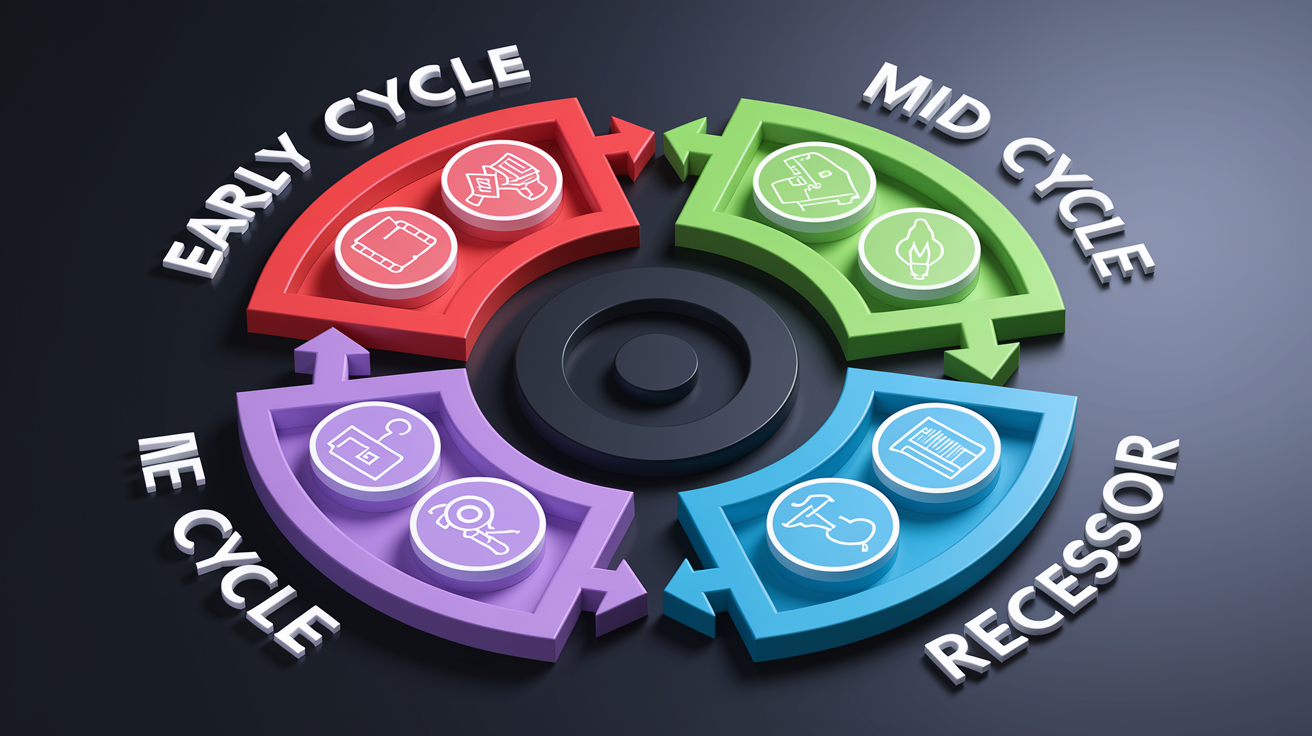
Different economic stages create conditions that favor certain sectors while pressuring others. Understanding this pattern matters if you want rotation to work.
Early Cycle
Early cycle starts when an economy exits recession and enters recovery. Growth accelerates from a low base, credit conditions ease, confidence improves. Tech and consumer discretionary typically lead here. Tech benefits from rising corporate spending on equipment, software, digital infrastructure as businesses invest for growth. Consumer discretionary gains as households resume spending on non-essentials, supported by better employment and rising confidence. Financials often perform well too as loan demand recovers and net interest margins stabilize.
Mid Cycle
Mid cycle means steady, sustained growth, moderate inflation, stable rates. Industrials and materials often outperform. Industrials benefit from expanding capital expenditure, infrastructure projects, global trade activity. Materials gain from rising demand for commodities used in construction and manufacturing as economic activity broadens. Mid cycle is usually the longest phase. Investors often favor a balanced mix of growth and cyclical exposure. Energy can start to strengthen if demand growth accelerates and supply tightens.
Late Cycle
Late cycle brings slowing growth, rising inflation, tightening monetary policy, and valuation pressure on growth stocks. Energy and materials frequently lead as inflation pushes commodity prices higher. Energy benefits from sustained demand paired with constrained supply. Materials gain from industrial activity still running near capacity. Financials may continue performing if rates rise and improve lending margins. But late cycle also introduces caution. Investors start rotating out of economically sensitive sectors and preparing for a potential downturn by moving into more stable, income-generating areas.
Recession
Recession means economic contraction, falling corporate earnings, rising unemployment, flight to safety. Defensive sectors like utilities, healthcare, and consumer staples outperform. Utilities provide steady dividends and stable demand regardless of economic conditions. People need electricity, water, gas. Healthcare benefits from inelastic demand because people need medical care and pharmaceuticals even during downturns. Consumer staples include essentials like food, beverages, household products that maintain sales volume when discretionary spending falls. Investors rotate into these sectors to reduce portfolio volatility and preserve capital while waiting for the next cycle to begin.
Examples of Sector Performance Trends

Historical data shows sectors rotate predictably around macroeconomic turning points. Watching these patterns helps you anticipate leadership shifts. Tech often leads after recessions when business investment resumes and innovation spending accelerates. Energy may lead during inflation spikes or supply disruptions when oil and gas prices rise sharply. Utilities and healthcare often stabilize portfolios during downturns, providing dividend income and defensive traits when cyclical sectors sell off.
| Sector | Typical Outperformance Scenario | Typical Underperformance Scenario |
|---|---|---|
| Technology | Early economic recovery, falling interest rates, rising capital spending | Late cycle with rising rates, inflation concerns, valuation pressure |
| Energy | Rising inflation, supply constraints, mid-to-late cycle demand growth | Recession, demand collapse, oversupply or falling commodity prices |
| Utilities | Recession, flight to safety, falling interest rates, income focus | Early recovery with rising growth expectations and risk appetite |
| Consumer Staples | Economic uncertainty, defensive rotation, late cycle or downturn | Strong growth environment when investors favor cyclical and discretionary exposure |
| Industrials | Mid cycle, infrastructure spending, global trade expansion | Recession, falling capital expenditure, trade disruptions |
Understanding these trends lets you align sector exposure with the broader economic narrative. When GDP growth accelerates and employment rises, cyclical sectors tend to outperform. When growth slows and uncertainty increases, defensive sectors provide stability. Recognizing these patterns doesn’t guarantee perfect timing, but it gives you a framework for making informed allocation decisions and avoiding concentration in sectors likely to lag the next phase.
Benefits and Risks of Sector Rotation

Sector rotation offers both advantages and challenges. You should weigh the trade-offs before adopting the strategy.
Benefits:
Potential for higher returns. By overweighting sectors poised to outperform and underweighting those expected to lag, rotation can boost portfolio returns compared to static allocations.
Dynamic risk management. Rotating out of weakening sectors reduces exposure to downturns in those areas, helping limit drawdowns and preserve capital.
Adaptability to changing conditions. Sector rotation lets portfolios respond to shifts in economic growth, interest rates, inflation, and policy rather than staying locked into a fixed allocation.
Diversification across cycle phases. Thoughtfully applied rotation spreads risk across sectors and economic environments, reducing dependence on any single sector’s performance.
Risks:
Timing is critical and imperfect. Economic turning points are hard to predict. Mistimed rotations can result in buying sectors after they’ve already peaked or selling before recovery begins.
Higher transaction costs. Frequent buying and selling generates trading commissions, bid-ask spreads, and potential tax consequences from realized gains, which can erode returns.
Performance-chasing bias. Investors may rotate into sectors after strong performance has already occurred, increasing the risk of buying near the top and missing the initial move.
Requires active monitoring. Sector rotation isn’t set and forget. It demands ongoing attention to macro data, earnings trends, and market signals, which takes time and discipline.
Comparing Sector Rotation to Buy-and-Hold Investing

Sector rotation and buy-and-hold represent two fundamentally different approaches to portfolio management. Sector rotation is active and tactical. You monitor economic cycles, adjust allocations regularly, and respond to changing market conditions. Buy-and-hold focuses on staying invested long term in a diversified portfolio regardless of short-term market movements. It relies on compounding returns and minimizing trading activity. Sector rotation tries to capture cyclical leadership shifts and boost returns through timely adjustments. Buy-and-hold prioritizes simplicity, lower costs, and long-term wealth accumulation without needing precise timing.
| Strategy | Key Characteristics | Ideal For |
|---|---|---|
| Sector Rotation | Active, tactical, requires monitoring macro signals, frequent rebalancing, higher transaction costs, timing-dependent | Investors with time and expertise to track economic cycles, those seeking tactical outperformance, active managers, shorter time horizons |
| Buy-and-Hold | Passive, long-term focus, minimal trading, lower costs, diversified across sectors, relies on compounding and market growth over time | Long-term investors, those preferring simplicity and lower effort, retirement accounts, investors who want to avoid timing risk |
Final Words
We walked through sector rotation in plain terms: shifting investments across investment sectors to follow the economic cycle, rates, and earnings.
You saw how it plays out in practice, the cycle-based leaders and laggards, historical examples, and the trade-offs versus buy-and-hold — plus the tools and risks to monitor.
If you’re wondering what is sector rotation, it’s a timing-minded portfolio tool. Used with data and discipline, it can help you tilt toward likely winners and stay ready for the next market phase.
FAQ
Q: What is meant by sector rotation?
A: Sector rotation means shifting investments between industry sectors based on the business cycle, interest-rate and inflation expectations, aiming to own sectors likely to outperform next.
Q: What to invest $1000 in right now?
A: To invest $1,000 right now, consider a low-cost diversified ETF (total market or S&P 500), or a mix of ETFs and cash for short-term needs; pick fractional shares if needed, and align with your risk tolerance.
Q: Who owns 93% of the stock market?
A: The claim that 93% of the stock market is owned points to wealthy households and institutions—roughly the top 10% of U.S. households plus large institutional investors hold the vast majority of equity.
Q: Is sector rotation fund good?
A: A sector rotation fund can be good for active investors seeking cyclical outperformance, but it carries timing and fee risks; it’s best if you accept higher turnover and monitor macro signals.