

Think the Fed will be predictable this summer?
The next FOMC meeting is June 16–17, 2026, with the policy decision due June 17 around 2:00 p.m. ET and the Chair’s press conference about 30 minutes later.
This post gives the exact meeting date, the full 2026 Fed schedule, and the specific data likely to tilt the vote.
You’ll get a clear read on what matters, dot plot timing, inflation and payrolls, and what markets are pricing so you can plan trades or portfolio moves with less guesswork.
Key Details About the Upcoming Federal Reserve Meeting

The next FOMC meeting lands on June 16–17, 2026. You’ll get the policy decision on the second day, June 17. Statement drops around 2:00 p.m. ET, then the Chair’s press conference starts roughly half an hour later. (Double check those times on the official Federal Reserve calendar before you lock in any trades.) From where we’re sitting on June 3, 2026, that’s 13 days until the meeting kicks off and 14 days until the announcement.
Every scheduled FOMC meeting runs two full days. Committee members dig into the latest economic data, talk through inflation trends, assess how the labor market’s behaving, and decide whether to move the federal funds rate or leave it alone. Because this one’s in June, it’ll also include the Summary of Economic Projections—the Fed’s quarterly forecast for GDP, unemployment, and inflation. Plus the dot plot, which everyone watches to see where each official thinks rates are headed.
Timing breakdown for June 16–17, 2026:
- Meeting starts: June 16, 2026 (first day of discussions)
- Policy statement: June 17, 2026, approximately 2:00 p.m. ET
- Chair press conference: June 17, 2026, approximately 2:30 p.m. ET
Check the Federal Reserve FOMC Calendar for the current schedule and any last minute changes.
Full-Year Federal Reserve Meeting Schedule and Key Dates

The FOMC meets eight times a year, usually spaced out every six to eight weeks. In 2026, those meetings fall in late January, mid-March, late April, mid-June, late July, mid-September, late October, and early December. Four of them—typically March, June, September, and December—come with economic projections and the dot plot, giving you a window into how officials expect the economy and interest rates to play out.
| Meeting Dates | Notes |
|---|---|
| January 27–28, 2026 | No SEP |
| March 17–18, 2026 | SEP released |
| April 28–29, 2026 | No SEP |
| June 16–17, 2026 | SEP released |
| July 28–29, 2026 | No SEP |
| September 15–16, 2026 | SEP released |
| October 27–28, 2026 | No SEP |
| December 8–9, 2026 | SEP released |
Expected Monetary Policy Moves at the Next Fed Meeting

Market-based pricing, especially fed funds futures, shows investors are split. Some think the committee will cut, others expect a hold, and a few are even pricing in another hike. As of early June, futures contracts show a divided read between staying put at the current 3.50 percent to 3.75 percent range and a modest chance of a 25-basis-point cut. (These probabilities shift every day as new data comes in, so check the CME FedWatch Tool before the meeting for the latest numbers.)
The current federal funds target range sits at 3.50 percent to 3.75 percent. That was set at the April 2026 meeting and left unchanged. The committee didn’t give much guidance about what comes next. Analyst forecasts are all over the place. Some big investment banks expect one or maybe two quarter-point cuts later in 2026 if inflation keeps cooling. Others see a real risk of another hike if price pressures come back, especially after the March CPI spike tied to energy.
The March 2026 SEP projections give you a baseline for what officials thought a few months ago. The median forecast showed real GDP growth of 2.4 percent for 2026, unemployment at 4.4 percent, and both headline and core PCE inflation at 2.7 percent for the year. If data since March has moved away from those projections, the June SEP could shift the dot plot up or down.
Four indicators shaping what the market expects:
- Fed funds futures-implied probabilities. Currently pricing a tight spread between hold and cut.
- Wall Street economist consensus. Ranges from one cut to one hike depending on the firm’s inflation view.
- Inflation path. CPI jumped in March because of gasoline. PCE data will confirm whether core inflation is sticky.
- Labor market signals. Payroll growth, jobless claims, wage data all feed into the Fed’s dual mandate.
Economic Indicators Influencing the Next Federal Reserve Decision
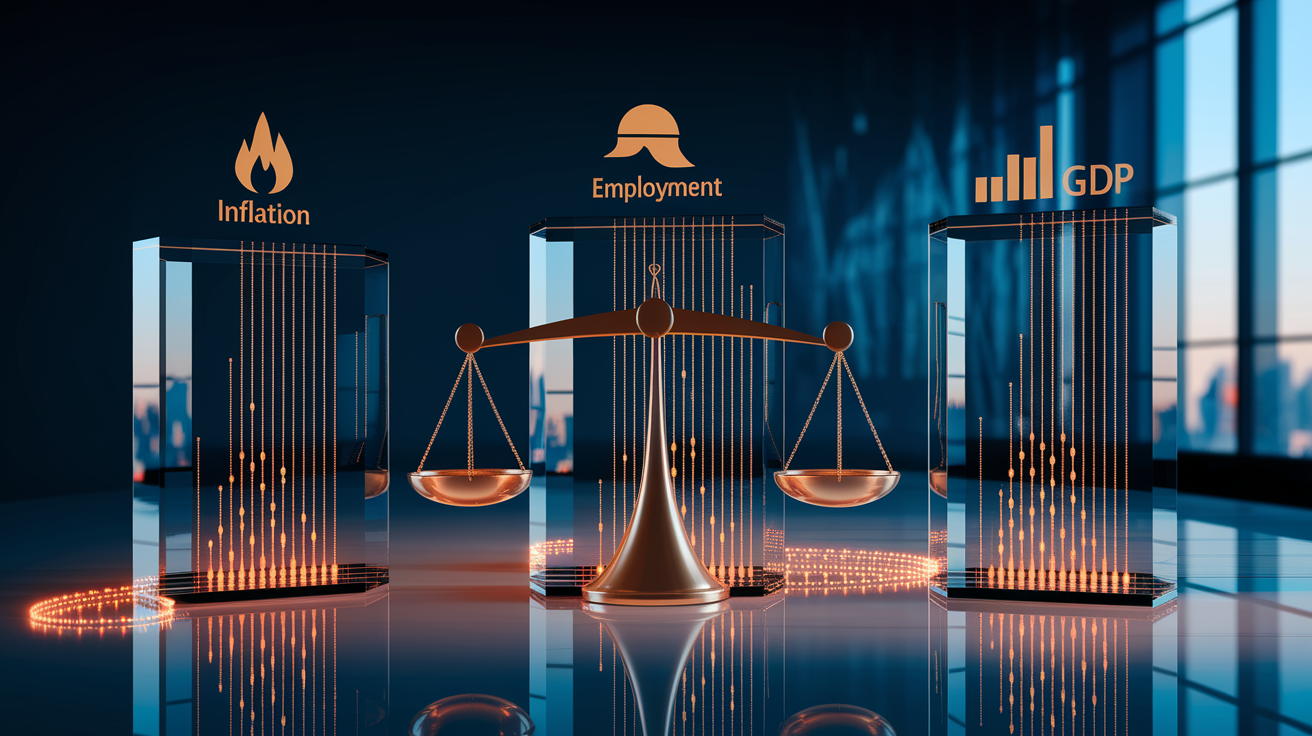
Three categories matter most in the final days before any FOMC decision. Inflation (both headline and core), the labor market (payrolls, unemployment rate, wage growth), and overall economic output (GDP, consumer spending, business investment). Each one feeds into the Fed’s dual mandate of price stability and maximum employment. All three get updated frequently enough to shift the committee’s thinking between meetings.
Inflation Data (CPI & PCE)
Consumer prices jumped in March 2026. CPI rose from 2.4 percent in February to 3.3 percent. About 75 percent of that month-to-month increase came from higher gasoline prices, a reminder that energy can mess with the headline number. The Fed prefers the Personal Consumption Expenditures price index, especially core PCE (which strips out food and energy), because it better reflects actual household spending. March’s SEP projected core PCE at 2.7 percent for 2026, still above the Fed’s 2 percent target. If the April and May PCE readings stay elevated, the case for holding rates or even hiking gets stronger.
Employment Conditions and Labor Dynamics
The March SEP forecast called for an unemployment rate of 4.4 percent by the end of 2026. Recent payroll reports have been mixed. Some months showed solid gains, others slowed. The labor market doesn’t respond to higher rates right away. It can take quarters for tighter credit to translate into softer hiring. Wage growth matters too. If average hourly earnings keep rising above 3 to 4 percent annually, that feeds into services inflation, which tends to be stickier than goods prices. Officials will dig into jobless claims, job openings, and quit rates for signs that the labor market is cooling without tipping into recession.
GDP Growth and Broader Economic Output
Real GDP growth was projected at 2.4 percent for 2026 in the March SEP. First-quarter GDP data, released before the June meeting, will show whether the economy is tracking above or below that pace. Consumer spending, about two-thirds of GDP, is especially important. If households are still spending freely despite higher borrowing costs, the Fed might judge that demand is too strong to bring inflation down quickly. Business investment and inventory changes round out the picture, offering clues about whether companies expect the expansion to continue or are bracing for a slowdown.
Review of the Previous Federal Reserve Meeting
The April 28–29, 2026 FOMC meeting ended with the committee voting to leave the federal funds rate unchanged at 3.50 percent to 3.75 percent. Officials acknowledged that inflation had stayed above target and that the labor market, while showing some signs of cooling, was still relatively tight. The policy statement released after that meeting didn’t signal an imminent move in either direction. Instead, it emphasized that future decisions would depend on incoming data and how the economic outlook evolves.
Because April wasn’t an SEP meeting, there were no updated economic projections or dot plot. The minutes from that session, typically published three weeks later, would have provided more detail on the internal debate. Whether any members argued for a cut, a hike, or keeping options open. Markets reacted quietly to the decision. Treasury yields moved only a few basis points and equity indices closed roughly flat on the day, a sign that the outcome matched what traders expected.
Highlights from the April meeting:
- Federal funds target range: held at 3.50% to 3.75%
- Tone of the statement: cautious, data-dependent, no clear signal of the next move
- Market reaction: minimal volatility. Yields and stocks largely unchanged
Key Topics Likely to Dominate the Next Fed Meeting Discussion

Beyond the headline decision on rates, the committee will debate several ongoing issues that shape the path of monetary policy over the next year. The trajectory of inflation (especially whether the March spike was a one-off or the start of a re-acceleration), the health of the labor market, risks to growth from geopolitical events, and technical questions about the balance sheet and reserve management.
The Fed’s balance-sheet runoff continues in the background. Letting maturing securities roll off without reinvestment. Officials will review whether current reserve levels are appropriate and whether any adjustments to the interest on excess reserves or the overnight reverse repo facility are needed. Geopolitical risks, such as tensions involving Iran or changes in trade policy (tariffs), can affect commodity prices, supply chains, and inflation expectations. And the potential for artificial intelligence to reshape labor productivity and employment is increasingly part of the committee’s long-term discussions, even if it doesn’t drive the immediate rate decision.
Five major agenda items for the June meeting:
- Inflation drivers: energy prices, core services inflation, whether March’s CPI surge was temporary
- Labor market slack: unemployment, wage growth, job openings, participation rates
- GDP growth and recession risk: first-quarter GDP, consumer spending strength, business investment trends
- Balance-sheet policy: pace of runoff, reserve adequacy, IOER and RRP settings
- External shocks: geopolitical developments, tariff impacts, AI-driven labor-market shifts
How Markets Typically React to Federal Reserve Announcements

FOMC decisions move asset prices because they change the cost of borrowing and the return on holding cash. When the Fed raises rates, bond yields climb and existing bond prices fall (because those older bonds now pay below-market coupons). Stocks can sell off, especially rate-sensitive sectors like real estate investment trusts, which rely on cheap financing, and utilities, which carry heavy debt loads. When the Fed cuts rates, the reverse happens. Bond prices rally, yields drop, and equities often rally on the expectation of easier credit and stronger growth.
Currency and commodity markets respond too. A rate hike typically strengthens the U.S. dollar, because higher rates attract foreign capital seeking better returns. A stronger dollar then weighs on commodities priced in dollars. Gold, silver, and crude oil often decline after hawkish Fed moves. A rate cut weakens the dollar and can lift commodity prices. Volatility spikes in the minutes immediately after the 2:00 p.m. statement release and again during the Chair’s press conference, as traders parse the language for clues about future moves.
| Asset Class | Typical Reaction | Why It Happens |
|---|---|---|
| U.S. Treasury bonds | Prices fall (yields rise) on hikes; prices rise (yields fall) on cuts | New bonds offer higher yields, making existing bonds less attractive, or vice versa |
| Equities (stocks) | Often decline on hikes; can rally on cuts or dovish hold | Higher rates raise discount rates on future earnings and increase borrowing costs; lower rates do the opposite |
| U.S. Dollar (DXY) | Strengthens on hikes; weakens on cuts | Higher rates attract foreign capital; lower rates reduce dollar demand |
| Commodities (gold, oil) | Pressure on hikes; support on cuts | Stronger dollar makes dollar-priced commodities more expensive for foreign buyers; weaker dollar makes them cheaper |
Historical Context and Major Past Fed Decisions
The Federal Open Market Committee was established in 1933, during the depths of the Great Depression, to centralize control of open-market operations and give the central bank a formal way to set monetary policy. Over the decades, the committee has navigated crises, inflation surges, and economic booms, adjusting rates to keep the economy on an even keel. Emergency rate cuts to near zero happened during the 2008 financial crisis and again in March 2020 at the onset of the pandemic. In both cases, the Fed eventually pivoted to a long hiking cycle once the economy recovered and inflation pressures built.
The most recent tightening cycle began in early 2022, when inflation surged to multi-decade highs. The committee raised rates aggressively. Sometimes by 50 or even 75 basis points at a single meeting. Taking the federal funds rate from near zero to a peak above 5 percent. By late 2023 and into 2024, the pace of hikes slowed and eventually stopped, leaving the target range at elevated levels as the Fed assessed whether inflation was truly coming down. The current 3.50 percent to 3.75 percent range reflects a modest easing from that peak, signaling the committee’s willingness to adjust policy as conditions change. Minutes from past meetings are released three weeks after each decision, providing a detailed record of the debate and the factors officials weighed.
Verification Tools and Where to Check Updates for the Next Fed Meeting

The most authoritative source for FOMC meeting dates, statement release times, and press-conference schedules is the official Federal Reserve FOMC Calendar. That page gets updated whenever the committee announces schedule changes or adds unscheduled emergency meetings. It also confirms which meetings include a press conference and which produce an SEP.
For real-time market expectations, the CME Group’s FedWatch Tool tracks fed funds futures contracts and translates them into probabilities for each possible rate outcome at upcoming meetings. Those probabilities shift throughout the day as traders react to economic data, Fed speeches, and geopolitical news. Major investment banks and research firms also publish pre-meeting outlooks, summarizing their own forecasts and the range of views across Wall Street economists.
Three resources for tracking the next Fed meeting:
- Official Federal Reserve FOMC calendar. Definitive source for dates, times, and format (press conference or not).
- CME FedWatch Tool. Live, market-based probabilities for rate moves, updated continuously.
- Economist consensus reports. Compiled by Bloomberg, Reuters, and major banks. Shows the distribution of forecasts across dozens of analysts.
Investor Positioning and Practical Strategies Ahead of the Next Fed Meeting

Investors adjust portfolios in the days before an FOMC decision based on their expectations for rates, inflation, and the Fed’s forward guidance. If the consensus expects a hold, but there’s a meaningful tail risk of a cut or hike, options traders will bid up volatility premiums on equity indices, Treasuries, and currency pairs. Bond investors might shorten or extend duration depending on whether they think yields are heading higher or lower. Equity investors often rotate between defensive sectors (consumer staples, utilities) and cyclical sectors (industrials, consumer discretionary) based on the likely policy path.
Hedging gets more active in the week before the announcement. Some traders use Treasury futures or interest-rate swaps to lock in borrowing costs or protect against yield moves. Others buy put options on rate-sensitive stocks or REITs to guard against a hawkish surprise. Cash levels often rise slightly as portfolio managers wait for clarity, then redeploy once the decision and press conference provide a clearer signal about the next few months.
Common investor strategies ahead of the meeting:
- Adjust bond duration. Shorten if expecting hikes, extend if expecting cuts
- Rotate sector exposure. Move into defensives if worried about tighter policy, into cyclicals if expecting easing
- Hedge rate-sensitive positions. Use options or futures to protect REITs, utilities, or long-duration bonds
- Monitor inflation-sensitive assets. Commodities, TIPS (Treasury Inflation-Protected Securities), and inflation breakevens react to Fed signals
Frequently Asked Questions About the Next Federal Reserve Meeting
When is the next FOMC meeting?
June 16–17, 2026, with the policy decision announced on June 17.
What time is the announcement?
The statement typically drops at 2:00 p.m. ET, followed by the Chair’s press conference around 2:30 p.m. ET.
What’s the current federal funds rate?
The target range is 3.50 percent to 3.75 percent, set at the April 2026 meeting.
Will there be economic projections at this meeting?
Yes. June is a scheduled SEP meeting, so the committee will release updated GDP, unemployment, and inflation forecasts along with the dot plot.
When are the minutes released?
Roughly three weeks after the meeting ends, usually on a Wednesday afternoon.
How does the Fed’s decision affect my savings and loans?
If the Fed raises rates, savings-account yields and CD rates tend to rise, which helps savers. Borrowers face higher interest on new mortgages, car loans, and credit cards. If the Fed cuts rates, the reverse happens. Lower yields for savers, cheaper borrowing costs for loans.
Final Words
We covered the hard facts: dates (June 16–17), decision time (~2:00 p.m. ET), and the press conference window. You got the schedule, the data that matters (CPI, jobs, GDP), and how markets typically move on policy calls.
Use the checklists: where to verify, probable market reactions, and practical hedges ahead of the vote.
Keep an eye on the key data points and official Fed timing. That focus will help you trade or position calmly into the next fed meeting.
FAQ
Q: Is there another Fed cut coming? Will the Fed lower rates in July? Will the Fed cut rates in March?
A: Another Fed cut is possible but not certain; decisions hinge on incoming inflation and jobs data. No firm March or July cut is scheduled—markets will update probabilities after key economic releases and Fed signals.
Q: What is the Fed rate prediction?
A: The Fed rate prediction is that the federal funds target currently sits at 3.50%–3.75%; economists are split, with some expecting one or two cuts in 2026 if inflation eases and labor slack appears.