


Is today’s rally real, or just a short-lived sigh of relief?
Markets lifted after a ceasefire extension eased headline risk, a Fed governor’s “policy is data dependent” line nudged yields down, and early earnings mostly beat estimates.
Put simply: geopolitics, Fed signals (rates), and earnings are driving the tape today, with crude near $90 and stronger-than-expected jobless claims adding a data twist.
That mix explains the bounce and the capped upside. Watch Tesla and ServiceNow after the close, plus consumer confidence and next week’s FOMC for the next move.
Today’s Market Drivers and Index Performance Overview

Markets opened higher this morning as investors grabbed onto a temporary geopolitical reprieve and chewed through a wave of early corporate results. As of 10:30 ET, the S&P 500 sat at roughly 4,120.50, up 22.30 points or +0.55%. The Dow Jones Industrial Average tacked on 210.10 points (+0.62%) to hit 33,950.40, while the Nasdaq Composite climbed 75.60 points (+0.59%) to 12,850.20. Market breadth leaned positive, with about 2,100 advancers against 1,250 decliners. The session logged 45 new highs and just 12 new lows.
The main thing lifting risk appetite today is a ceasefire extension in the Middle East, which has dialed down headline risk after two straight days of selling pressure. That said, crude oil prices edged higher and they’re still sitting near $90 per barrel. Talks between the United States and Iran appear stalled, which keeps energy normalization off the table for months or possibly years. Meanwhile, a Federal Reserve governor’s comment this morning that “policy is data dependent” got read as modestly dovish, helping Treasury yields drop roughly 6 basis points to 3.85%. Early corporate earnings reports have mostly beaten profit and revenue expectations, giving the indices some extra support. Two big results are due after the closing bell: Tesla and ServiceNow. Investors are positioning cautiously ahead of those releases.
Fast movers today:
- Economic data — Initial jobless claims reported at 08:30 ET came in at 210,000 versus a consensus estimate of 220,000 and prior reading of 225,000, signaling the labor market’s still holding up.
- Fed commentary — At 09:15 ET, a Fed governor stated “policy is data dependent,” which markets read as dovish. Treasury yields dropped 6 bps as a result.
- Sector leadership — Energy shares gained +1.8% (XLE +2.0%) on rising crude, while financials added +1.5% (XLF +1.7%).
- Risk sentiment — The VIX fell 6.0% to 15.8, though volatility’s still elevated and technical indicators suggest the market’s overbought near term.
- Earnings tone — Most results released before the open beat estimates, bolstering sentiment into the session.
- Crude dynamics — Oil climbed despite the ceasefire extension, driven by constrained European supplies and continued closure of the Strait of Hormuz for Iranian shipping.
These drivers matter for intraday direction because they’re creating a tug of war. Geopolitical relief and strong earnings support upside, while rising energy costs, overbought technicals, and lingering Fed confirmation uncertainty limit how far the tape can run without fresh catalysts.
Economic Data Influencing the Stock Market Today

This morning’s jobless claims print came in better than expected, reinforcing the narrative that the labor market’s still tight even as the Fed watches for signs of cooling. Initial claims hit 210,000 at the 08:30 ET release, below the 220,000 consensus and down from the prior week’s 225,000. Lower claims generally support stocks because they suggest consumers still have income and spending power, which props up corporate revenue expectations. But persistently strong employment also keeps the pressure on the Fed to maintain restrictive policy longer, which can cap equity multiples.
Later this afternoon, consumer confidence data’s scheduled for release at 14:00 ET, and that number will carry weight. If confidence ticks higher, it reinforces the soft landing scenario. If it slips, it may signal that rising energy prices and geopolitical headlines are starting to weigh on household sentiment. Looking ahead, investors are also keeping an eye on upcoming CPI and PPI releases, which will shape rate hike expectations heading into the April 29 FOMC decision.
| Indicator | Release Time (ET) | Actual | Consensus | Market Impact |
|---|---|---|---|---|
| Initial Jobless Claims | 08:30 | 210,000 | 220,000 | Positive—yields dipped, equities supported |
| Consumer Confidence | 14:00 | TBA | TBA | TBA—watching for energy price drag |
| CPI (upcoming) | TBA | TBA | TBA | Key Fed input for April 29 decision |
| PPI (upcoming) | TBA | TBA | TBA | Potential inflation pressure signal |
| Durable Goods Orders | April 29 | TBA | TBA | Capex and manufacturing health gauge |
Right now, the market’s watching jobless claims for labor trends and this afternoon’s consumer confidence print for any sign that geopolitical and energy price pressures are filtering into household sentiment. Both readings will inform positioning ahead of the FOMC meeting next week.
Federal Reserve Policy Influence on Today’s Market Movement

Treasury yields moved lower this morning after a Federal Reserve governor remarked at 09:15 ET that “policy is data dependent.” Markets interpreted the comment as slightly dovish, a signal that the Fed isn’t locked into further tightening if the data cooperate. The benchmark 10 year yield dipped roughly 6 basis points to 3.85%, down from levels above 4.05% earlier in the month when Middle East tensions first escalated. Lower yields tend to support equity valuations, particularly in growth and technology sectors, because they reduce the discount rate applied to future earnings.
Rate expectations remain fluid heading into the April 29 FOMC decision. Consensus still leans toward a hold, but investors are parsing every Fed speaker appearance for clues about the path beyond May. The Fed’s stance on quantitative tightening also matters. Any hint of slowing the balance sheet runoff could be read as an easing of financial conditions, which would likely lift stocks. On the other hand, persistently strong employment and rising energy costs give the Fed reasons to stay cautious, keeping the door open for additional hikes if inflation reaccelerates.
Political developments are adding a layer of uncertainty to Fed policy. Jerome Powell’s term as chair ends May 15, and his potential successor, Kevin Warsh, testified before the Senate on April 21. A Department of Justice criminal investigation into Powell has complicated confirmation timing. Senator Thom Tillis has publicly stated he won’t vote for Warsh until the DOJ probe concludes. Additionally, a pending Supreme Court ruling on a related case involving the removal of a Fed governor could drop any day, which would further muddy perceptions of central bank independence and policy continuity. For now, markets are treating these as background risks, but any headline that threatens a smooth transition could spike volatility.
Today’s Fed sensitive catalysts:
- 09:15 ET Fed governor comment interpreted as dovish. 10 year yield fell 6 bps to 3.85%.
- Upcoming FOMC decision scheduled for April 29. Markets pricing in a hold with close attention to the statement language.
- Powell’s term expires May 15. DOJ investigation delaying Warsh confirmation vote.
- Supreme Court ruling on Fed governor removal case could arrive this week, adding policy uncertainty.
Corporate Earnings and Guidance Moving Stocks Today

Earnings season’s in full swing, and the early day results have largely exceeded expectations, helping to offset some of the geopolitical and energy price headwinds. Companies that reported before the bell delivered a mix of profit beats and forward guidance updates, creating distinct winners and losers across sectors. The market’s now waiting for two major reports due after the close: Tesla and ServiceNow. Tesla’s expected to post roughly a 30% year over year increase in Q1 adjusted profits and approximately 15% revenue growth, though the company’s recent delivery miss has kept expectations tempered. ServiceNow shares rose about 1.5% ahead of its release, reflecting optimism around enterprise software demand.
Boeing shares climbed 3% after the company disclosed a record order backlog of $695 billion and reported that commercial airlines revenue jumped 13% year over year in Q1, while defense, space, and security revenue surged 21%. GE Vernova, the power and energy technology spinoff, rallied 8% after beating estimates and raising its fiscal 2026 guidance, citing strong data center demand for electrical infrastructure. United Airlines gained roughly 1.5% despite issuing Q2 EPS guidance below the FactSet consensus. The airline also trimmed its Q3–Q4 capacity target to flat to down 2%, a reduction from the 3.4% growth rate posted in Q1. Meanwhile, Best Buy fell 4.6% following the announcement of a CEO succession, with shares now down approximately 36% from their late August peak.
The broader takeaway from today’s earnings flow is that companies with exposure to data center buildouts, defense spending, and commercial aerospace are showing strong momentum, while consumer discretionary names and those facing capacity constraints are struggling to maintain investor confidence. As more results roll in this week and next, the market will be watching for any signs that elevated energy costs or geopolitical risks are starting to weigh on forward guidance.
High impact earnings today
- Tesla (TSLA) — Reporting after the close. Analysts expect +30% YoY Q1 adjusted profit and +15% revenue growth. Last quarter’s delivery numbers missed expectations, so guidance will be closely watched.
- ServiceNow (NOW) — Reporting after the close. Shares up ~1.5% in early trading as investors anticipate strong enterprise software demand.
- Boeing (BA) — Beat expectations. Commercial revenue +13% YoY, defense +21% YoY, and order backlog at a record $695 billion. Stock +3%.
- GE Vernova (GEV) — Beat estimates and raised full year 2026 guidance. Data center electrical demand cited as a key driver. Shares +8%.
| Company | Catalyst | Price Move | Timestamp (ET) |
|---|---|---|---|
| Boeing (BA) | Record backlog, +13% commercial revenue YoY | +3% | 10:30 |
| GE Vernova (GEV) | Beat estimates, raised guidance on data center demand | +8% | 10:30 |
| United Airlines (UAL) | Beat EPS/revenue; trimmed capacity outlook | +1.5% | 10:30 |
| Best Buy (BBY) | CEO succession announced; shares down 36% since Aug peak | -4.6% | 10:30 |
Sector Rotation Trends Driving Today’s Market Moves

Energy led sector performance this morning, gaining 1.8% with the Energy Select Sector SPDR Fund (XLE) up 2.0%. The move’s tied directly to rising crude prices and ongoing supply constraints in Europe, as the Strait of Hormuz remains effectively closed to Iranian shipping and U.S. Iran talks have stalled. Even with a temporary ceasefire extension in Lebanon, normalization of energy supplies could take months or years for some liquefied natural gas infrastructure, keeping upward pressure on oil and gas prices.
Technology and semiconductors also posted solid gains, reflecting continued investor appetite for AI and data center themes. The PHLX Semiconductor Index (SOX) climbed roughly 1% in the session and it’s now up 35% from its March 30 closing low for the year. Memory equipment and storage names showed particular strength: Seagate (STX) rose 3%, Western Digital (WDC) added 3%, and SanDisk (SNDK) climbed 2%. Meanwhile, the laggards were concentrated in defensive sectors. Utilities fell 0.9% (XLU down 1.1%) and Real Estate dropped 0.7% (XLRE down 0.8%) as investors rotated out of bond proxies in response to lower Treasury yields and a risk on tone.
Sector specific movers and explanations:
- Energy (+1.8%) — Rising crude near $90, supply constraints in Europe, and Strait of Hormuz closure driving upside.
- Financials (+1.5%) — Lower yields helping bank net interest margin concerns ease. XLF +1.7%.
- Semiconductors (SOX +1%) — Memory and storage names leading on data center demand. STX +3%, WDC +3%, SNDK +2%.
- Tech overall — AI and cloud infrastructure themes supporting sentiment. Alphabet +1.5% on cloud partnership news.
- Utilities (down 0.9%) — Defensive rotation. Lower yields reducing bond proxy appeal. XLU down 1.1%.
- Real Estate (down 0.7%) — Similar dynamic to utilities. XLRE down 0.8% as growth sectors attract flows.
Individual Stock Movers Shaping Today’s Trading Direction

Several individual names are driving significant volume and shaping the broader market narrative this morning. Boeing (BA) climbed 3% after posting a record order backlog of $695 billion and reporting year over year revenue growth of 13% in commercial airlines and 21% in defense, space, and security. GE Vernova (GEV) surged 8% following a better than expected earnings report and raised fiscal 2026 guidance, with management highlighting heavy data center demand for electrical equipment as a key growth driver.
United Airlines (UAL) gained about 1.5% despite issuing second quarter EPS guidance below the FactSet consensus and trimming its third and fourth quarter capacity target to flat to down 2%, down from the 3.4% growth rate achieved in Q1. Alphabet (GOOGL) rose 1.5% on the back of cloud partnership updates, while T Mobile US (TMUS) slipped 1.5% on reports that Deutsche Telekom is considering a merger with T Mobile. Crypto related stocks saw a sharp rally as bitcoin futures climbed roughly 5% to match post Iran highs above $78,000. MicroStrategy (MSTR), Circle (CRCL), and Coinbase (COIN) all rose between 4% and 6%.
Top Gainers and Decliners
| Ticker | Catalyst | Price Change (%) | Volume vs Avg |
|---|---|---|---|
| GEV | Beat estimates, raised guidance on data center demand | +8% | Above average |
| BA | Record backlog, strong commercial and defense revenue | +3% | Above average |
| STX | Semiconductor/storage demand; SOX +1% | +3% | Above average |
| MSTR | Bitcoin futures +5% to ~$78,000 | +4–6% | Elevated |
| BBY | CEO succession; shares down 36% from Aug peak | -4.6% | Above average |
| TMUS | Deutsche Telekom merger speculation | -1.5% | Normal |
These stock specific moves are reinforcing the broader market themes: strong performance in companies exposed to infrastructure buildouts (power, defense, aerospace, semiconductors), weakness in consumer discretionary names facing leadership transitions, and speculative upside in crypto linked equities as bitcoin rallies. The divergence between gainers and losers is wide today, which suggests stock selection and sector positioning matter more than broad index exposure in the current environment.
Geopolitical Events and Global Factors Steering Markets Today

The primary geopolitical driver lifting markets this morning is the announcement of a ceasefire extension in Lebanon, which has temporarily reduced headline risk after two days of selling pressure. But the relief is fragile. Crude oil supplies in Europe continue to dwindle, and the Strait of Hormuz remains closed to Iranian shipping as the United States actively blocks Iranian vessels. Energy analysts estimate that normalization of supply chains, particularly for liquefied natural gas infrastructure damaged during the conflict, could take months or even years, keeping upward pressure on energy prices and limiting the economic benefit of any diplomatic progress.
The conflict’s impact is asymmetric across regions. Natural gas prices in Europe and larger Asian economies have spiked sharply, while the United States, as a net energy exporter, faces lower domestic prices and benefits from increased export demand. This dynamic is giving U.S. equities a relative edge, as American companies are less exposed to the energy cost shock hitting their European and Asian peers. That said, rising crude near $90 per barrel is still a headwind for U.S. consumers and could weigh on discretionary spending and profit margins in energy intensive industries.
Broader supply chain disruptions are also starting to show up in corporate commentary. Companies with European exposure or those reliant on Middle Eastern shipping routes are flagging potential cost increases and delivery delays, which could pressure margins in the coming quarters. Investors are watching for any escalation in U.S. Iran tensions, as a breakdown in the current fragile ceasefire would likely trigger a sharp risk off move across equities, credit, and commodities.
Intraday geopolitical catalysts:
- Ceasefire extension in Lebanon announced. Markets rallied on reduced headline risk.
- Crude oil rose to ~$90 despite the ceasefire, driven by European supply constraints and Strait of Hormuz closure.
- U.S. Iran negotiations remain stalled. Any breakdown could trigger renewed volatility.
- Natural gas prices spiking in Europe and Asia, while the U.S. benefits from net exporter status and lower domestic costs.
Market Internals, Technical Levels, and Volatility Signals Today
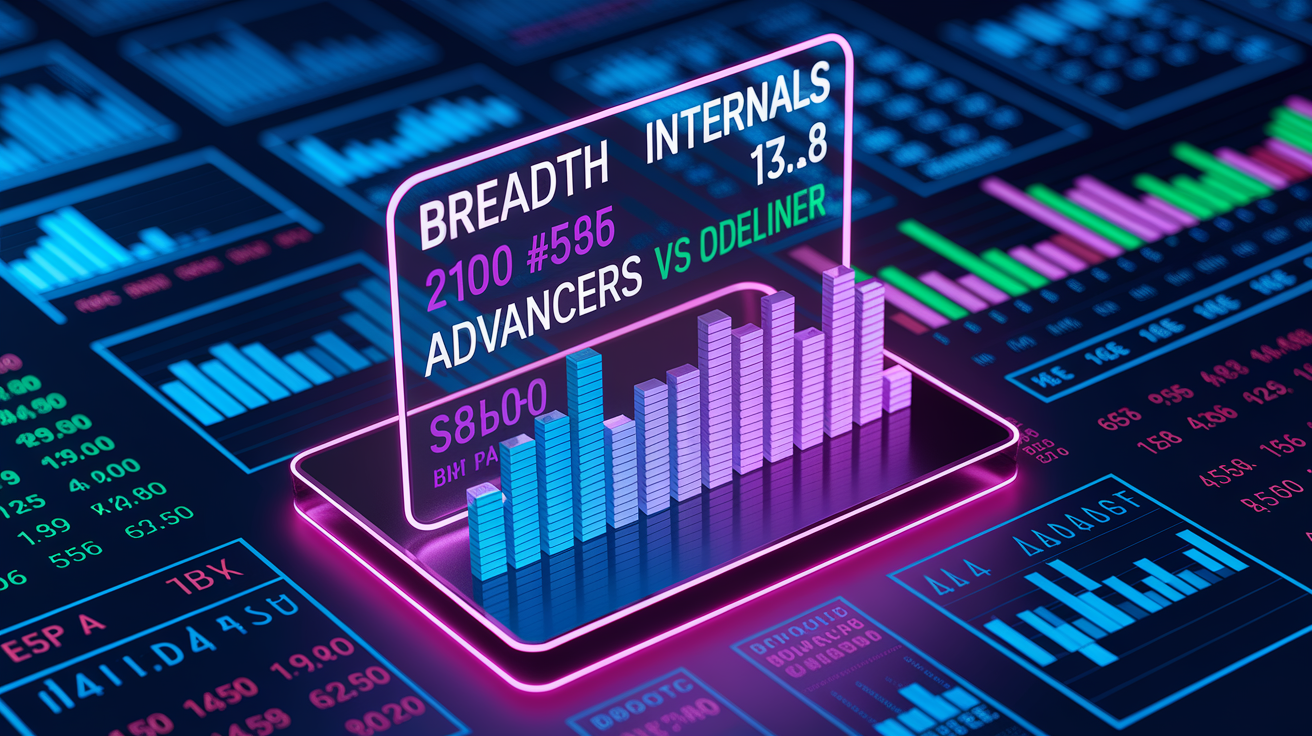
Market internals this morning are supportive, with breadth tilting positive at roughly 2,100 advancers versus 1,250 decliners. The session has recorded 45 new highs against just 12 new lows, signaling broad participation in the rally. However, the S&P 500 closed well off its highs yesterday, and the small cap Russell 2000 fell 1% on Tuesday, suggesting that the risk on tone isn’t uniform across all segments of the market.
The VIX fell 6% to 15.8 this morning, reflecting reduced fear and a more constructive sentiment backdrop. That said, volatility remains elevated on an absolute basis, and technical analysts are flagging that the market’s overbought in the near term, which typically limits the upside potential unless new catalysts emerge. The S&P 500 is holding above its 50 day moving average near 4,100, a key support level. The next resistance sits around 4,180. A sustained move above that level would likely require either strong earnings beats from Tesla and ServiceNow tonight or a meaningful de escalation in the Middle East conflict.
Technical inflection points and breadth details:
- Breadth: 2,100 advancers / 1,250 decliners. 45 new highs / 12 new lows as of mid morning.
- VIX: 15.8, down 6% from prior close. Still elevated relative to recent historical norms.
- S&P 500 support: Holding 50 day moving average at approximately 4,100.
- S&P 500 resistance: Next meaningful level around 4,180. A break higher would signal continuation.
- Overbought signals: Technical indicators suggest limited near term upside unless fresh catalysts materialize.
Upcoming Market Catalysts That Could Drive Stocks Later Today

The remainder of the trading day holds several catalysts that could shift intraday momentum. At 14:00 ET, consumer confidence data will be released, and any meaningful surprise, either stronger or weaker than consensus, could move rate expectations and sentiment. If confidence ticks higher, it would reinforce the soft landing narrative and support cyclical stocks. A downside miss could signal that rising energy prices and geopolitical headlines are starting to weigh on household sentiment.
After the closing bell, Tesla and ServiceNow will report earnings. Tesla’s expected to show roughly a 30% year over year rise in Q1 adjusted profits and about 15% revenue growth, but the company’s recent delivery miss has investors focused on guidance and commentary around demand trends. ServiceNow shares are already up 1.5% in anticipation of strong enterprise software results. A beat and raise would likely lift the broader software sector, while a miss could trigger profit taking in high multiple tech names.
- 14:00 ET, Consumer Confidence release: Watching for any sign that energy costs or geopolitical risks are denting household sentiment. A stronger than expected print would support cyclical stocks.
- After close, Tesla (TSLA) earnings: Expected +30% YoY Q1 adjusted profit and +15% revenue. Guidance on deliveries and pricing power will be critical.
- After close, ServiceNow (NOW) earnings: Enterprise software demand in focus. Shares up 1.5% ahead of results.
- 12:00 ET update noted strength concentrated in 7 Dow stocks: Watching for breadth to improve or narrow further into the close.
- Week ahead, April 23 earnings: American Express (AXP), Intel (INTC), Thermo Fisher (TMO), Honeywell (HON), Union Pacific (UNP), Lockheed Martin (LMT), and several others due.
- April 29 FOMC decision: Rate expectations are stable for now, but any hawkish or dovish surprises in the statement or press conference could drive a sharp repricing of equities and bonds.
Final Words
In the action: markets moved on a mix of Fed comments, rising energy prices, a ceasefire extension, and heavy earnings — pushing intraday gains and rotation into energy and semiconductors.
The post broke down index moves, economic releases, Fed tone, corporate reports, sector leadership, geopolitics, and technical signals — all drivers investors should track.
Short answer on what is driving the stock market today: policy signals, oil, and earnings — a clear set of catalysts that still creates trading opportunities.
FAQ
Q: Should a 70 year old get out of the stock market?
A: A 70-year-old should not automatically get out of the stock market. Decision depends on income needs, time horizon, and risk tolerance; consider a conservative mix (bonds, dividend growers) while keeping some equity for inflation protection.
Q: What causes stocks to go up today? / Why did the stock market fall suddenly today?
A: Stock moves today happen when news changes expectations. Better-than-expected earnings, weaker inflation, easing geopolitics, or dovish Fed comments lift prices; weak data, hawkish Fed remarks, or surprise shocks trigger sudden drops through rapid selling and risk-off flows.
Q: What is Warren Buffett saying about the stock market?
A: Warren Buffett is saying investors should focus on long-term value and avoid short-term market timing. He prefers buying quality businesses at fair prices and holding them for years.