


Think futures are just gambling on prices?
Not quite. Futures are standardized contracts to buy or sell an asset at a set price on a future date, and they help traders, farmers, and big funds manage risk and set prices now for tomorrow.
In plain terms, futures are tools for hedging, speculating, and price discovery—not shares of a company.
This post gives a simple definition, shows how futures differ from stocks, and explains why they matter for markets and your portfolio.
Core Explanation of Futures in the Stock Market

A futures contract is a standardized agreement to buy or sell a specific quantity of an underlying asset at a predetermined price on a specified future date. Both sides are obligated to complete the transaction unless they close the position before expiration. These contracts trade on regulated exchanges and cover stock indexes, commodities, currencies, and interest rate products. Unlike stocks, futures don’t represent ownership. They’re derivative contracts tied to the value of an underlying asset.
Futures exist for two main reasons: risk management and transparent pricing. Producers, consumers, and investors use them to lock in prices and hedge against adverse moves. A farmer expecting to harvest 10,000 bushels of corn in six months can sell corn futures today to lock in a guaranteed price, protecting against a potential drop. At the same time, a cereal manufacturer can buy those same futures to secure supply at a known cost. This two-sided market creates stability for participants who need to manage price volatility.
Futures work through standardized contracts that specify exact terms: contract size, tick value, expiration date, and settlement type. All futures trade on exchanges like the CME, NYMEX, or ICE, and a clearinghouse guarantees performance on both sides, eliminating counterparty risk. Each contract is marked to market daily, meaning gains and losses get calculated and settled in your margin account every trading day. This daily settlement ensures transparency and reduces default risk.
How Futures Differ From Stocks
Stocks represent ownership in a company. When you buy shares, you own a piece of that business and may receive dividends and voting rights. Futures are derivative contracts with no ownership component. A futures contract is just an agreement about a future transaction. You don’t own the underlying asset until settlement occurs, and in many cases (like index futures), settlement is entirely cash-based with no physical delivery.
Futures use leverage through a margin system. Instead of paying the full contract value upfront, traders post initial margin, typically 3 percent to 12 percent of the notional value, as a performance bond. This leverage amplifies both gains and losses. A stock purchase doesn’t require margin unless you borrow to buy more shares, and even then the mechanics are different. Futures positions also get marked to market daily, meaning your account is credited or debited each day based on price movement. If your balance falls below the maintenance level, you’ll get a margin call.
Key differences between futures and stocks:
Leverage: Futures require only a small margin deposit to control a large notional position. Stocks require full payment unless using a margin loan.
Expiration: Futures contracts have fixed expiration dates and must be closed, rolled, or settled. Stocks have no expiration.
Shorting mechanics: Going short in futures is as simple as selling a contract. Shorting stocks requires borrowing shares and involves different risks and costs.
Underlying asset types: Futures can be based on indexes, commodities, currencies, or interest rates. Stocks represent equity in a single company.
Trading hours: Many futures markets trade nearly 24 hours on electronic platforms. Stock exchanges have fixed trading hours with after-hours sessions that are less liquid.
Key Functions of Futures: Hedging, Speculation, and Price Discovery

Hedging is the primary function futures were designed to serve. Commercial participants use futures to lock in prices and protect against adverse moves. A cotton manufacturer worried about rising fabric costs can buy cotton futures at 75 cents per pound for delivery next year. If a fire destroys 15 percent of the crop and spot prices surge to 90 cents, the manufacturer still pays the locked-in price of 75 cents. The hedge protects the business from unpredictable cost increases, even if it means missing out on cheaper prices if supply floods the market.
Speculation involves taking directional positions to profit from price movements without any intention of taking delivery. A trader who expects the S&P 500 to rise might buy E-mini S&P futures contracts. If the index climbs, the trader sells the contract at a higher price and captures the difference. Speculators provide liquidity to hedgers and help ensure someone’s available on the other side of a hedge. But this activity involves significant risk because leverage magnifies losses as much as it magnifies gains.
Futures also contribute to price discovery, the process by which transparent, real-time market activity helps set fair prices for underlying assets. Because futures markets are centralized, standardized, and heavily traded, the prices that emerge reflect the collective expectations of thousands of participants. Crude oil futures prices influence the cost of gasoline at the pump. Treasury futures signal where bond yields are likely headed. This price transparency benefits the entire economy by making it easier to plan, invest, and allocate resources efficiently.
Common Types of Futures Contracts
Commodity futures cover physical goods like crude oil, natural gas, gold, silver, corn, wheat, soybeans, livestock, and cotton. These contracts allow producers and consumers to hedge supply and price risk. WTI crude oil futures on NYMEX represent 1,000 barrels per contract, and a minimum price move (tick) of one cent equals ten dollars. Commodity futures often involve physical delivery, though most speculative traders close their positions before expiration to avoid taking possession of barrels of oil or bushels of grain.
Index futures are based on stock market benchmarks like the S&P 500, Nasdaq 100, or Dow Jones Industrial Average. The E-mini S&P 500 contract (ticker ES) has a multiplier of 50, meaning each one-point move in the index equals 50 dollars per contract. Index futures are cash-settled, so no shares change hands at expiration. These contracts are popular with institutional traders, hedge funds, and retail speculators because they offer leveraged exposure to broad market moves and trade nearly around the clock on electronic platforms.
Currency futures allow traders to take positions on exchange rates between major currencies like the euro, British pound, Japanese yen, and U.S. dollar. The Euro FX futures contract on CME represents 125,000 euros, and the minimum tick is 0.00005, which equals $6.25 per contract. Currency futures are used by multinational corporations to hedge foreign exchange risk and by speculators betting on central bank policy, interest rate differentials, or geopolitical events that drive currency values.
Interest rate and treasury futures are tied to U.S. government debt instruments like 10-year Treasury notes, 30-year bonds, and short-term rates. These contracts allow investors to hedge interest rate risk or speculate on changes in borrowing costs and monetary policy. When the Federal Reserve signals rate hikes, treasury futures prices typically fall because bond yields move inversely to prices. Financial institutions, pension funds, and macro traders use these contracts to manage duration risk and position for shifts in the yield curve.
How Futures Trading Works
Futures trading operates on a margin system, which means you don’t pay the full notional value of the contract upfront. Instead, you post initial margin, a performance bond that typically ranges from 3 percent to 12 percent of the contract value depending on volatility and asset class. If an E-mini S&P 500 contract has a notional value of $210,000 (index at 4,200 times the 50 multiplier), initial margin might be around $10,000. This creates leverage of roughly 21 to 1, meaning a small price move can generate large percentage gains or losses relative to the margin posted.
Every futures position is marked to market daily. Gains and losses are calculated and settled in your account at the end of each trading session. If the market moves against you and your account balance falls below the maintenance margin level, you’ll receive a margin call requiring you to deposit additional funds immediately. Failure to meet a margin call can result in forced liquidation of your position. Settlement depends on the contract type: index futures and some financial contracts are cash-settled, while many commodity contracts allow for physical delivery if the position is held through expiration.
Futures contracts have fixed expiration dates, usually following a quarterly cycle like March, June, September, and December for major contracts. Traders who want to maintain exposure beyond expiration must roll their position by closing the expiring contract and opening a new one in a later month. Contract specifications (the size, tick value, trading hours, and delivery terms) are standardized by the exchange and published openly so all participants trade on the same terms.
| Contract Feature | Description | Typical Values |
|---|---|---|
| Initial Margin | Collateral required to open a position | 3%–12% of notional value |
| Tick Size | Minimum price movement | 0.25 points (ES), $0.01 per barrel (crude oil) |
| Contract Size | Standardized quantity of underlying asset | 50 × index (ES), 1,000 barrels (crude), 100 oz (gold) |
| Expiration Cycle | Scheduled contract expiration months | Quarterly (Mar, Jun, Sep, Dec) for most major contracts |
Essential Futures Terminology for Beginners
Long: Buying a futures contract, agreeing to receive the underlying asset or cash equivalent at expiration. Profits if price rises.
Short: Selling a futures contract, agreeing to deliver the underlying asset or pay cash equivalent. Profits if price falls.
Notional value: The total dollar value controlled by the contract, calculated as contract size multiplied by current price (example: 4,000 index level × 50 multiplier = $200,000).
Initial margin: The upfront collateral required to open a position, set by the exchange and your broker.
Maintenance margin: The minimum account balance required to keep a position open. Falling below this level triggers a margin call.
Mark to market: The daily process of crediting gains and debiting losses to your account based on the settlement price.
Tick and tick value: The smallest allowable price movement and its dollar equivalent per contract (example: 0.25 index points = $12.50 for ES).
Simple Step by Step Example of a Futures Trade
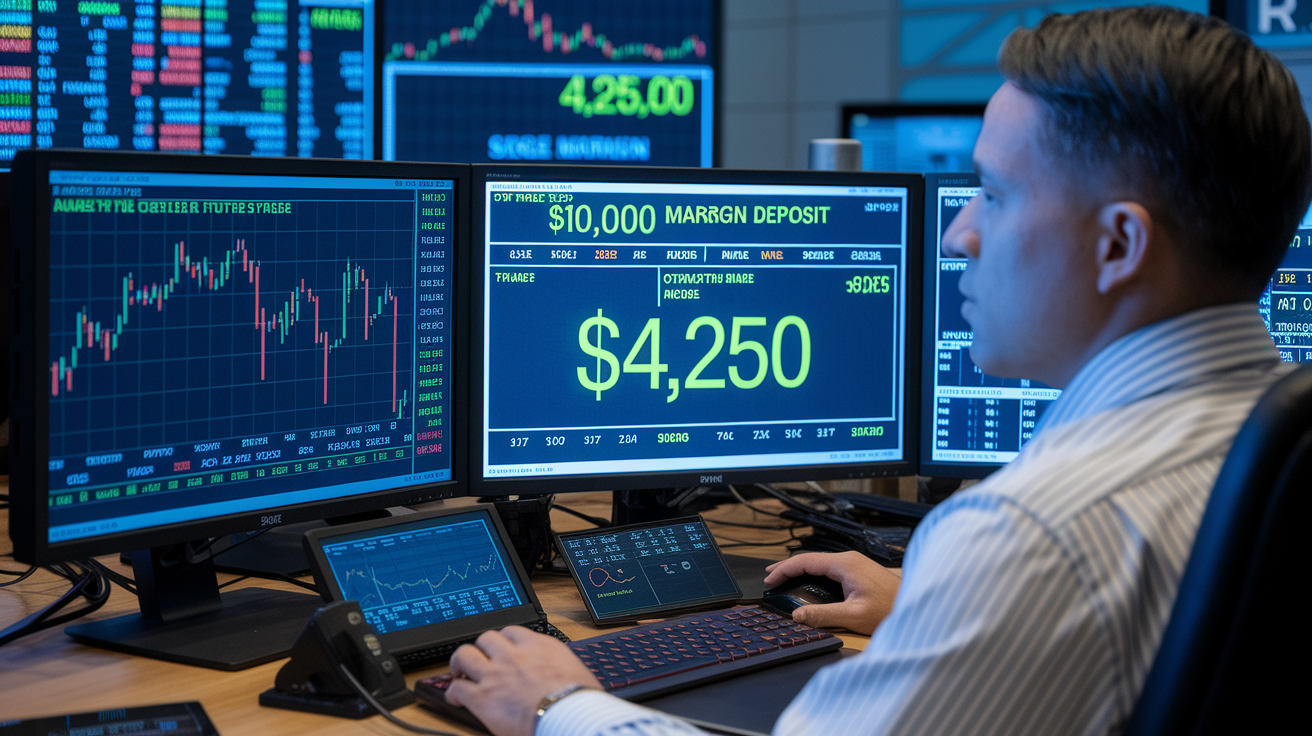
Imagine you expect the S&P 500 index to rise over the next month and decide to buy one E-mini S&P 500 futures contract when the index is trading at 4,200. The contract multiplier is 50, so the notional value is $210,000. Your broker requires $10,000 in initial margin to open the position.
Enter the contract: You buy (go long) one ES contract at 4,200, posting $10,000 margin and controlling $210,000 in exposure.
Post margin: The $10,000 sits in your account as collateral. You don’t pay the full $210,000 upfront.
Price movement: The index rises 50 points to 4,250 over two weeks. Each point move equals $50, so a 50-point gain equals $2,500.
Calculate gain or loss: Your account is credited $2,500 via daily mark to market settlements as the contract appreciates.
Exit or settle the trade: You sell the contract at 4,250, locking in the $2,500 profit, or you can hold through expiration for cash settlement based on the final index value.
Final Words
You now have a compact map: a beginner‑friendly definition of futures, why they exist, how they trade, the key differences versus stocks, their roles in hedging, speculation, and price discovery, the main contract types, trading mechanics, core terms, and a step‑by‑step trade example.
If you’re still asking what does futures mean in the stock market, it’s simply standardized contracts to buy or sell an asset later — a practical tool for managing risk or taking directional bets. Use this to read market moves with more confidence.
FAQ
Q: What do stock futures tell you?
A: Stock futures tell you the market’s expected direction for stocks before the cash session opens, reflecting traders’ pricing of overnight news, earnings, and macro data and signaling likely open sentiment.
Q: Why buy futures instead of stocks?
A: Buying futures instead of stocks gives leverage (bigger exposure with less capital), easier shorting, and flexible hedging, but it increases risk through margin requirements and amplified gains or losses.
Q: How does future work in the stock market?
A: A future works as a standardized contract to buy or sell an underlying index or asset at a set price on a future date; contracts trade on exchanges with daily mark-to-market.
Q: Are stock futures good for beginners?
A: Stock futures are generally not ideal for beginners because leverage, margin calls, and rapid losses make them riskier; beginners should learn basics and try simulated trading first.