

Is Tesla finally trading growth for profits?
Q2 2026 missed expectations: revenue $24.1 billion, adjusted EPS $0.68, and shares fell about 7% after hours.
Automotive gross margin slid to 16.8% as factory retooling and higher costs bit into profitability.
Free cash flow turned positive, but capex rose for AI and next-gen tooling.
This post breaks down the headline numbers, why the market cared, and the next catalysts that could flip the story.
Quick take: margins matter more than deliveries right now.
Executive Summary of Latest Tesla Earnings

Tesla’s Q2 2026 numbers came in below what the Street was expecting, and shares took a 7 percent hit after hours. Revenue landed at $24.1 billion (down 3 percent from last year), while adjusted EPS checked in at $0.68 against a consensus estimate of $0.82. GAAP net income dropped to $1.2 billion as automotive margins got squeezed and the company poured more cash into AI infrastructure. Investors didn’t like the weaker profitability or the cautious tone on full-year deliveries.
The real issue? Margin pressure. Automotive gross margin slipped to 16.8 percent from 18.2 percent a year ago, thanks to higher factory costs and ongoing price tweaks in China and Europe. Management blamed factory retooling for next-gen platforms and bigger warranty reserves. Free cash flow flipped positive at $890 million (up from a $200 million burn last quarter), but that’s still down 22 percent year over year as capex climbed.
Three numbers that matter most:
- Revenue: $24.1 billion (down 3 percent YoY)
- Adjusted EPS: $0.68 (missed by $0.14)
- Automotive gross margin: 16.8 percent (down 140 basis points YoY)
Detailed Financial Breakdown
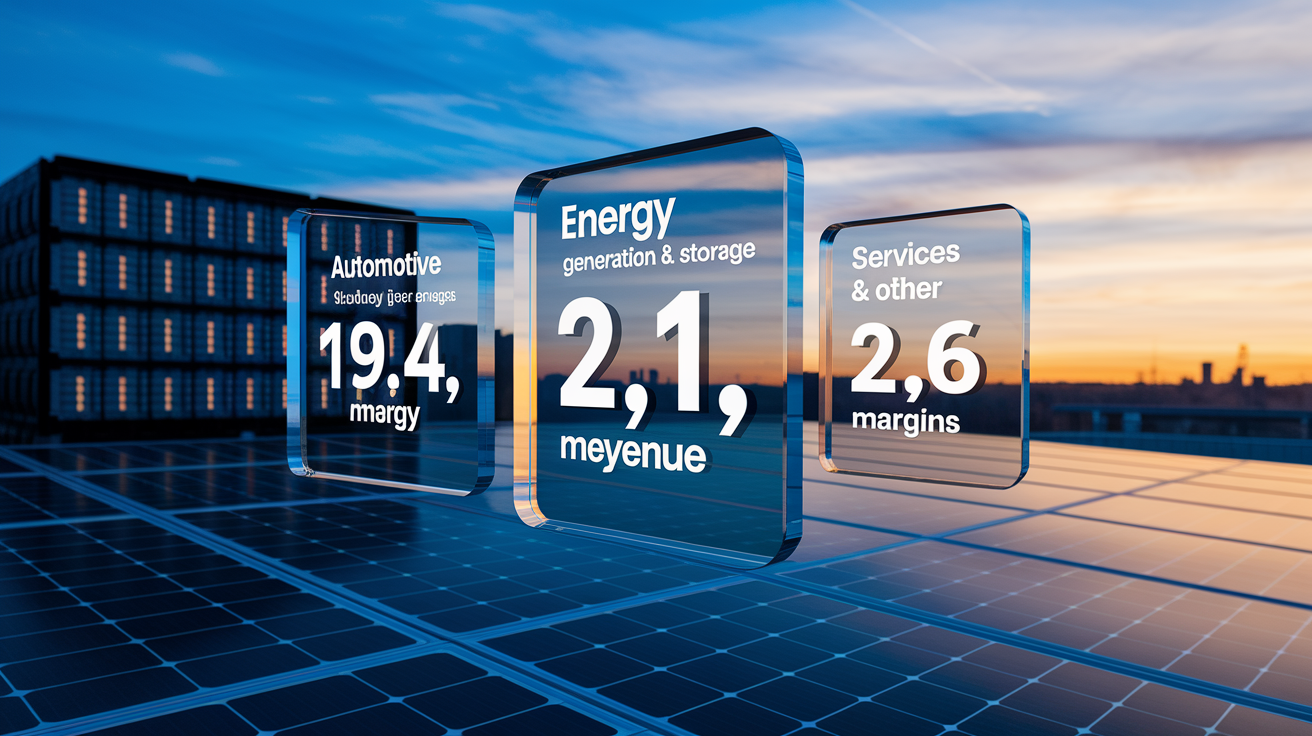
Revenue across Tesla’s segments told a mixed story. Automotive brought in $19.4 billion (80.5 percent of the total) but fell 4 percent year over year because average selling prices dropped faster than deliveries grew. Energy generation and storage hit $2.1 billion, up 18 percent, driven by Megapack orders and residential solar. Services and other revenue reached $2.6 billion, a 6 percent bump, as Supercharger usage and collision repair volume increased.
Margins kept shrinking. Consolidated gross margin fell to 18.1 percent from 19.3 percent last year. Automotive gross margin, stripping out regulatory credits, came in at 15.2 percent. Operating margin compressed to 9.4 percent from 11.1 percent, weighed down by heavier R&D spending on full self-driving and the Optimus robot. Regulatory credit revenue was $532 million, down 11 percent sequentially because European automakers needed fewer credits after meeting tougher emissions rules.
Net income of $1.2 billion translated to $0.34 per share on a GAAP basis, compared to $0.91 in Q2 2025. The company recorded $1.1 billion in stock comp and $420 million in restructuring charges tied to factory optimization. Free cash flow turned positive at $890 million after three straight quarters in the red, helped by better working capital management and smaller inventory builds. Cash sat at $26.1 billion, down slightly from $27.0 billion at the end of Q1.
| Segment | Revenue (billions) | YoY Change | QoQ Change |
|---|---|---|---|
| Automotive | $19.4 | –4% | –1% |
| Energy Generation & Storage | $2.1 | +18% | +9% |
| Services & Other | $2.6 | +6% | +3% |
Vehicle Production and Delivery Metrics

Tesla built 462,000 vehicles and delivered 448,000 during the quarter. Both numbers dropped around 2 to 3 percent year over year. Model 3 and Model Y made up 421,000 of those deliveries (down 3 percent), while Model S, Model X, and Cybertruck combined for 27,000 units, flat versus last year. Sequential delivery growth of 4 percent showed some recovery from a weak Q1, but the year-over-year comparison points to ongoing demand issues in China and softer European sales.
Production snags eased a bit. Gigafactory Shanghai got back to full speed after maintenance work in Q1. Fremont stayed steady, and the Texas plant ramped Cybertruck output to roughly 15,000 units for the quarter. Berlin lagged expectations because of battery cell supply problems, which limited Model Y production in Europe. Total installed capacity now sits above 2.1 million vehicles annually, with utilization around 85 percent.
Three delivery takeaways:
- Global deliveries: 448,000 units (down 3 percent YoY, up 4 percent QoQ)
- Model 3/Y share: 94 percent of volume
- Cybertruck ramp: 15,000 units in Q2, up from 8,000 in Q1
Guidance and Forward-Looking Outlook

Management stuck with its full-year delivery target of 1.9 million vehicles, which implies 6 percent growth over 2025, but admitted the goal depends on a strong second half. Elon Musk said on the call, “We’re confident in the ramp, but it’s going to be back-end loaded.” The company expects automotive gross margin to hold steady in the low-to-mid 17 percent range during the second half, helped by cost cuts from localized battery production and cheaper raw materials. No new price cuts were announced, suggesting a shift toward volume growth through new models instead of more discounting.
Capex guidance for the year went up to $10 billion from $9 billion, reflecting faster spending on AI compute and next-gen platform tooling. Tesla’s planning to add another 50,000 H100 GPUs by year-end to support full self-driving and Optimus training. The company repeated its plan to start limited production of its next affordable vehicle in late 2027, with early output focused at Gigafactory Texas.
Energy storage deployment should top 100 gigawatt-hours for the full year, more than doubling 2025. Management pointed to solid order visibility for Megapack projects through 2027 and better margins in the energy segment as production scales. Services revenue should keep growing in the high single digits as the vehicle fleet expands and Supercharger use ticks up. Operating expense as a percentage of revenue is expected to drop a bit in the second half as hiring slows and restructuring savings kick in.
Analyst Reactions and Market Commentary

Wall Street zeroed in on the margin decline and the slower-than-hoped recovery in auto profitability. Morgan Stanley kept its Overweight rating but cut its price target to $275 from $310, calling out “near-term headwinds that will take two to three quarters to clear.” Adam Jonas noted that while the energy business looked good, automotive margins are getting squeezed by competition in China and manufacturing efficiency gains that aren’t showing up fast enough. Goldman Sachs downgraded to Neutral from Buy, saying valuation doesn’t account for the earnings risk and that 2027 consensus estimates look too high given where margins are trending.
JPMorgan kept its Underweight rating and $180 price target, highlighting the gap between Tesla’s valuation and weakening fundamentals. Their auto analyst wrote, “Delivery growth is stalling, margins are compressing, and the company is increasing capex at a time when free cash flow generation should be accelerating.” But Wedbush Securities stuck with Outperform and a $350 target, arguing the market’s undervaluing Tesla’s AI and energy potential. Dan Ives said full self-driving attach rates and energy storage margin gains will trigger a re-rating over the next 12 months.
Three quick analyst notes:
- Consensus 12-month price target: $262 (down from $285 before earnings)
- Rating split: 18 Buy, 14 Hold, 8 Sell (two downgrades after the print)
- Next catalyst: Q3 delivery update in early October and any sign margins are stabilizing
Final Words
We opened with the headline numbers — revenue, EPS, and the immediate market move — then dug into segment revenues, margins, and cash flow.
You saw production and delivery trends, management’s guidance on future output and margin plans, plus what analysts are saying.
If you’re tracking tesla earnings, the takeaways are clear: near-term stock moves will follow guidance and deliveries, while the longer game is margin and production progress.
Watch the next delivery update and management commentary. Overall, the outlook still leans constructive.
FAQ
Q: What is Tesla’s next earnings date?
A: Tesla’s next earnings date is set by the company each quarter; check Tesla’s investor relations page or a market calendar for the exact release time and whether results come pre-market or after-hours.
Q: What if I invested $10,000 in Tesla 10 years ago?
A: If you invested $10,000 in Tesla 10 years ago, its current value depends on share-price appreciation and stock splits; use a historical price calculator or your brokerage to get the exact present value.
Q: What state does not sell Tesla?
A: No U.S. state completely blocks Tesla sales today; a few still limit direct manufacturer sales versus traditional dealerships—check your state’s motor-vehicle rules or Tesla’s online store locator for local availability.
Q: Did Tesla’s earnings fall?
A: Whether Tesla’s earnings fell depends on the specific quarter; compare the latest GAAP and adjusted EPS to prior-period figures and analyst estimates, and read the company’s earnings release for confirmed YoY and QoQ changes.