


What if a buyer tries to buy your company without asking the board?
That’s a hostile takeover, and it hands real power to shareholders, often with a tempting cash premium but big risks.
This post explains, in plain terms, your rights, your practical options (tender, vote, hold, or sell), and the likely financial outcomes: short-term price jumps, possible dilution, and long-term uncertainty.
Read on to learn what to watch next, how to evaluate offers, and when waiting might pay off.
What a Hostile Takeover Means for Shareholders

A hostile takeover happens when an acquiring company tries to take control of a target without getting the board’s blessing. The bidder skips management entirely and goes straight to shareholders with tender offers or proxy fights. “Hostile” just means the board’s pushing back. It doesn’t necessarily mean shareholders hate the idea.
You become the decision maker here. The acquiring company offers to buy your shares at a premium over current market price, hoping enough people will sell to hand them a controlling stake (usually north of 50 percent). When the board says no, it becomes a direct fight for your support.
This flips the script. Power moves from the boardroom to you. Standard acquisitions? Boards negotiate and tell you what to do. Hostile bids? You’re evaluating offers on your own, deciding whether to sell, vote for new directors, or sit tight for something better.
What matters to you:
Control shifts to shareholders: Your choice to tender or vote determines what happens, not what the board wants.
Premium pricing: Bidders typically offer 20 to 50 percent above market price to get you to sell.
Time pressure: Tender offers come with hard deadlines. Waiting too long can cost you options.
Defensive responses: Target companies might deploy poison pills or hunt for white knights, which can mess with share value and dilution.
How the Hostile Takeover Process Unfolds
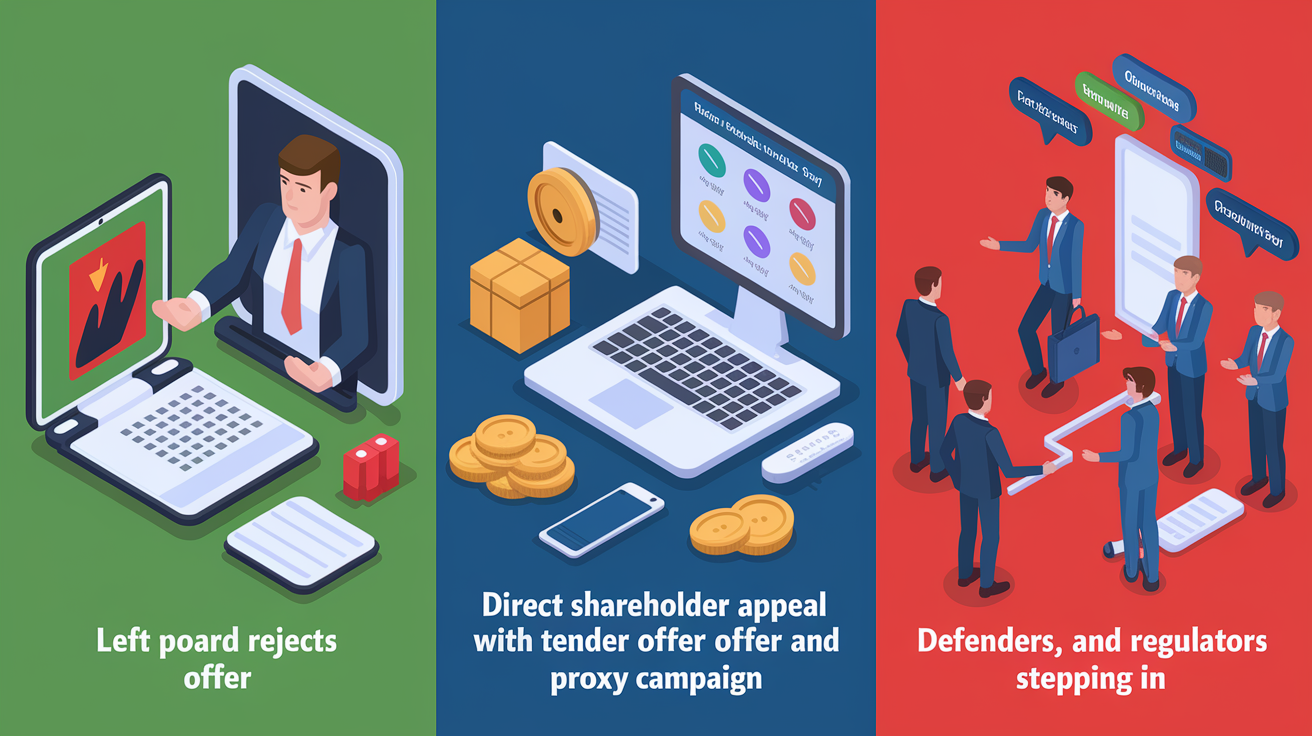
Hostile takeovers follow a pattern, though timing and tactics change. It starts when an acquiring company makes an unsolicited pitch to the target’s board with a price and terms. Board says no (maybe the price is too low, strategy doesn’t fit, or they just don’t like it), so the bidder pivots to you.
Two main tactics: tender offers and proxy fights. A tender offer invites you to sell shares directly to the bidder at a set price within a specific window. A proxy fight asks you to vote out the board and replace them with directors who’ll approve the deal. Bidders sometimes use both, or buy shares on the open market to build pressure.
Here’s how it typically goes:
- Initial offer or approach: Bidder pitches terms to the target board, usually at a premium.
- Board rejection: Target management says no, citing low value or strategic problems.
- Direct shareholder appeal: Bidder launches a tender offer, proxy campaign, or public push to win you over.
- Defensive measures: Target board might roll out poison pills, find white knights, or restructure to block the bid.
- Shareholder response: You tender shares, vote in proxy contests, or hold out for better offers.
- Resolution: Deal closes if the bidder gets majority control. Fails if you reject or regulators step in. Or it turns into a negotiated deal.
Timelines run from weeks to years. Oracle chased PeopleSoft for about 18 months and ten revised offers before closing in December 2004 at $10.3 billion. Sanofi’s Genzyme bid took roughly five months from first offer to shareholder acceptance in February 2011 at $20.1 billion. You’ll see SEC filings, proxy mailings, tender deadlines, antitrust reviews, and maybe court fights if defenses get challenged.
How Hostile Takeovers Impact Shareholders

Hostile takeover announcements almost always spike stock prices immediately. Bidders offer premiums to get you to sell. Microsoft’s 2008 Yahoo bid carried a 62 percent premium. InBev’s final Anheuser-Busch offer in July 2008 delivered about 40 percent above pre-offer price at $70 per share. Your shares jump in value overnight as the market prices in the offer.
Short-term gains can be big. Long-term? That varies. If the deal closes and integration works, combined-company synergies might keep value up. Roche projected $750 to $850 million in annual synergies after buying Genentech in March 2009. If the takeover fails, share prices often fall back toward pre-bid levels, wiping out paper gains. Failed bids or debt-heavy deals can wreck value. RBS’s $97 billion ABN Amro acquisition in October 2007 hit right before the financial crisis and left lasting damage to both companies.
Voting power shifts during hostile campaigns. Proxy fights revolve around your ballot. Replacing directors hands strategic control to the acquirer. Defensive moves like poison pills dilute the bidder’s stake by letting existing shareholders buy discounted shares. That raises acquisition costs but might also dilute your ownership if triggered.
What you’re looking at:
Immediate premium: Tender offers usually give you cash or stock above market price, locking in gains fast.
Long-term uncertainty: Post-acquisition restructuring, management turnover, or added debt can change company performance in unpredictable ways.
Dilution risk: Poison pills and rights plans may issue new shares, shrinking your percentage ownership and voting clout.
Shareholder Options During a Hostile Takeover

When a hostile bid shows up, you’ve got several moves. The most straightforward? Tender your shares. Accept the bidder’s offer to sell at the stated price before the deadline. This locks in the premium and gets you out, converting equity to cash or bidder stock depending on the deal.
Or you can hold your shares and vote if the bidder launches a board-replacement campaign. Voting lets you shape governance without selling. Holding also keeps you in position for competing bids or negotiated settlements that might offer higher prices. Some shareholders sell on the open market as prices climb toward the offer level, grabbing part of the premium without waiting for deal closure.
What you can do:
Tender shares: Sell directly to the bidder at the offer price before the deadline. Guarantees the stated premium.
Vote in proxy contests: Back or oppose director slates in shareholder meetings. Your vote decides board control.
Sell in the market: Liquidate at current market price, which typically rises but stays below the offer during uncertainty.
Hold and wait: Keep shares to see if competing bids, defensive measures, or long-term value under new ownership play out.
Think about valuation, tax hits, and your own risk tolerance. Compare the offer price to what you think the company’s actually worth and recent trading ranges. Oracle’s initial $16 per share PeopleSoft offer in 2003 was only a 6 percent premium. Shareholders held out and eventually got $26.50 per share in December 2004. Tendering might trigger capital gains tax if you’re selling at a profit. Holding exposes you to deal failure or regulatory blocks but keeps upside alive if a white knight or higher bid shows up.
Legal Protections and Defensive Measures

You get transparency through securities regulations. Tender offers must include detailed disclosure documents filed with the SEC, laying out offer terms, financing sources, bidder plans, and material risks. Proxy solicitations need similar filings, giving you access to both management’s and the bidder’s arguments before you vote.
Anti-takeover defenses serve two purposes: protecting management control and (in theory) getting you more money by forcing higher bids. A poison pill lets existing owners buy discounted shares when a bidder crosses a threshold (typically 10 to 20 percent ownership), diluting the acquirer’s stake and jacking up costs. Staggered boards stop immediate director replacement by electing only a fraction of seats each year, slowing takeover timelines. White knight strategies invite friendly buyers to outbid the hostile party, potentially pumping up premiums.
Courts balance fiduciary duty with shareholder rights. Boards that reject high-premium offers without good reason risk lawsuits. Shareholders have successfully challenged defenses that protect management at the expense of premium offers. Regulations require quick disclosure of material changes, bid amendments, and defense activations.
| Defense Type | Purpose |
|---|---|
| Poison Pill (Shareholder Rights Plan) | Dilutes bidder ownership by allowing existing shareholders to buy discounted shares, raising acquisition cost. |
| Staggered Board Elections | Delays full board replacement by electing directors in rotating classes, extending takeover timeline. |
| White Knight | Solicits a friendly buyer to outbid the hostile party, potentially increasing shareholder premium. |
Disclosure rules make bidders and targets file amended schedules when terms change, so you get updated info before tendering or voting. These filings include financing details, regulatory approvals needed, and any litigation affecting the deal.
Real‑World Examples of Hostile Takeovers

Oracle went after PeopleSoft for about 18 months starting in 2003. PeopleSoft’s share price had fallen from $56 to around $15 in 2003. Oracle initially offered $16 per share, a modest 6 percent premium. The board fought back, shareholders held on, and Oracle raised its bid ten times. The deal closed December 13, 2004, at $10.3 billion and $26.50 per share. Shareholders who waited got way more than early tender prices. Patience paid off when boards credibly resist lowball offers.
Sanofi approached Genzyme in 2010 with an opening bid of $69 per share. Genzyme shareholders wanted $75. Sanofi negotiated directly with investors and eventually closed February 15, 2011, at $74 per share plus performance-based contingent value rights, totaling $20.1 billion. The campaign lasted about five months. Shareholders who held through negotiations locked in a higher price and upside tied to future drug performance.
Kraft Foods launched a hostile bid for Cadbury in 2009 despite pushback from management, shareholders, and even the government. Kraft closed the takeover in 2010 for $19.6 billion. Cadbury shareholders got a premium, but post-acquisition controversies over job cuts and factory closures showed the disruption hostile deals can cause. Financially positive for sellers. Operationally messy for employees and communities.
What you can take from these:
Initial offers often lowball: Oracle and Sanofi both raised bids significantly. Holding can capture higher premiums if boards resist credibly.
Direct shareholder engagement works: Sanofi’s direct talks with Genzyme investors bypassed entrenched management and delivered better terms.
Post-deal integration varies: Kraft and Cadbury delivered premiums but also operational chaos. Check the bidder’s track record and stated plans before tendering.
Hostile vs. Friendly Takeovers: Key Differences for Shareholders
Friendly takeovers move forward with board approval. Management negotiates terms, runs due diligence, and recommends the deal to you. Timelines are shorter, governance fights minimal, and your involvement is limited to a final ratification vote. Prices reflect negotiated value, not competitive bidding pressure.
Hostile takeovers skip management consent. The bidder comes straight to you, usually after the board rejects an offer. Your participation (tendering shares or voting for new directors) decides the outcome. Premiums are typically higher because bidders have to overcome board resistance and get you to act against management’s recommendation.
| Takeover Type | Board Role | Shareholder Role | Typical Outcome |
|---|---|---|---|
| Friendly | Negotiates and recommends deal | Votes to ratify pre-negotiated terms | Smooth closure, negotiated premium |
| Hostile | Resists and implements defenses | Decides via tender or proxy vote | Higher premiums, longer timelines, greater uncertainty |
| Friendly | Collaborative due diligence | Passive approval role | Lower governance conflict |
| Hostile | Adversarial or non-cooperative | Active decision-making on offers and votes | Potential for competing bids or deal failure |
The shareholder experience is completely different. In friendly deals, you get a board-endorsed recommendation and vote on agreed terms. In hostile scenarios, you’re evaluating competing arguments from management and the bidder, assessing premiums on your own, and dealing with time-sensitive tender deadlines. Communication is more direct but also more heated, with both sides going after your support through proxy materials, press releases, and investor calls.
Final Words
In the action, a hostile takeover puts shareholders front and center — you’re the decision point via tender offers or proxy fights.
We ran through what a hostile takeover means, how the process unfolds, the likely impacts, your choices, legal defenses, and real examples showing different outcomes.
Keep evaluating offers vs. value, vote with care, and watch disclosure and timelines. This guide is a simple reference with hostile takeover explained for shareholders so you’re better prepared if one arises.
With that context, you’ll be ready to act and protect value.
FAQ
Q: What is a hostile takeover in simple terms and what happens to shareholders in a hostile takeover?
A: A hostile takeover in simple terms is when an acquirer seeks control without board approval; shareholders decide through tender offers or proxy fights, often seeing short-term price gains and longer-term uncertainty.
Q: What percentage of shares do you need for a hostile takeover?
A: The percentage of shares needed for a hostile takeover typically means owning more than 50% of voting shares to control the company, though proxy fights or large minority stakes can succeed if ownership is fragmented.
Q: Can a 51% shareholder be removed?
A: A 51% shareholder can be removed only in limited cases—court orders, fraud findings, or a negotiated buyout—since majority ownership usually prevents involuntary removal without legal or contractual action.