

Think the Fed reacts to every flashy headline? Not true.
The Fed watches a short list of data in the weeks before a meeting, and a single surprise can swing rate odds quickly.
This post walks you through the indicators that matter most, including CPI (consumer prices), jobs data (payrolls, unemployment, wages), and Core PCE (the Fed’s preferred inflation gauge), explains why each shifts policy expectations, and shows what specific surprises or trends traders watch in the run-up to an FOMC decision.
Key Economic Indicators the Fed Monitors Most Closely

The Federal Reserve leans on a specific set of economic indicators to guide every interest rate decision, and if you understand what’s on that watchlist, you can start anticipating FOMC outcomes before the market does. These indicators form the empirical backbone of the Fed’s dual mandate: keeping prices stable (2.0 percent annual inflation) and pushing employment as high as it can sustainably go. Before each scheduled meeting, Fed officials comb through the latest readings on inflation, jobs, growth, and financial conditions to decide whether policy needs to tighten, ease, or stay put.
Not every data release matters equally. The Fed’s told us outright that it prefers certain measures (Core PCE over headline CPI, for instance) and focuses on multi-month trends rather than one-off prints. The reports that really move markets are the ones that reveal shifts in inflation momentum or labor tightness, because those two forces sit at the center of the Fed’s decision tree. A surprise in any top-tier release within two weeks of an FOMC meeting can materially change the odds of a rate move that futures markets are pricing in.
Here are the five indicators that hold the most sway over Fed policy, ranked by how closely officials track them and how often they show up in FOMC statements, minutes, and Chair Powell’s press conferences:
Core Personal Consumption Expenditures (Core PCE) inflation is the Fed’s preferred gauge. The Bureau of Economic Analysis releases it monthly, usually on the last business day of the month. Core PCE strips out food and energy prices and gets tracked month over month, annualized over three months, and year over year. When Core PCE stays above 2.5 percent, policy stays restrictive. If it moves toward or below 2.0 percent for a sustained period, that opens the door to rate cuts.
Consumer Price Index (CPI and Core CPI) comes from the Bureau of Labor Statistics mid-month, typically between the 10th and 15th. CPI drives immediate market reactions even though the Fed officially watches PCE. Large CPI surprises (monthly prints of 0.3 percent or higher when markets expect 0.1 or 0.2 percent) move rate expectations sharply because they often signal similar moves in Core PCE two weeks later.
Nonfarm Payrolls and the Unemployment Rate drop together in the monthly Employment Situation report on the first Friday of each month at 8:30 AM Eastern. Payroll gains above 200,000 in a month signal continued labor tightness and wage pressure. Sustained gains below 100,000 to 150,000 indicate cooling. The unemployment rate rising by 0.3 to 0.5 percentage points over several months is historically a threshold that increases the Fed’s urgency to cut rates.
Average Hourly Earnings (AHE) is part of the monthly jobs report. AHE measures wage growth and feeds directly into the Fed’s inflation outlook. Year over year wage growth persistently above 4.0 percent raises inflation concerns. Deceleration toward 2 to 3 percent removes a key source of price pressure and makes cuts more likely.
Gross Domestic Product (GDP) is released quarterly with an advance estimate roughly one month after the quarter ends, followed by second and third revisions. Strong quarterly annualized growth above 3 percent reduces the odds of near term easing. Growth near zero or negative for consecutive quarters raises recession probability and accelerates the path to cuts.
These indicators form a real-time feedback loop that the Fed uses to calibrate monetary policy. When inflation measures, labor data, and growth signals move in the same direction for several consecutive months, the Fed’s decision becomes clear. Divergences (cooling inflation paired with robust payrolls, for example) force a more nuanced judgment about which side of the dual mandate requires priority. That’s when Fed communication and market pricing become especially sensitive to each new release.
Release Timing and What to Watch in Monthly Data Cycles

Knowing when key indicators are published relative to the next FOMC meeting is essential for understanding which data points will carry the most weight in the room. The Federal Reserve meets eight times a year, roughly every six weeks, and the calendar’s structured so that major economic releases cluster in the two to four weeks before each decision. A surprise in the jobs report, inflation print, or GDP revision released within 48 hours of a meeting can shift the policy outcome or the tone of the Fed’s statement and projections.
The monthly data cycle follows a predictable rhythm. The Employment Situation report (Nonfarm Payrolls, unemployment rate, and Average Hourly Earnings) arrives on the first Friday of the month at 8:30 AM Eastern, covering the prior month. CPI is published by the Bureau of Labor Statistics around the 10th to 15th of the month for the prior month, typically landing mid-morning. Core PCE (the Fed’s preferred inflation measure) comes later in the cycle, released by the Bureau of Economic Analysis at the end of the month as part of the Personal Income and Outlays report. GDP is quarterly, with the advance estimate appearing roughly 30 days after the quarter ends, followed by second and third estimates at 60 and 90 days. This staggered schedule means that in any given FOMC cycle, the Fed will have at least one fresh jobs report, one or two fresh inflation readings, and often a recent GDP update to inform the decision.
| Indicator | Release Frequency | Typical Release Day | Relevance to Fed Decisions |
|---|---|---|---|
| CPI (headline and core) | Monthly | Mid-month (10th–15th) | Drives market inflation expectations; large surprises move rate odds even though Fed prefers PCE |
| Core PCE | Monthly | End of month (last business day) | Fed’s official inflation target gauge; sustained readings near 2.0% increase cut probability |
| Nonfarm Payrolls | Monthly | First Friday, 8:30 AM ET | Direct measure of job creation; gains >200k signal tightness, <100–150k signal cooling |
| Unemployment Rate | Monthly | First Friday, 8:30 AM ET (with payrolls) | Tracks labor slack; rises of 0.3–0.5 percentage points over months trigger cut consideration |
| GDP (advance, second, third) | Quarterly | ~30, 60, 90 days after quarter-end | Broad growth signal; annualized growth >3% delays cuts, near-zero or negative accelerates them |
How Markets React to Economic Data Surprises

Markets are forward-looking machines, and they reprice the path of interest rates within seconds of an unexpected economic release. When an indicator comes in stronger or weaker than the consensus estimate published by Bloomberg or Reuters, traders immediately adjust their expectations for the next FOMC decision and the trajectory of rates over the following 12 months. This real-time reaction is visible across Treasury yields, Fed funds futures, equity volatility, and the U.S. dollar. The magnitude of the move tells you how much the surprise mattered to the Fed’s decision calculus.
A hotter than expected inflation print (say, Core CPI rising 0.4 percent month over month when markets expected 0.2 percent) typically pushes two year Treasury yields higher within minutes, as bond traders price in a longer period of restrictive policy or a higher terminal rate. Fed funds futures, which directly reflect market implied probabilities of rate moves at upcoming meetings, will shift to show reduced odds of a near term cut or increased odds of an additional hike. Equity markets often sell off on the news, with rate sensitive sectors like technology and real estate hit hardest. The VIX (equity volatility index) may spike as uncertainty around the Fed’s path increases. The U.S. dollar usually strengthens because higher expected U.S. rates attract foreign capital.
Weaker than expected labor data (payrolls missing estimates by 50,000 or more, or the unemployment rate ticking up unexpectedly) tends to pull Treasury yields lower, increase the probability of rate cuts priced into futures, and lift equities (especially growth stocks that benefit from lower discount rates). The dollar often weakens as traders anticipate earlier or deeper Fed easing. The speed and size of these reactions depend on how large the surprise is relative to expectations and how persistent the trend appears across multiple releases.
Here’s how markets typically respond to different types of economic surprises ahead of an FOMC meeting.
Treasury yields are the first domino. Two year yields are most sensitive to Fed policy changes. A 0.2 to 0.3 percentage point surprise in Core CPI can move the two year by 10 to 20 basis points intraday. Ten year yields move less but still shift, especially if the data changes the growth or inflation outlook for the next year.
Fed funds futures price in the expected federal funds rate at future FOMC meetings. After a major data surprise, the implied probability of a 25 basis point move (cut or hike) at the next meeting can swing by 20 to 40 percentage points within an hour.
Equity volatility (VIX) spikes when unexpected inflation or sharp labor deterioration increases uncertainty about the policy path. That elevated reading signals near term risk in equities.
U.S. dollar strength reflects relative interest rate differentials. The dollar strengthens when data supports a hawkish Fed stance (higher rates for longer) and weakens when data points to easing, because international investors adjust their currency allocations accordingly.
Historical Patterns: When Indicators Triggered Fed Shifts
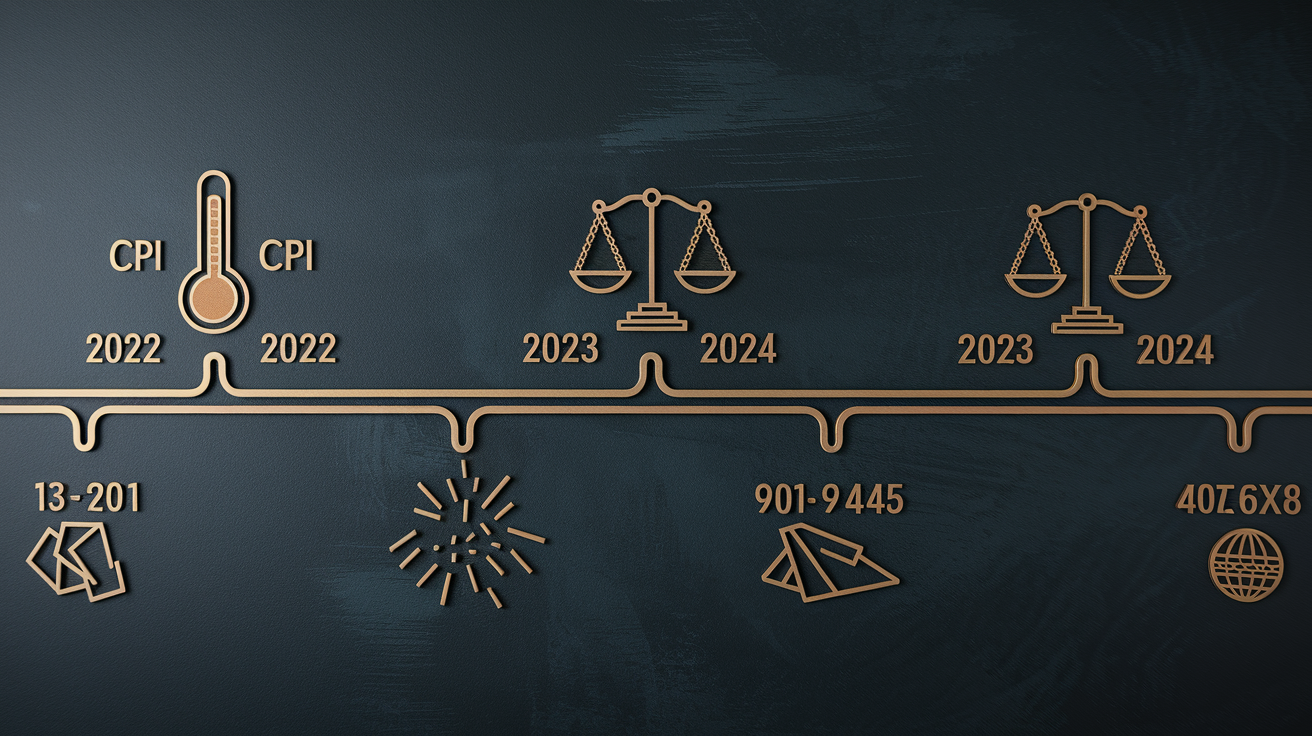
History offers clear examples of how specific economic indicators have directly driven Federal Reserve policy pivots. In 2022, CPI peaked at 9.1 percent year over year in June, the highest reading in more than 40 years. That spike, combined with persistent monthly Core CPI prints above 0.5 percent and Core PCE running well above the Fed’s 2.0 percent target, forced the FOMC into the most aggressive tightening cycle since the early 1980s. Between March 2022 and July 2023, the Fed raised rates by 525 basis points (5.25 percentage points), moving from near zero to a range of 5.25 to 5.50 percent. The consistent message from Chair Powell during this period was that inflation data had to show sustained deceleration before the Fed would pause. Markets learned to treat every CPI and Core PCE release as a potential trigger for an additional 75 basis point hike.
The 2008 financial crisis provides the opposite case study. Labor deterioration became the primary driver of Fed action once credit markets froze. New residential building permits had peaked in 2005 and entered a sustained freefall through 2006 and 2007, signaling collapsing housing demand well before the broader recession began. By late 2007, the unemployment rate started rising and Nonfarm Payrolls turned negative. The Fed responded with aggressive cuts, reducing the federal funds rate from 5.25 percent in September 2007 to effectively zero by December 2008. In this episode, the Fed prioritized the employment side of its dual mandate as inflation fell sharply alongside collapsing demand.
A less dramatic but instructive example is the mid-1990s soft landing. In 1994 to 1995, the Fed raised rates preemptively to cool an accelerating economy and prevent inflation from taking hold. GDP growth had been running above 4 percent annualized, and the Fed hiked the funds rate from 3.0 percent to 6.0 percent over 12 months. By early 1995, economic indicators (particularly retail sales, manufacturing orders, and early labor signals) showed the economy was slowing more than expected. The Fed paused, then cut rates modestly in mid-1995, and the economy reaccelerated without triggering a recession. That cycle demonstrated the Fed’s willingness to adjust quickly when growth data and leading indicators pointed to an overshoot in tightening.
More recently, in 2023 to 2024, the Fed held rates steady in a restrictive range even as Core PCE gradually decelerated from above 5.0 percent toward 2.5 percent, because labor indicators (especially payrolls consistently above 200,000 per month and wage growth above 4.0 percent year over year) signaled persistent tightness that could reignite inflation. The lesson? The Fed won’t ease until multiple indicators across both inflation and employment align to show that restrictive policy is no longer needed.
How to Interpret Indicators Like a Trader Before the Fed Meets
Professional traders and institutional investors build a decision framework that weights indicators by relevance to the Fed’s current priorities, tracks multi-month trends instead of reacting to single prints, and watches for divergences that signal late cycle risks or turning points. The goal isn’t to predict every data point perfectly, but to anticipate how a cluster of releases will shift the Fed’s reaction function and the market’s pricing of future rate moves. This approach requires combining the raw data with an understanding of what the Fed has emphasized in recent communications (FOMC statements, minutes, and Chair Powell’s press conference remarks).
The first rule is to prioritize Core PCE over CPI when forming your inflation view, even though CPI is released earlier and generates bigger headlines. The Fed has repeatedly stated that Core PCE is its preferred measure because it better captures actual consumer spending patterns and adjusts for substitution effects. If CPI comes in hot but you know Core PCE tends to run 0.2 to 0.3 percentage points cooler on a year over year basis, you can anticipate that the Fed’s internal assessment will be less alarmed than the initial market reaction suggests. A single month of elevated CPI driven by a temporary factor (a spike in airfares or used car prices, for example) matters far less than a three month trend showing persistent month over month gains above 0.3 percent annualized.
Second, labor cooling is only significant if it’s accompanied by wage deceleration and a sustained rise in unemployment or a clear downtrend in payroll gains. A one month payroll miss of 50,000 jobs can be noise or a statistical revision. Three consecutive months of payrolls below 100,000, combined with Average Hourly Earnings decelerating from 4.5 percent to 3.0 percent year over year and the unemployment rate rising from 3.7 percent to 4.2 percent, is a material signal that the labor market is loosening and inflation pressures from wages are easing. Traders build rolling averages (three month, six month) to smooth volatility and identify durable trends.
Third, assess GDP relative to the Fed’s estimate of potential growth (typically around 1.8 to 2.0 percent). Quarterly annualized GDP growth consistently above 3.0 percent indicates demand is running ahead of supply, which keeps upward pressure on inflation and makes rate cuts unlikely. Growth near or below potential, especially if paired with decelerating Core PCE, suggests the economy is moving toward balance and the Fed has room to ease without reigniting inflation.
Finally, evaluate labor breadth by looking beyond the headline payroll number to participation rates, the employment to population ratio, quits rates (from JOLTS), and industry level job gains. Broad based weakness across sectors is more concerning to the Fed than isolated softness in one or two industries.
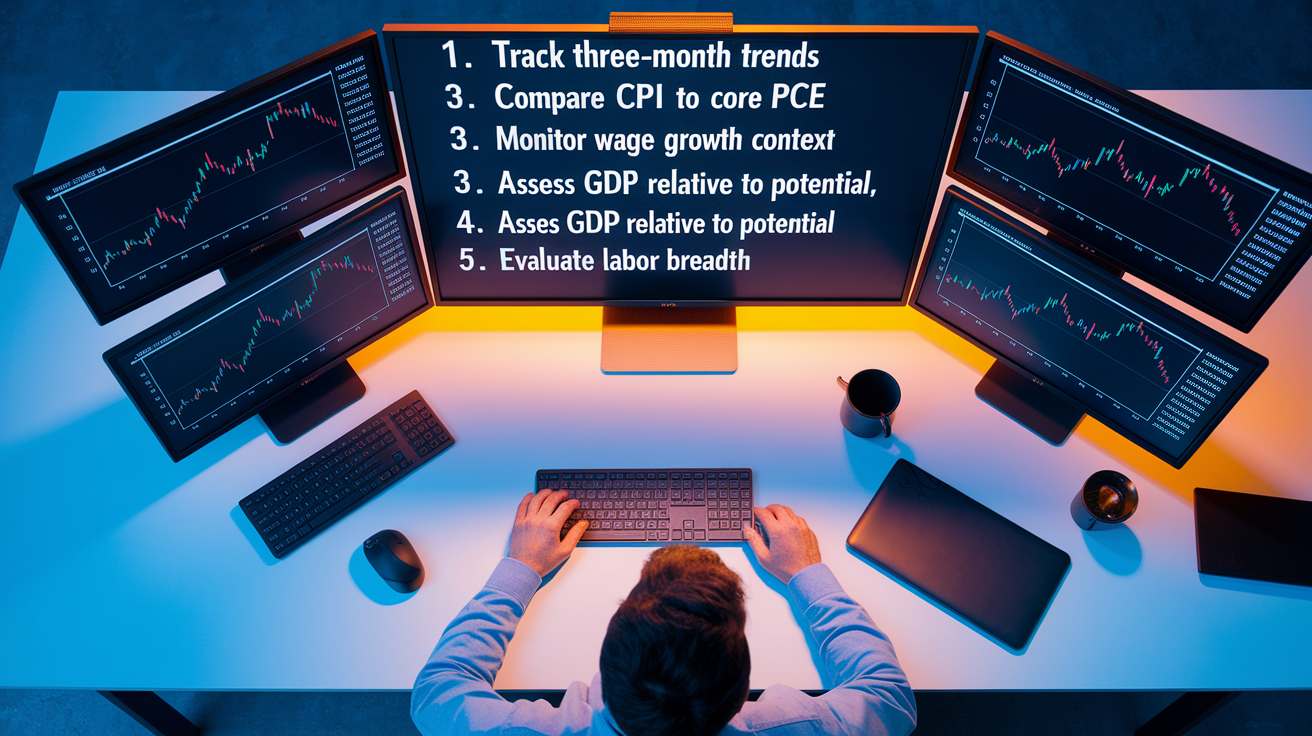
Here are five practical steps to evaluate upcoming economic releases and form expectations for the next FOMC decision.
Track three month annualized trends. Calculate rolling three month averages for Core PCE, Core CPI, and payroll gains. Compare the current three month pace to the prior three months to identify acceleration or deceleration. A deceleration in Core PCE from a 3.0 percent annualized pace to 2.0 percent over two consecutive three month windows is a strong easing signal.
Compare CPI to Core PCE systematically. When CPI is released mid-month, apply historical spreads (Core CPI typically runs 0.2 to 0.4 percentage points hotter than Core PCE on a year over year basis) to estimate the likely Core PCE print at month end. If CPI surprises high but the estimated PCE is still on track toward 2.0 percent, the Fed’s internal view will be less hawkish than the headline suggests.
Monitor wage growth in context. Average Hourly Earnings above 4.0 percent year over year is a red flag for the Fed only if it’s paired with strong payroll gains and low unemployment. If wage growth is elevated but payrolls are slowing and unemployment is rising, the Fed will interpret that as a lagging signal rather than a reason to stay restrictive.
Assess GDP relative to potential and prior quarters. Look at the sequential pattern. If GDP was 3.5 percent annualized last quarter and drops to 1.5 percent this quarter, that’s a significant deceleration even if 1.5 percent is still positive. Compare to the Fed’s long run potential estimate (around 1.8 percent) to judge whether the economy is overheating or cooling.
Evaluate labor breadth beyond the headline. Check the household survey (which drives the unemployment rate) alongside the establishment survey (which drives payrolls), review the labor force participation rate, and look at JOLTS job openings and quits. If payrolls are strong but participation is rising and openings are falling, the labor market is loosening even if the headline number looks tight.
Final Words
We ran through the Fed’s must-see data — CPI, Core PCE, Nonfarm Payrolls, the unemployment rate and GDP — what they measure and how they feed into policy.
You saw when each print arrives, how surprises shift yields and futures, and practical steps to read the trend instead of one-off noise.
Keep a short checklist of economic indicators to watch before the fed meeting and focus on trend durability; that habit turns noisy data into clearer policy odds. Stay prepared and confident.
FAQ
Q: What are the 5 main economic indicators? / What are the 4 economic indicators?
A: The five main economic indicators are CPI (consumer prices), Core PCE (Fed’s preferred inflation), Nonfarm Payrolls (job creation), unemployment rate (labor slack), and GDP (overall growth).
Q: What are the 10 leading economic indicators? / What are the 11 leading economic indicators?
A: The ten leading indicators commonly watched include the yield curve (spread), stock market, initial jobless claims, new manufacturing orders, building permits, consumer confidence, average weekly hours, vendor deliveries, money/credit conditions, and capital goods orders; an eleventh is commodity prices.