


Think an earnings restatement is proof a company cooked the books?
Not always.
Companies restate results for a handful of clear reasons: honest accounting mistakes, new or misapplied rules, reclassifications, consolidation errors, or, sometimes, deliberate manipulation.
This post breaks those causes down into plain terms.
You’ll learn what triggers a restatement, how it shifts reported profits and controls, and what to watch next when a company amends past reports.
By the end you’ll be able to tell when a restatement is a fix versus a red flag.
Core Reasons Behind Earnings Restatements and What Drives Companies to Revise Results

A financial restatement happens when a company goes back and reissues one or more old financial statements because someone found a material mistake after the original filing. Material means big enough to matter, stuff that could’ve changed how investors or lenders made decisions. Think understated liabilities, inflated revenue, expenses in the wrong bucket shifting your ratios or EPS. And restatements aren’t always fraud. Sometimes they’re legitimate fixes triggered by new accounting rules, reclassifications, or interpretation errors nobody caught the first time around.
You can split restatements into two camps. Unintentional ones come from honest screw-ups: misreading new revenue guidance, botching lease accounting, fat-fingering consolidation numbers. Intentional restatements can be defensive plays (like reclassifying discontinued ops to smooth earnings) or, in the worst cases, outright manipulation (hiding cost of goods sold in other lines to pump gross margin). Higher scrutiny usually surfaces the mess. Prepping for an IPO, switching from reviewed to audited financials, or bringing in a new controller or audit firm often uncovers discrepancies that sat there for years.
Stuff that commonly forces companies to restate:
- Accounting mistakes or botched standard interpretations – applying lease or contract-revenue rules wrong
- Reclassification errors – moving discontinued ops around or shuffling cash flows between investing, financing, and operating buckets
- Revenue recognition changes – booking too early, milestone mess-ups, bad cut-off calls
- Expense misclassification – shifting COGS on purpose to juice gross profit, or hiding R&D somewhere else
- Equity transaction errors – business combo accounting, convertible securities, stock valuations done wrong
- Fraud, noncompliance, or just plain incompetence – sometimes restatements expose intentional games or control breakdowns
These drivers explain why fixing one quarter usually means restating multiple periods. The error started way before anyone noticed.
Accounting Error Categories That Commonly Lead to Earnings Restatements

Revenue recognition mistakes sit at the top because revenue rules are complicated and judgment-heavy. Companies constantly trip on percentage-of-completion, recognize revenue before performance obligations clear, or fail to defer when collection looks shaky. Expense misclassification (capitalizing operating costs as assets, misallocating depreciation) messes up both the balance sheet and income statement. Inventory errors, wrong cost-flow picks (FIFO versus weighted average) or late obsolescence write-downs, can overstate assets and understate cost of sales for quarters on end.
Consolidation mistakes pop up when firms miscalculate intercompany eliminations, skip consolidating variable interest entities, or fumble equity-method accounting. Lease accounting restatements spiked after ASC 842 landed, tons of companies struggled to classify leases right or missed embedded leases altogether. Impairment reversals get corrected when management undoes a goodwill or asset hit that shouldn’t have happened, or fails to record one that should’ve, forcing a look-back fix across prior periods. These error buckets explain why restated financials show revised margins, different working-capital ratios, and shifted cash-flow classifications that can materially flip an analyst’s thesis.
| Error Type | Example Impact on Results |
|---|---|
| Revenue Recognition Mistakes | Overstated sales in prior quarters; revised lower revenue and earnings per share on restatement |
| Expense Misclassification | Operating expenses capitalized as PP&E; restated income lower, depreciation higher over multiple periods |
| Inventory Accounting Errors | Inventory and assets overstated; cost of sales understated; restatement reduces gross margin and net income |
| Consolidation Reporting Mistakes | Subsidiary or VIE omitted; assets, liabilities, and minority interest restated; leverage ratios shift materially |
| Lease Accounting Restatement | Operating leases not recorded under ASC 842; balance sheet restated to add right-of-use assets and lease liabilities |
Regulatory Enforcement, SEC Actions, and Compliance Drivers Behind Restated Earnings

When a public company finds a material error, SEC rules say you’ve got to amend old filings (usually by filing an amended 10-K or 10-Q) and issue a non-reliance statement telling investors the prior numbers are toast. SEC staff kick off comment-letter processes when they spot inconsistencies during routine reviews, and those letters can force a restatement. Enforcement actions ramp up when restatements involve revenue games, undisclosed related-party deals, or intentional GAAP violations. In those situations, the SEC might pursue civil penalties, bar officers and directors, or hand things over for criminal investigation.
SOX compliance, especially Section 404 internal-control sign-offs, plays a direct role in how often restatements happen. Companies with material weaknesses are statistically more likely to restate because those gaps mean they can’t catch or stop misstatements in real time. Public company disclosure requirements go beyond the numbers. Management must also disclose whether the restatement came from a control problem, whether it affects prior guidance or MD&A, and what fix-it steps are underway. The combo of SEC scrutiny, SOX documentation, and auditor approval creates a backstop that surfaces errors, often years after they happened.
The amended-filing process isn’t quick or cheap. Companies have to re-audit or re-review the corrected periods, update all affected footnotes and reconciliations, and refile exhibits and certifications. During that stretch, trading can get wild, analysts may pause coverage, and lenders or counterparties might invoke material-adverse-change clauses. The threat of enforcement alone pushes many companies to self-report errors rather than wait for SEC staff to flag them, because cooperation and timely disclosure can cut penalties and keep management credibility with regulators and the market intact.
Internal Control Failures, Audit Issues, and Governance Breakdowns Leading to Result Corrections

Most restatements trace back to weak internal controls. Inadequate segregation of duties, missing account recs, manual spreadsheets with no version control, or a lack of technical accounting chops in-house. When those gaps exist, even honest mistakes go undetected quarter after quarter until something external triggers a deeper look (new auditor review, controller hire). The governance signal is clear. In the year a company restates, auditor turnover jumps to roughly 25 percent versus 11 percent for companies that don’t restate, and that gap has held for two decades.
Audit failures occur when external auditors miss material misstatements during procedures, either because management got around controls, the audit scope was too narrow, or the team lacked specialized knowledge (derivatives valuation, complex consolidation). Auditor independence concerns come up when long tenure, big non-audit fees, or personal relationships cloud professional skepticism. Director and audit committee jobs include overseeing financial reporting, picking and watching the auditor, and making sure management implements effective controls. A restatement often shows gaps in how actively the committee challenged assumptions or reviewed big judgments. Internal audit’s role is to test controls and flag weird stuff before external auditors show up, yet many restatements reveal that internal audit was under-resourced, reported to management instead of the board, or focused on operational rather than financial risks.
Control-related red flags that come before or with restatements:
- Frequent changes in accounting people or high finance-team turnover – signals instability and loss of knowledge
- Material weaknesses disclosed in prior 10-K filings – formal admission that controls can’t prevent or catch misstatements
- Late filings or repeated extension requests – suggests resource constraints or complex issues management can’t resolve
- Unusual journal entries near period-end – especially top-side entries with no detailed support or approvals
- Lack of segregation between transaction processing and reconciliation – creates room for errors or manipulation to hide
How Forensic Analysis, Whistleblower Tips, and Investigation Processes Trigger Earnings Restatements

Forensic accounting steps in when initial red flags (unexpected ratio shifts, anonymous hotline complaints, auditor concerns) push for a deeper dive. Forensic accountants reconstruct transactions from source docs, re-do calculations, and compare multiple versions of the same period’s data to catch inconsistencies. Whistleblower tips, whether from employees, vendors, or former execs, often deliver the precise details (dates, accounts, amounts) that focus investigative resources and shorten time to discovery. Once a tip or anomaly surfaces, companies typically bring in external counsel and forensic specialists to run an independent investigation, preserving privilege and making sure findings can guide both fixes and any required disclosure.
Accrual manipulation detection includes analyzing the gap between cash flow from operations and reported earnings (big divergences suggest aggressive accruals), testing revenue cut-off by reviewing invoices and shipping docs around quarter-end, and using Benford’s Law or statistical sampling to flag journals with odd digit patterns. Data integrity issues (missing audit trails, altered Excel files, discrepancies between sub-ledgers and the general ledger) often show up during forensic work and point to either poor systems or intentional hiding. These investigations can take months and usually end in a restatement once the scope and amount of the error are nailed down and management concludes prior financials are materially wrong.
Investigation Techniques
Forensic teams start with document review, pulling emails, board minutes, contracts, and accounting policy memos to understand management’s intent and the control environment. They re-calculate key transactions (revenue recognition milestones, inventory reserves, tax provisions) using original source data instead of summary schedules, which exposes calculation errors or unsupported assumptions. Verifying journal entries means tracing each entry back to its backup, confirming approvals, and testing whether the entry lines up with the stated business reason. Unusual or repetitive adjustments often lack real support. Testing cutoffs means picking transactions near quarter-end, checking shipping logs and customer acceptances for revenue, and reviewing vendor invoices and receiving reports for expenses, making sure economic activity lands in the correct period. Together, these steps build a fact pattern that either clears management or confirms the need to restate.
How Restatements Affect Investor Sentiment, Stock Prices, and Market Confidence

Restatement announcements usually trigger immediate stock drops, as investors discount both the size of the error and uncertainty about what else might be wrong. Studies and data show average negative returns in the days after a restatement disclosure, with severity tied to whether the error inflates earnings (worse reaction) or deflates them, and whether fraud is suspected. Beyond the initial price hit, restatements correlate with elevated financial stress signs. In 2023, 45 percent of companies that restated fell into the risky range on Altman Z-score metrics versus 36 percent of companies without restatements, signaling higher bankruptcy risk. Going-concern opinions also spiked. 41 percent of restating companies got going-concern flags in 2023 compared to 30 percent of non-restaters, the highest rate outside the 2021 SPAC anomaly year.
Signaling effects go beyond the numbers. A restatement signals management either lacked the skills to prepare accurate financials or that internal controls failed to catch material errors. Or worse, that manipulation happened. Market liquidity often worsens after a restatement as institutional investors trim positions, analysts suspend coverage pending clarity, and options market-makers widen bid-ask spreads to reflect higher information risk. The uncertainty premium sticks around until the company files amended reports, gives clear guidance on restated metrics, and shows control fixes are in place.
Common investor reactions to restatement announcements:
- Immediate sell-off and increased trading volume – as algorithmic and discretionary traders exit on headline risk
- Analyst downgrades and target-price cuts – reflecting lower earnings bases and higher governance concerns
- Credit-spread widening – bond investors demand higher yields to offset increased default probability and weaker transparency
- Class-action lawsuit filings – securities litigation typically follows material restatements, especially when stock prices tank and prior guidance now looks misleading
The Restatement Process: How Companies Adjust and Reissue Corrected Financial Statements
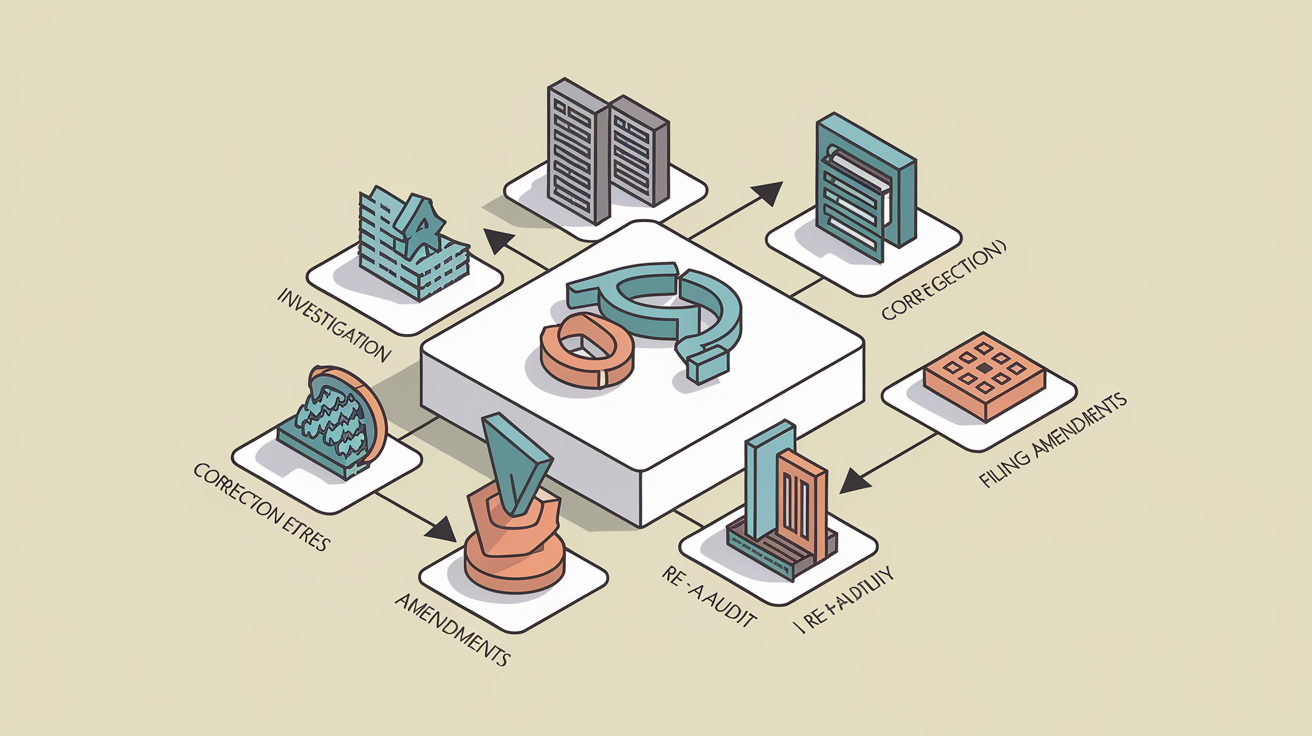
Restatements require retrospective adjustments, meaning the company revises actual reported numbers for prior periods instead of just recording a cumulative catch-up in the current quarter. If FY18 revenue was overstated and the error surfaces during FY19 reporting, the company must go back and restate FY18’s income statement, balance sheet, cash-flow statement, and all related footnotes to reflect corrected amounts. This retrospective approach makes sure trend analysis and year-over-year comparisons use an apples-to-apples basis. A reclassification, by contrast, moves line items within a statement without changing totals (shifting an expense from COGS to SG&A) and typically needs less extensive re-auditing, though it still demands amended filings if material.
Scenarios requiring prior-period restatements include discovering multiple quarters of revenue were recognized too early, finding a liability was left off several balance-sheet dates, or identifying a business combination was accounted for wrong at acquisition and every period since. Systems that track financial data often log both the original filed values and the corrected restated values, creating an audit trail that shows exactly what changed and when. This dual record matters for auditors verifying the restatement and for analysts who need to understand the magnitude and direction of the revision when rebuilding models.
The step-by-step correction process usually follows this sequence:
- Identification and scoping – management or auditors spot the error, estimate its size, and figure out which periods and statements are affected.
- Investigation and root-cause analysis – forensic or internal teams document how the error happened, who was involved, and whether controls failed or got overridden.
- Quantification and journal entry prep – accountants calculate correcting entries for each affected period, updating all line items and recalculating dependent figures like tax provisions and EPS.
- Re-audit or review – external auditors re-perform procedures on restated periods, issue new opinions, and update reports to reference the restatement.
- Filing amendments and disclosure – the company files amended 10-Ks or 10-Qs, issues an 8-K announcing the restatement and non-reliance on prior reports, and updates investor presentations and earnings materials to reflect corrected metrics.
Real-World Examples and Historical Patterns in Earnings Restatements

In one documented case, a company’s fiscal-year 2018 sales figure was originally reported in its FY18 annual filing but later got corrected when the FY19 income statement was prepared. The firm’s data-extraction tech caught the discrepancy between the two filings (the FY18 value had changed) and automatically logged both the original and restated figures in an audit panel, letting analysts see exactly how much revenue got revised and assess the materiality of the shift. That kind of automated detection shows how restatements often surface not through management disclosure but through systematic version-control and data checks.
SPAC restatements dominated 2021, accounting for more than 80 percent of all restatements that year. The main issues were technical: improper accounting for warrant liabilities and redeemable common stock under ASC 815 and ASC 480. Because these errors were widespread and driven by evolving guidance rather than fraud, 2021’s restatement stats are considered an outlier when looking at long-term trends. Excluding that spike, historical patterns show CFO turnover in a year with a restatement peaked at 30 percent in 2023 (the highest rate in two decades) and CEO turnover in restatement years hit 24 percent in 2020. Industry-specific issues also pop up. Energy and mining companies often restate asset impairments and reserve estimates, while tech and biotech firms frequently correct revenue recognition tied to multi-element arrangements or licensing deals. Restatement patterns among small caps show higher rates of control weaknesses and less-frequent auditor oversight, amplifying the risk that errors stick around for multiple reporting cycles before discovery.
| Example | Cause Category | Notable Impact |
|---|---|---|
| FY18 sales restated in FY19 filing | Revenue recognition error or reclassification | Automated extraction flagged discrepancy; historical credit metrics revised downward |
| 2021 SPAC warrant liability corrections | Technical misapplication of ASC 815 | Over 80% of 2021 restatements; minimal fraud implication but broad market impact |
| Energy company reserve impairment reversal | Asset valuation and impairment timing | Overstated assets for multiple quarters; restatement triggered going-concern opinion |
| Biotech milestone revenue correction | Premature revenue recognition on contingent milestones | Revenue and earnings per share reduced across three prior quarters; stock price fell 18% on announcement |
Post-Restatement Consequences: Legal, Strategic, Compensation, and Governance Impacts

Restatements often trigger securities class-action lawsuits, as plaintiffs’ attorneys argue investors got misled by materially wrong financials and that management or auditors were negligent or complicit. Legal consequences for execs can include SEC enforcement actions, settlements requiring financial penalties and admissions of wrongdoing, and in fraud cases, criminal referrals. Executive comp clawbacks have become more common under Dodd-Frank and revised NYSE/NASDAQ listing rules, which require boards to recover incentive-based pay if a restatement results from material noncompliance with financial reporting requirements, even without proof of executive misconduct.
Investor lawsuits typically allege violations of Section 10(b) of the Securities Exchange Act and Rule 10b-5, claiming management made material misrepresentations or omissions. Litigation can stretch on for years, distracting management, burning through legal budgets, and pressuring the company to settle to avoid prolonged uncertainty. Governance improvements after restatement are both voluntary and mandatory. Boards often replace the CFO (30 percent turnover rate in 2023 restatement cases), strengthen the audit committee by adding financial experts, roll out new controls or enterprise resource planning systems, and bump up internal-audit staffing. Post-restatement fix-it plans get disclosed in amended filings and may include hiring a Big Four firm to design better controls, running entity-level risk assessments, and setting up whistleblower hotlines with direct board reporting.
Common consequences companies face after corrections:
- Executive turnover and leadership restructuring – CFO and CEO changes at elevated rates, sometimes forced resignations or terminations for cause
- Credit downgrades and covenant breaches – lenders may declare technical defaults if restated financials violate debt covenants; credit rating agencies often downgrade on governance concerns
- Increased audit and legal costs – re-audits, forensic investigations, and securities litigation collectively add millions in professional fees and settlement expenses
Final Words
Companies correct the books when mistakes, changing rules, weak controls, or investigations reveal material errors. This post laid out why restatements happen, common error types, the SEC and audit role, investor reactions, and the correction process.
A restatement isn’t always fraud — sometimes it’s an honest fix — but it still affects trust, governance, and future filings.
If you want clarity on earnings restatement why companies restate results, focus on controls, disclosure, and the next filings. There’s a clear path to remediation.
FAQ
Q: Why do companies restate financials? What does it mean to restate earnings? What is the purpose of restating financial statements?
A: Restating financials means revising previously issued earnings to correct material inaccuracies; companies do this to fix errors, accounting misinterpretations, reclassifications, or fraud, and to comply with regulators and give investors accurate information.
Q: What is the 5% materiality rule?
A: The 5% materiality rule is a shorthand threshold where misstatements over roughly 5 percent of a financial-statement base (revenue, net income, assets) are likely material; actual materiality is judgment-based and context-dependent.