


What if one sudden CEO resignation can erase weeks of gains in a single trading session?
Stocks typically fall 2% to 15% the first day after an unexpected exit.
Algorithms and fast money amplify the headline.
This article explains why investors sell first and ask questions later, how price moves usually unfold over the first 72 hours, and which signs (interim CEO named, strong earnings, clear succession) cut the losses.
If you trade or own the stock, this is the short guide on what to watch next.
Immediate Market Response Patterns

When a CEO suddenly resigns, you’re usually looking at an immediate 2% to 15% stock drop within the first trading session. If the news breaks after the closing bell, pre-market selling can start within minutes. Automated trading systems and professional investors don’t wait around, they react to the headline risk fast. How steep the drop gets depends on whether the company’s whole identity and strategy were wrapped up in that one executive.
Pre-market is messier than regular trading hours because there’s less liquidity and bid-ask spreads blow out. Let’s say a CEO resignation hits at 6:00 a.m. Eastern. Shares might crater 8% in pre-market, then claw back to a 5% loss by the closing bell once bargain hunters show up and institutions figure out if the fundamentals are actually broken. During trading hours, though, announcements tend to produce sharp intraday swings as algorithms tear apart the press release looking for red flags like “effective immediately” or “personal reasons.” Both scream unplanned exit.
Fear kicks volatility into overdrive in the first 72 hours. Investors worry about strategic drift, hidden problems, and messy succession plans, and all that anxiety gets jammed into a narrow window. Companies that don’t name an interim CEO or offer vague succession language? They tend to get hit harder than those announcing a board-approved replacement at the same time.
You’ll see a few common patterns play out short term:
- Opening gap down, then an intraday recovery if no real fundamental damage shows up
- Multi-session decline when the resignation lines up with weak earnings or regulatory trouble
- Muted reaction (under 3%) if the CEO was already seen as dead weight or controversial
- Sharp bounce within 48 hours if a respected internal successor gets promoted right away
Factors That Shape Stock Reactions

How much the stock moves after a sudden CEO exit depends on whether the company’s value story is tied to one person. Founder-CEOs and visionary types (think Steve Jobs at Apple or Elon Musk at Tesla) carry a huge “leadership premium” baked into the stock price. When they leave out of nowhere, markets assume the vision, innovation pipeline, and investor confidence will all take a hit, even if the business itself is solid. Companies with diversified management teams and clear succession plans see smaller drops because investors believe the show can go on.
Company stability when the departure happens matters just as much as the CEO’s profile. A resignation during a quarter of record revenue and expanding margins? Less alarming. An exit in the middle of a guidance cut or missed earnings? That’s trouble. When Harry Sommer resigned as CEO effective immediately in late 2025, the stock fell 7.6% to $21.49 despite the company posting its highest quarterly revenue ever and 36.7% adjusted operating EBITDA margins just weeks before. Strong fundamentals got overridden by leadership uncertainty, and risk-averse investors dumped shares anyway.
Sector sensitivity and whether there’s an interim appointment also shape reactions. Tech and biotech stocks are more vulnerable to abrupt CEO exits because innovation roadmaps and R&D leadership are harder to hand off. Financial services and industrials, with their process-driven operations, tend to see smaller moves. Immediate appointment of an interim CEO, especially a board member with operating chops, can cut the initial decline in half by signaling continuity and killing the “leadership vacuum” narrative that fuels panic selling.
Case Studies of Abrupt CEO Resignations

In June 2018, Intel announced that CEO Brian Krzanich had resigned effective immediately due to a policy violation. Shares fell 6% intraday as investors wrestled with the unplanned exit and worried about strategic continuity during a critical stretch of competition with AMD. Intel named an interim CEO the same day, which kept the decline to single digits, but the stock stayed range-bound for weeks until the board announced a permanent successor and reaffirmed long-term chip roadmap commitments.
When Jack Dorsey stepped down as CEO of Twitter in November 2021, the market barely flinched. Shares dipped less than 3% intraday, reflecting investor relief that Dorsey’s split focus between Twitter and Square (now Block) was finally over. The company had already named a CTO-turned-CEO with deep product knowledge, and the departure got framed as a planned succession even though the timing caught some analysts off guard. It’s a case study in how negative CEO sentiment can actually lead to neutral or even positive stock reactions when the market views the exit as removing an obstacle instead of losing a visionary.
Compare that to when the CEO of a major rideshare company resigned in 2017 amid a series of scandals involving workplace culture and regulatory battles. Shares in the private market (pre-IPO) declined by an estimated 12% to 15% within days. The departure was sudden, there was no clear succession plan, and investor confidence in governance collapsed. That double-digit loss stuck around for months, showing how scandal-driven exits amplify negative reactions and stretch out recovery timelines compared to performance-based or strategic transitions.
Planned vs. Unplanned CEO Departures

Planned CEO transitions with multi-month handoffs and named successors barely move the stock. When a company announces in January that the CEO will retire in June and the CFO will step up, markets have time to size up the new leader’s track record, hear their strategy on earnings calls, and watch a smooth handoff unfold. These planned successions often move stocks less than 2% on announcement day, and any dip usually reverses within a week once continuity becomes obvious.
Unplanned exits, especially those with “effective immediately” language, create sharp declines because investors are staring at an information vacuum. Without clarity on why the CEO left, who’s leading next, or whether there are deeper problems lurking, risk premiums spike. No transition period means the market can’t evaluate the successor’s capabilities or confirm that strategic priorities are staying the same, so the default move is sell first, ask questions later.
| Event Type | Typical Market Reaction | Volatility Level |
|---|---|---|
| Planned succession (3–6 month transition) | -1% to +1% on announcement; recovery within days | Low |
| Sudden resignation (effective immediately) | -5% to -15% within 24 hours; extended weakness possible | High |
| Scandal-driven abrupt exit | -10% to -20%; prolonged underperformance | Very High |
Typical Stock Movement Timeline
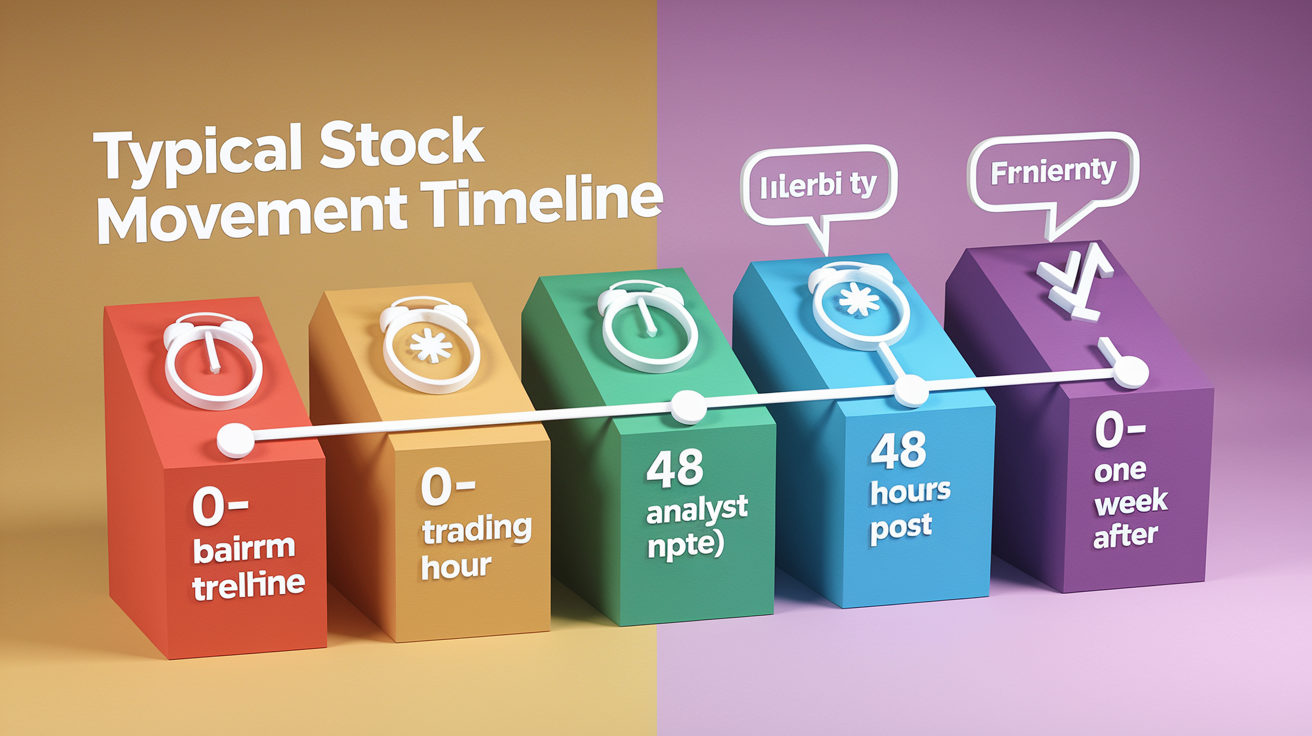
Stock reactions to sudden CEO resignations follow a predictable sequence, though the magnitude varies by company and context:
-
First 15 minutes after announcement: Algorithmic selling triggers an immediate gap down, often 3% to 8% in pre-market or within seconds of a press release during trading hours.
-
First trading hour: Volatility peaks as institutional investors read the full press release, check for accompanying disclosures (earnings warnings, regulatory filings, board statements), and assess the news.
-
End of day one: Initial panic selling runs out of steam. Shares often recover 20% to 40% of the intraday loss if no additional negative news surfaces and an interim CEO gets named.
-
48 hours post-announcement: Analyst notes and media coverage shape the narrative. Downgrades and price target cuts (like JPMorgan’s move to Neutral with a $20 target or Barclays’ cut to $23) can extend the decline or validate the sell-off, keeping the stock under pressure.
-
One week after: Stock enters a “wait and see” phase. If fundamentals (revenue, margins, guidance) stay intact, bargain hunters start accumulating shares and the stock stabilizes or rebounds modestly. If there’s still no clarity on succession or strategy, the stock can become dead money for weeks.
Most of the negative reaction happens within the first 24 hours because uncertainty is at its peak and liquidity providers widen spreads to protect against unknown risks. Partial recovery in days two through five happens when investors start distinguishing between leadership risk and business risk. If the company recently reported strong earnings (highest quarterly revenue, 220 basis points of margin expansion, over $100 million in cost savings), the fundamentals provide a floor that limits further downside.
Extended declines beyond one week usually signal that the resignation is a symptom of deeper issues. When selling pressure lasts past the initial shock, it often means investors suspect undisclosed problems (fraud, regulatory action, strategic failure) or believe the business was overly dependent on the departed CEO’s relationships and vision.
Long‑Term Market Effects of Sudden Leadership Changes

Long-term stock performance after a sudden CEO resignation depends on whether the company’s value proposition rests on one individual or on durable business fundamentals. Companies with strong balance sheets, diversified revenue streams, and deep management benches often recover within three to six months. When a stock falls 7.6% to around $21 on an abrupt CEO exit but the company just posted 36.7% adjusted EBITDA margins and eliminated all secured notes from its capital structure, valuation models may show significant upside (in one recent case, a target near $36 implies roughly 65% upside from the post-shock price).
Firms whose brands and strategies are inseparable from the departing CEO face structural challenges that can last years. Founder-led companies without clear number-twos often see extended underperformance as new leadership struggles to articulate a differentiated vision or maintain the culture and innovation pace that justified premium valuations. Investors reevaluate growth assumptions, apply higher discount rates, and wait for proof that the business can thrive under new management before re-rating the stock upward.
Recovery timeline also gets shaped by how quickly the board names a permanent CEO and how effectively that leader communicates strategy. When John Chidsey (former CEO of Subway and Burger King) was named to replace a suddenly departed CEO in late 2025, the market adopted a “show me” stance, waiting for his first earnings call and strategic plan before reversing the initial sell-off. Until that clarity arrives, stocks can trade sideways for quarters, with analysts calling them dead money and maintaining neutral ratings despite strong underlying fundamentals.
Final Words
In the action, we walked through the typical market moves after an unexpected CEO exit: the first‑day drops, who’s most exposed, timeline stages, and real case studies.
Key drivers were reputation, company health, and whether a clear interim leader appears. Watch the first 48 hours for volatility and the one‑week mark for signs of stabilization.
The sudden CEO resignation stock reaction often shows an initial selloff but can calm if fundamentals hold. Stay focused on cash flow, guidance, and succession signals—there’s usually a clearer picture soon.
FAQ
Q: What happens to stock when CEO resigns?
A: When a CEO resigns, the stock typically falls 2–15% in the first trading session, with bigger pre-market moves if announced off-hours; the size depends on succession clarity, the CEO’s role, and company health.
Q: Who owns 90% of the stock market today? Who owns 93% of the stock market?
A: No single group owns 90–93% of the market; ownership is concentrated among institutional investors—mutual funds, pension funds, and ETFs—while high-net-worth households hold a disproportionate, but not total, share.
Q: Should a 70 year old get out of the stock market?
A: A 70-year-old shouldn’t automatically exit stocks; keep some equity for inflation protection, shift toward income and capital preservation, and set allocation by retirement income needs, risk tolerance, and time horizon.