


What if one document could trigger a 10% stock swing overnight?
That document exists: the earnings report.
It’s the company’s quarterly report card: revenue, profit, EPS, guidance.
Knowing where to pull the filing and which numbers to trust turns noise into an edge.
In this guide we’ll map the fastest places to access filings and earnings schedules, explain the key metrics that move stocks, and show what to watch next so you can trade or invest with smarter timing.
What Earnings Reports Are and Why They Matter for Investors

An earnings report is a required financial disclosure that public companies release every quarter (or year). Think of it as a report card showing revenue, net income, and earnings per share over a specific period. Every publicly traded U.S. company has to file these with the SEC. It’s not optional.
For investors, these reports are the main way to figure out if a company’s growing, stuck, or losing ground. The numbers inside can move a stock fast. Sometimes really fast. A single quarterly report can push a stock up 10% at the open or drop it 15% after hours, depending on whether the company beat or missed what analysts expected. Markets watch revenue trends, profit margins, updated guidance, and what management says during earnings calls.
But it’s not just about the headline numbers. Earnings reports also show how efficiently a company runs, where it’s putting money, and what obstacles it sees ahead. Analysts use these filings to adjust their price targets. Institutional investors rebalance portfolios based on the updated fundamentals. Retail traders look for beat or miss scenarios to time their entries and exits around volatility spikes.
The core purposes of earnings reports include:
- Meeting regulatory requirements with transparent financial disclosure
- Updating investors on revenue growth, profitability, and cash generation
- Providing forward guidance that shapes what the market expects next quarter
- Allowing performance comparisons against prior periods and competitor companies
How Earnings Reports Work
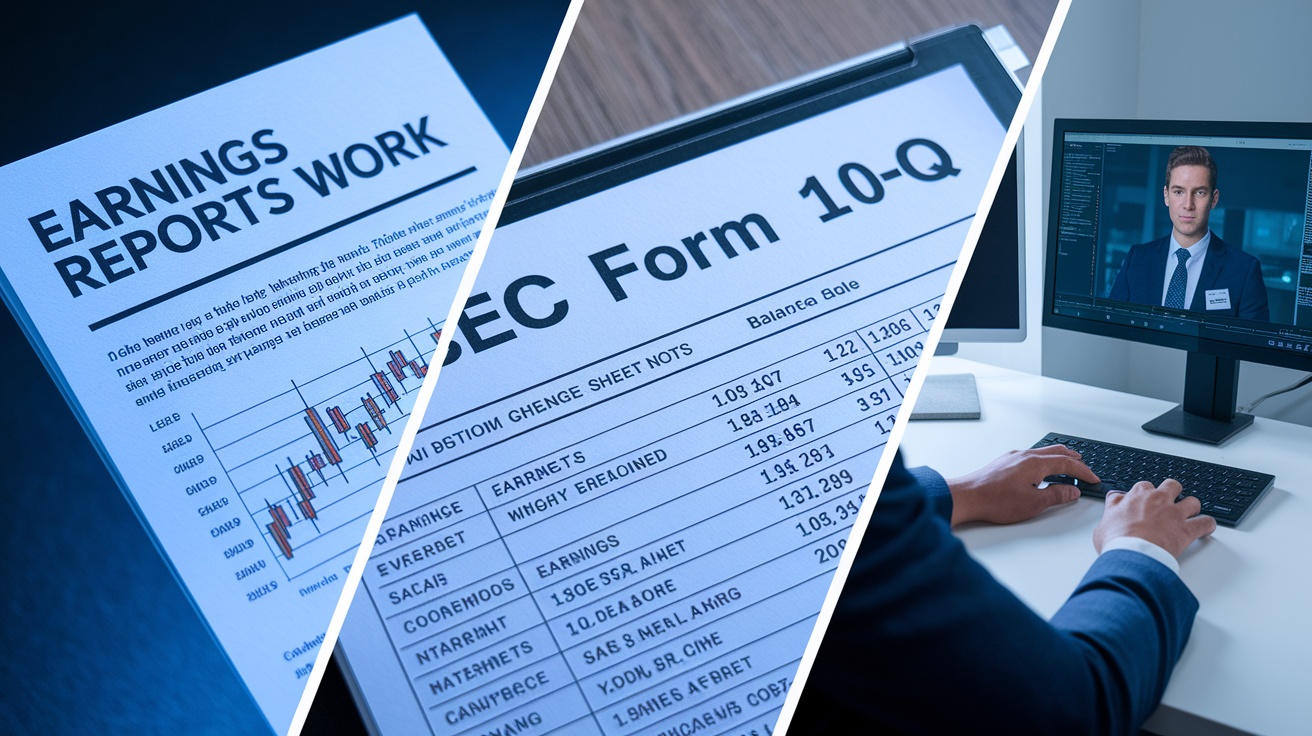
Companies follow a structured, time-sensitive process to prepare and release quarterly earnings. Internally, accounting teams close the books at the end of each fiscal quarter, reconcile revenue and expenses, and build financial statements that comply with GAAP. Once the numbers are finalized and auditors review them, the executive team and investor relations department prepare a press release summarizing key results and schedule an earnings call to discuss performance and outlook.
The public release usually happens in three steps. First, the company issues a press release before the market opens or after it closes, highlighting revenue, net income, and EPS with management commentary. Shortly after, the company files the official Form 10-Q (quarterly) or Form 10-K (annual) with the SEC, which includes detailed footnotes, balance sheets, cash flow statements, and risk disclosures. Then executives host a live conference call or webcast where they present prepared remarks and answer questions from analysts and institutional investors.
After the release, analysts update their models and tweak earnings estimates for future quarters. If results come in above consensus and management raises guidance, analysts often bump their price targets. If the company misses or lowers guidance, downgrades and target cuts can follow within hours. This cycle repeats every quarter, creating four distinct earnings seasons each year that concentrate market attention and trading volume around specific windows.
The typical release timeline follows these steps:
- Quarter ends and books close (usually within two weeks after period end).
- Press release and SEC filing published (between two and eight weeks after quarter close).
- Earnings call held within hours of the press release, followed by transcript availability.
Key Metrics Inside an Earnings Report

Investors and analysts focus on a consistent set of metrics each quarter to assess financial health and trajectory. Every industry has unique operating metrics, but the core financial data points stay standard across all public companies.
-
Revenue (Top Line): Total sales recognized during the period, often reported with year over year (YoY) and quarter over quarter (QoQ) growth rates. For example, $500 million in revenue growing 8% YoY signals expansion. Revenue is the starting point for all profitability calculations.
-
Earnings Per Share (EPS): Net income divided by the weighted average number of common shares outstanding. The formula is (Net income − preferred dividends) / weighted average shares. If a company earns $100 million and has 50 million shares, EPS is $2.00. Analysts compare reported EPS to consensus estimates. Even a one cent beat or miss can move the stock.
-
Net Income (Bottom Line): Total profit after all expenses, interest, taxes, and one time items. Positive net income means the company made money. Negative means a loss. Companies also report GAAP versus non-GAAP (adjusted) net income, with non-GAAP excluding stock based compensation and restructuring charges.
-
Operating Margin and EBITDA: Operating margin shows profitability from core business operations before interest and taxes. EBITDA (earnings before interest, taxes, depreciation, and amortization) strips out non-cash expenses to highlight cash generating ability. Higher margins indicate efficiency.
-
Forward Guidance: Management’s outlook for the next quarter and full fiscal year, typically given as ranges for revenue and EPS. Raising guidance often matters more than beating the past quarter. Lowering guidance can sink a stock even after a beat.
-
Free Cash Flow (FCF): Cash generated from operations minus capital expenditures. Positive FCF means the company can fund growth, pay dividends, or buy back shares without borrowing. The formula is operating cash flow − capex.
These metrics combine to tell a story about growth, profitability, and sustainability. A company posting strong revenue growth but negative cash flow could be investing heavily for the future or struggling with collections. A firm beating EPS estimates thanks to share buybacks rather than profit growth is using financial engineering. Investors cross check all six metrics to separate real operational strength from accounting adjustments.
How to Read and Analyze an Earnings Report

Reading an earnings report starts with comparing the headline numbers to market expectations. Pull the consensus estimates for revenue and EPS from financial data platforms or analyst notes, then check whether the company beat, met, or missed. A beat by itself isn’t enough. Look at the magnitude of the surprise and whether both top line and bottom line results exceeded forecasts. If revenue missed but EPS beat due to cost cuts or buybacks, the market might not react positively.
Next, examine the trend across multiple quarters. Is revenue growth accelerating or slowing down? Are profit margins expanding or compressing? Compare the current quarter to the same quarter last year (YoY) to account for seasonality, and review sequential trends (QoQ) to spot momentum shifts. Pay close attention to guidance changes and management commentary in the press release and on the earnings call. Executives often signal upcoming challenges or opportunities before they show up in the numbers.
Steps for Evaluating an Earnings Report
- Compare reported revenue and EPS to consensus estimates. Calculate the percent surprise using (Reported − Expected) / Expected × 100.
- Review guidance for the current quarter and full year. Note any revisions up or down versus prior guidance and analyst expectations.
- Check key profitability metrics: gross margin, operating income, net income, EBITDA, and free cash flow.
- Identify non-recurring items such as restructuring charges, asset sales, or tax adjustments that distort GAAP earnings.
- Read the MD&A (Management’s Discussion and Analysis) section of the 10-Q or 10-K for qualitative insights on market conditions, competitive pressures, and strategic initiatives.
Common pitfalls include overreacting to headline beats without confirming guidance and cash flow, mistaking EPS growth driven by share buybacks for true profit expansion, and ignoring one time items that inflate or deflate reported earnings. Always cross check the press release against the full SEC filing and listen to the Q&A portion of the earnings call for unscripted management comments that can reveal risks not mentioned in prepared remarks.
Where to Access Earnings Filings and Results

The official source for all public company filings is the SEC’s EDGAR database, accessible at sec.gov. Search by company name or ticker symbol, then filter by filing type to view 10-Q (quarterly), 10-K (annual), and 8-K (material event) documents. Each filing is timestamped and archived permanently, so investors can review historical reports and compare trends across years. The EDGAR interface is free and updated in real time as companies submit filings.
Company investor relations pages provide a more user friendly experience, offering press releases, slide decks, earnings call transcripts, webcast replays, and downloadable PDFs of financial statements. Most large companies maintain an “Investor Relations” or “IR” section on their corporate website with a dedicated earnings center. Financial news platforms and data providers aggregate earnings calendars, consensus estimates, and real time alerts for beats and misses, making it easier to monitor multiple companies at once.
Reliable sources for earnings data include:
- SEC EDGAR for official 10-Q, 10-K, and 8-K filings with full footnotes and auditor reports
- Company investor relations websites for press releases, management presentations, and call transcripts
- Financial data platforms and news aggregators that compile calendars, estimates, and real time alerts
Earnings Calendars and Reporting Schedules

Earnings season occurs four times per year, typically concentrated in the weeks right after the end of each fiscal quarter. Most companies operate on a calendar fiscal year, so quarters end in March, June, September, and December. Reporting begins two to three weeks after each quarter closes and peaks in the following four to six weeks, creating predictable windows of elevated market volatility and volume.
Large accelerated filers must submit their 10-Q within 40 days of quarter end and their 10-K within 60 days of fiscal year end. Accelerated filers have 40 days for the 10-Q and 75 days for the 10-K, while non-accelerated filers get 45 days for quarterly reports and 90 days for annual filings. Companies usually release their press release and hold their earnings call before or on the same day the 10-Q or 10-K is filed, so investors often see headline results days or weeks before the full filing appears on EDGAR.
| Quarter | Coverage Period | Typical Release Window |
|---|---|---|
| Q1 | January – March | Mid-April to early May |
| Q2 | April – June | Mid-July to early August |
| Q3 | July – September | Mid-October to early November |
| Q4 | October – December | Late January to mid-February |
Recent Examples of Major Earnings Reports

Apple’s fiscal Q1 2024 results (covering the holiday quarter ending December 2023) showed revenue of $119.6 billion, up 2% YoY, driven by iPhone sales and strong services growth. The company beat analyst estimates for both revenue and EPS, and management highlighted record installed base and margin expansion in services. Shares gapped higher at the open and held gains for several sessions as investors rewarded the beat and positive commentary.
Amazon reported Q4 2023 earnings with revenue of $170 billion, up 14% YoY, powered by AWS cloud growth and advertising revenue. Operating income more than doubled to $13.2 billion, well above consensus, thanks to cost discipline and improved retail margins. CEO Andy Jassy discussed AI infrastructure investments on the call, signaling continued capital spending. The stock jumped 8% in after hours trading and analysts raised price targets across the board.
Tesla’s Q3 2023 results included automotive revenue of $19.6 billion and operating margin compression to 7.6% due to price cuts. EPS of $0.66 missed the $0.73 consensus, and the company lowered its full year delivery guidance, citing production ramp challenges. Despite revenue growth, the margin pressure and guidance cut sent shares down 9% the following day, showing how forward guidance can outweigh a revenue beat.
Final Words
You’ve got the essentials: what earnings reports show, how companies publish them, the key metrics to watch, a simple analysis framework, where to find filings, and the seasonal calendar.
Use that framework to spot trends, compare results to expectations, and avoid common traps like fixating on one quarter’s number.
Earnings reports are a repeatable tool for clearer decisions. Small wins add up — soon you’ll scan a report in minutes and know what’s already priced in.
FAQ
Q: What time do earnings reports usually come out?
A: Earnings reports usually come out either before the market opens or after the market closes — typically early morning (about 4–8 AM ET) or late afternoon/evening (about 4–7 PM ET). Check the company’s investor calendar.
Q: Did Microsoft beat earnings?
A: Whether Microsoft beat earnings depends on the quarter; check Microsoft’s earnings release and compare reported EPS and revenue to analyst consensus on the company’s investor site or major financial news platforms.
Q: What stocks had good earnings today?
A: Stocks that had good earnings today are those that beat revenue and EPS estimates and often raised guidance; view an earnings calendar, market headlines, or your broker’s earnings screener for a current list.
Q: What is in an earnings report?
A: An earnings report summarizes revenue, net income, earnings per share (EPS), operating margin, cash flow and balance sheet highlights, plus management commentary and forward‑looking guidance investors use to judge performance.