


Think a crash is around the corner? Not exactly.
Fed recession models and major banks say an immediate crash is unlikely, but several red flags mean downside risk is higher than usual.
Valuations are stretched, five stocks now make up over 30 percent of the S&P, and earnings revisions have turned negative.
This piece cuts through the noise.
We explain what moved markets, why investors should care, and the handful of indicators, like the yield curve, credit spreads, unemployment, and earnings breadth, that could push prices from a wobble to a sharp drop.
Current Market Conditions and Crash Risk Overview

Federal Reserve recession models and big bank forecasts as of early 2025 suggest an imminent crash isn’t likely, though risk sits higher than usual. The S&P 500 trades within 5 percent of record highs, up about 8 percent year to date. The Nasdaq’s climbed roughly 12 percent, the Dow’s added 4 percent. The VIX sits around 14, well under the 20 threshold that marks stress and nowhere near the 30-plus readings you see when fear takes over. Goldman Sachs, JPMorgan, and Morgan Stanley put recession odds somewhere between 20 and 35 percent over the next twelve months. Cautious optimism, not panic.
Market breadth is more complicated. Headlines look strong, but concentration risk has gotten worse. The five biggest stocks now make up over 30 percent of S&P 500 market cap. Fewer than half of individual stocks trade above their 200-day moving average. Credit spreads in both investment-grade and high-yield bonds remain narrow, meaning bond markets aren’t pricing in systemic trouble yet. But a sharp widening would change that fast. Corporate earnings revisions turned slightly negative recently, with analysts cutting forward estimates by an average of 2 percent across the index.
Interest-rate markets are sending mixed signals. The 2-year Treasury yields 3.85 percent, the 10-year sits at 4.21 percent. That keeps the slope modestly positive, avoiding the classic inversion that’s preceded most recessions. Unemployment ticked up to 4.1 percent in the latest monthly report. Still historically low, but higher than the cycle low of 3.4 percent recorded eighteen months ago. Inflation data show core PCE at 2.6 percent year-over-year, above the Fed’s 2 percent target but below the 5-plus percent peaks from 2022.
Real-time crash indicators worth watching:
- Yield curve status – The 2-year/10-year spread stays positive at +0.36 percentage points. Historical inversions typically lead recessions by 12 to 24 months.
- Credit spreads – Investment-grade spreads at 95 basis points, high-yield spreads at 310 basis points. Both below long-term medians, signaling low default risk priced in.
- Unemployment acceleration – A rise of more than 0.5 percentage points over three months would trigger the Sahm Rule recession indicator. Current pace shows +0.3 percentage points over six months.
- Inflation persistence – Core PCE above 3 percent for consecutive quarters would probably force renewed Fed tightening and weigh on equity multiples.
- Earnings revision breadth – Fewer than 40 percent of S&P 500 companies getting upward estimate revisions. A drop below 30 percent has historically preceded sharp pullbacks.
Economic Indicators Signaling Market Stress

GDP growth in the second quarter came in at 3.3 percent annualized, driven mostly by tech-sector capital spending and consumer outlays. About 1.3 percentage points of that expansion came from AI-related infrastructure investment. That’s nearly 40 percent. It raises questions about sustainability if returns on those investments disappoint. Consumer spending, which accounts for roughly 70 percent of U.S. GDP, grew 2.8 percent year-over-year in real terms. That’s been supported by excess pandemic savings that have now mostly been drawn down. Credit-card delinquency rates crept up to 3.1 percent in the most recent quarter, the highest reading since 2019. Auto-loan delinquencies reached 2.8 percent, suggesting stress among lower-income households.
Interest-rate policy remains the lever everyone’s watching. The Fed cut rates by a cumulative 100 basis points in autumn 2024, yet long-term yields have since risen because of persistent fiscal deficits and investor demand for higher term premiums. The current federal-funds target sits at 4.25 to 4.50 percent, well above the neutral rate most economists peg around 2.5 to 3 percent. Yield-curve inversions have preceded every recession since 1970, with an average lead time of 18 months. The curve briefly inverted for 16 months between mid-2022 and late 2023 but has since normalized. If it re-inverts and persists for more than three months, historical patterns point to heightened recession risk within the following year.
Labor-market data offer the clearest early-warning system. July payrolls added only 73,000 jobs versus a consensus estimate of 115,000. May and June figures were revised downward by a combined 258,000 positions. Two years ago, monthly job creation routinely topped 250,000. The current three-month average has slipped to about 100,000. A sustained drop below this threshold, paired with rising initial jobless claims above 250,000 per week, would signal labor-market deterioration consistent with past recession entries.
Market Valuations and Whether They Signal Overheating

The S&P 500 forward price to earnings ratio stands at 22.5, the highest reading since the dot-com peak in 1999–2000, with the exception of a brief spike in August 2020. Compare that to a 25-year median of roughly 16.5. Current multiples sit in the 95th percentile of historical observations. The Shiller cyclically adjusted price to earnings ratio sits near 33, well above its long-run average of 17. It’s been exceeded only during the late-1990s tech bubble and the period right after the 2020 pandemic lows. Elevated valuations don’t predict the timing of corrections. Markets can stay expensive for years. But they do compress forward return expectations and amplify downside risk when catalysts show up.
Price to sales ratios across the S&P 500 have climbed to 2.8, compared to a historical norm closer to 1.8. That reflects both multiple expansion and revenue growth concentrated in tech and communication-services sectors. Microsoft, Nvidia, Apple, Amazon, and Alphabet together represent more than 30 percent of the index’s total market cap. That’s the highest concentration since the late 1960s when a handful of “Nifty Fifty” conglomerates dominated. When leadership narrows this sharply, broad market performance becomes vulnerable to single-stock or single-sector shocks.
The table below shows key valuation metrics against their long-term averages, illustrating how stretched current readings look relative to history:
| Metric | Current Reading | Historical Average |
|---|---|---|
| S&P 500 Forward P/E | 22.5 | 16.5 |
| Shiller CAPE Ratio | 33.0 | 17.0 |
| Price-to-Sales Ratio | 2.8 | 1.8 |
| Top-5 Concentration (%) | 31% | 18% |
Historical Patterns and How Past Crashes Compare
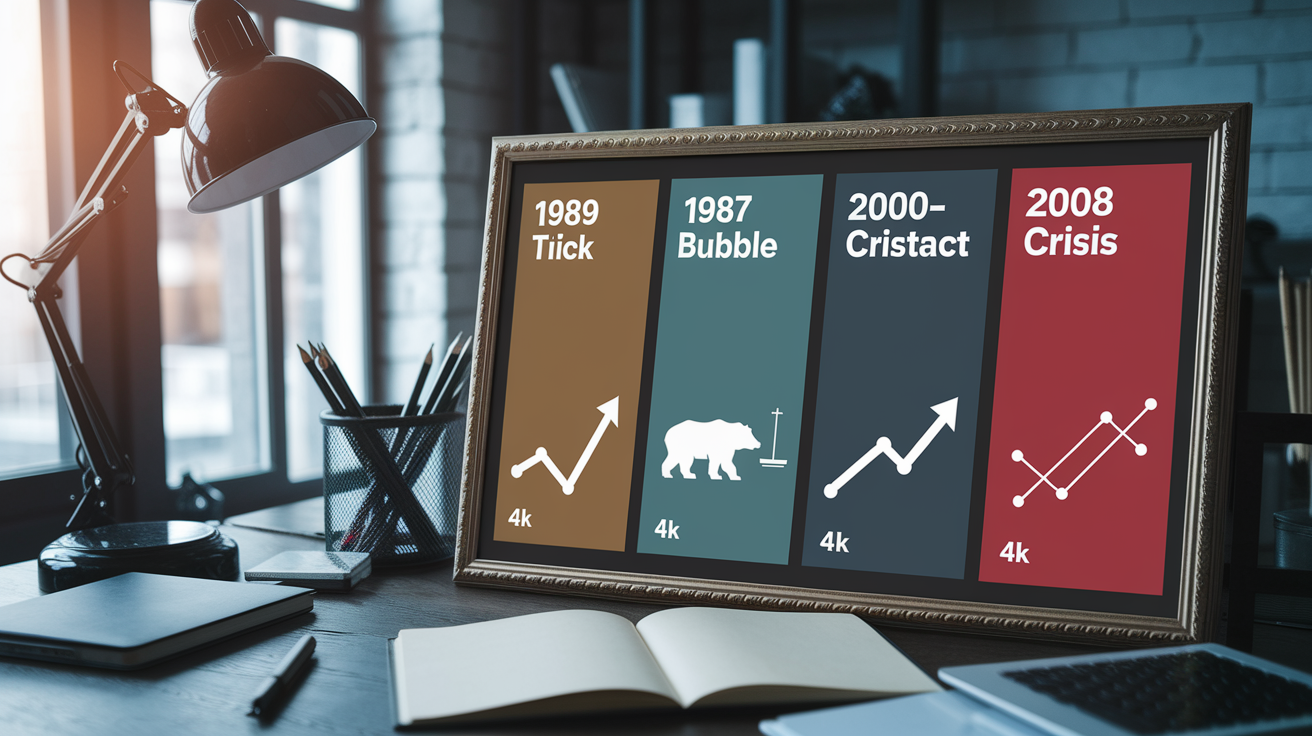
The 1929 crash began after the Dow Jones Industrial Average had more than tripled between 1924 and September 1929, reaching a forward P/E above 20 and a dividend yield below 3 percent. Both extreme by the standards of that era. Margin debt had ballooned to nearly 12 percent of GDP, and credit conditions were loose despite rising industrial inventories. When the Federal Reserve tightened to curb speculation, the market fell 89 percent peak to trough over nearly three years. Today’s leverage sits lower relative to GDP. Margin debt hovers around 2 percent of market cap, and Fed policy remains accommodative by comparison, reducing the parallel to 1929.
The October 1987 crash unfolded without a recession. Program trading and portfolio insurance strategies amplified a one-day 22 percent drop in the S&P 500, yet the economy kept expanding and the market recovered within two years. Valuations in 1987 were elevated but not extreme. Forward P/E ratios near 18, corporate earnings growth remained solid. The crash illustrated that technical factors and liquidity shocks can drive sharp declines even when fundamentals don’t justify sustained bear markets.
The dot-com bubble burst between March 2000 and October 2002, erasing roughly 49 percent of the Nasdaq Composite and 38 percent of the S&P 500. Forward P/E ratios for tech stocks exceeded 40, revenue growth projections proved wildly optimistic, and many companies carried no earnings at all. The 2000–2001 recession was mild by historical standards, but equity losses were severe and concentrated in overvalued growth sectors. Current AI-related valuations echo some dot-com dynamics. High expectations, unproven business models, and concentrated capital flows into a narrow theme.
The 2008 financial crisis resulted from systemic credit risk, subprime mortgage defaults, and the collapse of major financial institutions. The S&P 500 fell 57 percent from its October 2007 peak to its March 2009 trough. The recession lasted 18 months. Credit spreads widened to more than 600 basis points in high-yield bonds, interbank lending froze, and unemployment surged to 10 percent. Today’s credit environment shows far less stress. Bank capital ratios remain strong under post-crisis regulation, mortgage underwriting standards are tighter, and credit spreads sit well below crisis levels, making a 2008-style systemic event less likely barring a major unforeseen shock.
Expert Forecasts and Institutional Outlook

Goldman Sachs economists assign a 25 percent probability to a U.S. recession over the next twelve months, up from 15 percent six months ago but still below the 30 percent threshold they typically link with elevated risk. Their base case assumes that the Fed will cut rates by another 50 basis points by year-end, supporting a soft landing where GDP growth slows to around 2 percent without turning negative. JPMorgan’s outlook is slightly more cautious, placing recession odds at 35 percent. They’re highlighting the risk that persistent inflation forces the Fed to hold rates higher for longer, eventually tipping the economy into contraction.
Morgan Stanley analysts project that the S&P 500 will end 2025 near current levels, implying low single-digit returns and a higher probability of a 10 to 15 percent correction at some point during the year. They cite narrow market breadth, slowing earnings growth, and elevated valuations as headwinds, but don’t forecast a full-blown crash absent a significant catalyst such as a geopolitical shock or a sharp re-acceleration in inflation. Hedge-fund managers surveyed by Bank of America in the most recent Global Fund Manager Survey report the highest cash allocations since 2020, averaging 5.2 percent. That’s a defensive posture that reflects caution without outright pessimism.
Range of expert viewpoints on crash risk:
- Bullish case – Continued AI productivity gains drive earnings upside, inflation falls back to 2 percent, and the Fed cuts rates further, supporting multiple expansion and low double-digit equity returns.
- Cautious consensus – Markets trade sideways to modestly higher with periodic corrections. Recession probability remains below 40 percent, and any drawdowns stay in the 10 to 20 percent range.
- Bearish scenario – A policy mistake, geopolitical escalation, or AI investment disappointment triggers a 25 to 35 percent decline and a shallow recession.
- Contrarian view – Elevated valuations and concentration mask underlying fragility. A sudden shift in sentiment or liquidity could produce a sharp, violent correction even without a clear fundamental catalyst.
Geopolitical and Global Risk Factors
Ongoing conflicts in Eastern Europe and the Middle East continue creating supply-chain bottlenecks and energy-price volatility. Brent crude oil fluctuates between 75 and 85 dollars per barrel, well off the 2022 peaks above 120 dollars but still elevated enough to pressure consumer budgets and manufacturing costs. Natural-gas prices in Europe remain nearly double pre-2022 levels, forcing energy-intensive industries to curtail production and raising the risk of regional recessions that could spill over into global trade.
Trade tensions between the U.S. and China have reignited, with new tariffs on semiconductor equipment and restrictions on technology exports. The cumulative effect of tariffs introduced in 2025 is estimated to reduce U.S. consumer disposable income by about 0.4 percent, with the burden falling disproportionately on lower-income households. Import prices for electronics and consumer goods have risen 3 to 5 percent, feeding into headline inflation and complicating the Fed’s easing path. Export-dependent sectors such as agriculture and industrial machinery face retaliatory tariffs that compress profit margins and dampen capital-expenditure plans.
Currency volatility has increased as central banks diverge in policy stance. The U.S. dollar index sits near multi-year highs, strengthening against the euro, yen, and emerging-market currencies. A strong dollar benefits U.S. consumers by lowering import costs but hurts multinational corporations by reducing the value of overseas earnings when translated back into dollars. Roughly 40 percent of S&P 500 revenue comes from international markets, meaning sustained dollar strength acts as a headwind to reported earnings growth and can pressure stock valuations if foreign-exchange losses mount.
Investor Risk Management and Preparation Strategies

Diversification remains the foundational defense against market crashes. A balanced portfolio that includes domestic equities, international stocks, investment-grade bonds, commodities, and real assets such as real estate reduces the impact of any single-asset-class decline. Historical data show that during the 2008 crisis, a 60/40 stock-bond portfolio fell roughly 22 percent peak to trough, compared to a 57 percent drop in the S&P 500 alone. Rebalancing annually or when allocations drift more than 5 percentage points from targets forces disciplined selling of winners and buying of undervalued assets.
Five ways to protect portfolios during heightened crash risk:
-
Increase cash reserves to 10 to 20 percent of the portfolio – holding dry powder lets you buy opportunistically during sharp selloffs and reduces the need to liquidate stocks at depressed prices to meet cash needs. Money-market funds currently yield above 5 percent, providing a meaningful return on waiting capital.
-
Rotate into defensive sectors – consumer staples, utilities, and healthcare historically decline less than the broad market during recessions. These sectors offer stable earnings, higher dividend yields, and lower volatility, making them suitable core holdings when economic uncertainty rises.
-
Use trailing stop-loss orders – setting automatic sell orders 10 to 15 percent below current prices limits downside exposure without requiring constant monitoring. This mechanically enforces discipline and prevents emotional decision-making during volatile periods.
-
Ladder bond maturities to lock in current yields – building a bond ladder with maturities spread over two to ten years captures today’s higher interest rates, generates predictable cash flows, and reduces reinvestment risk if rates fall during a market downturn.
-
Consider put options or hedging strategies for concentrated positions – buying out-of-the-money put options on individual stocks or index ETFs provides downside protection at a known cost. Investors with large unrealized gains in a narrow set of holdings can hedge without triggering capital-gains taxes by purchasing puts rather than selling shares.
Maintaining a long-term perspective helps you avoid panic-driven mistakes. Market timing consistently underperforms buy-and-hold strategies over multi-decade horizons, and missing just the ten best trading days over a twenty-year period can cut total returns by more than half. Investors who remain disciplined, rebalance systematically, and add to equities during corrections position themselves to benefit from the inevitable recoveries that follow every bear market in history.
Final Words
Markets are sitting on mixed signals: some risk gauges are flashing caution, valuations look rich, but growth and jobs data aren’t collapsing.
This piece ran through volatility, yield curves, earnings trends, historical crash patterns, expert outlooks, geopolitical risks, and practical portfolio steps.
The bottom line: is a stock market crash coming? Right now a sudden, broad crash doesn’t look likely, though pockets of weakness could hit. Stay diversified, hold some cash, and stick to a plan—those moves help protect capital and let you act when opportunities show up.
FAQ
Q: How likely is a US stock market crash and could the stock market crash in 2026?
A: The likelihood of a US stock market crash in 2026 is uncertain. Current indicators show moderate risk, not an obvious imminent crash; watch yield curve, earnings revisions, inflation, and Fed signals.
Q: Should I take my money out of the stock market?
A: You should not automatically pull money from the stock market; decisions depend on goals, time horizon, and risk tolerance. Consider rebalancing, raising cash for short-term needs, or shifting to defensive sectors.
Q: Who owns 90% of the stock market today?
A: No single group owns 90% of the stock market. Ownership is split between institutions (pensions, mutual funds, ETFs, sovereign funds) and households, with heavy concentration in top mega-cap stocks.