


Want a portfolio that actually rotates with the economy instead of sitting still?
This post walks through how to build a sector rotation model that shifts with market cycles.
You’ll see exactly which data to use, simple signal formulas (momentum, volatility-adjusted, macro overlay), and clear allocation rules so you can trade it.
I’ll also cover backtesting and practical risk controls.
By the end you’ll be able to rank the 11 S&P sectors, size positions, and set triggers so your cash moves into likely winners as the cycle changes.
Core Concepts of Sector Rotation Strategies

Sector rotation strategies move money across the 11 S&P 500 sectors based on which ones are set to outperform in different market conditions. You’re not just parking everything in fixed percentages like a passive index fund. You’re shifting exposure toward sectors showing strength or positioned to catch the next wave.
The basic idea? Sectors don’t move together. They rotate through leadership cycles driven by interest rates, economic growth, inflation, and investor sentiment.
Here’s how it works. Every month or quarter, you evaluate sectors using signals like price momentum, relative strength versus the S&P 500, or macro data such as the Purchasing Managers’ Index. Then you rank all 11 sectors and load up on the top performers while cutting or ditching the laggards. Some models go all cash or bonds when markets get ugly, which paid off during the dot-com crash and 2008.
People use rotation strategies to beat buy and hold without the wild swings of concentrated bets. Avoid sectors in decline, catch emerging leaders early, grab market gains, dodge the worst selloffs.
Why investors rotate:
- Exploit economic cycles – Put money into sectors that historically do well in the current phase of the business cycle.
- Reduce portfolio drawdowns – Get out of weak sectors before major drops and shift to defensive spots or cash.
- Capture momentum – Ride sectors with strong recent performance that tends to stick around for 3 to 12 months.
- Adapt to macro shifts – Respond to changes in interest rates, inflation, commodity prices, and policy.
- Enhance risk-adjusted returns – Chase higher Sharpe ratios by rotating away from high volatility, low return setups into better risk/reward trades.
Economic Cycle Frameworks for Rotation

Economic cycle frameworks split the business cycle into distinct phases, each tied to different sector leadership patterns. Most common model uses four phases: early expansion, mid-cycle growth, late-cycle peak, and contraction or recession.
Early expansion? Cyclical sectors like consumer discretionary and financials usually lead as credit loosens and consumer spending picks up. Mid-cycle favors tech and industrials, which feed off sustained corporate investment and productivity jumps. Late-cycle often sees energy and materials run as capacity gets tight and commodity prices climb. Defensive sectors like utilities, healthcare, and consumer staples tend to lead during contractions when investors want stability and dividend income.
Rotation models figure out where the economy sits by tracking leading indicators. GDP growth rates, manufacturing PMI, employment trends (jobless claims and payroll growth), the yield curve shape, and Fed policy statements. When PMI crosses above 50 and the yield curve steepens, the model reads this as early expansion and leans into cyclical sectors. A flattening or inverted yield curve combined with rising unemployment claims? That screams late-cycle or contraction, so you shift to defensives or cash.
Common Sector Leaders by Cycle Phase
Early expansion typically rewards consumer discretionary and financials as loan growth accelerates and consumers spend more on non-essentials. Mid-cycle expansion sees tech and industrials take over, driven by business capital spending and innovation adoption. Late-cycle environments favor energy and materials, which benefit from tight supply and rising input costs. During recessions, utilities, healthcare, and consumer staples outperform because their earnings stay more stable and dividend yields attract defensive flows.
Data Inputs Required for Building a Rotation Model
Sector rotation models need clean, consistent time series of sector performance and macro data to generate reliable signals. The foundation is daily or monthly total-return price series for each of the 11 S&P 500 sectors, usually accessed via sector ETFs: XLK (Technology), XLF (Financials), XLE (Energy), XLV (Healthcare), XLY (Consumer Discretionary), XLP (Consumer Staples), XLI (Industrials), XLB (Materials), XLRE (Real Estate), XLU (Utilities), and XLC (Communication Services). Total-return series include reinvested dividends and adjust for corporate actions, so you get accurate historical performance.
Macro inputs help classify the current cycle phase and adjust sector picks. Models commonly track GDP growth, Purchasing Managers’ Index (manufacturing and services), unemployment claims, payroll growth, the Leading Economic Index, yield curve slopes (10-year minus 2-year Treasury spread), and Fed policy statements or rate changes. Some models also pull in inflation readings (CPI, PPI), commodity price indices, and volatility measures like the VIX to refine timing and risk controls.
Key data categories:
- Sector price and total-return series – Daily or monthly ETF prices with dividends reinvested.
- Benchmark returns – S&P 500 (SPY) total returns for relative strength calculations.
- Macro indicators – GDP, PMI, employment reports, Leading Economic Index.
- Interest rate and credit data – Yield curve, Fed funds rate, corporate bond spreads.
- Volatility measures – VIX, sector-specific volatility, trailing standard deviation.
- Cash and bond returns – Money market or short duration bond yields for periods when the model is in cash.
Constructing Rotation Signals
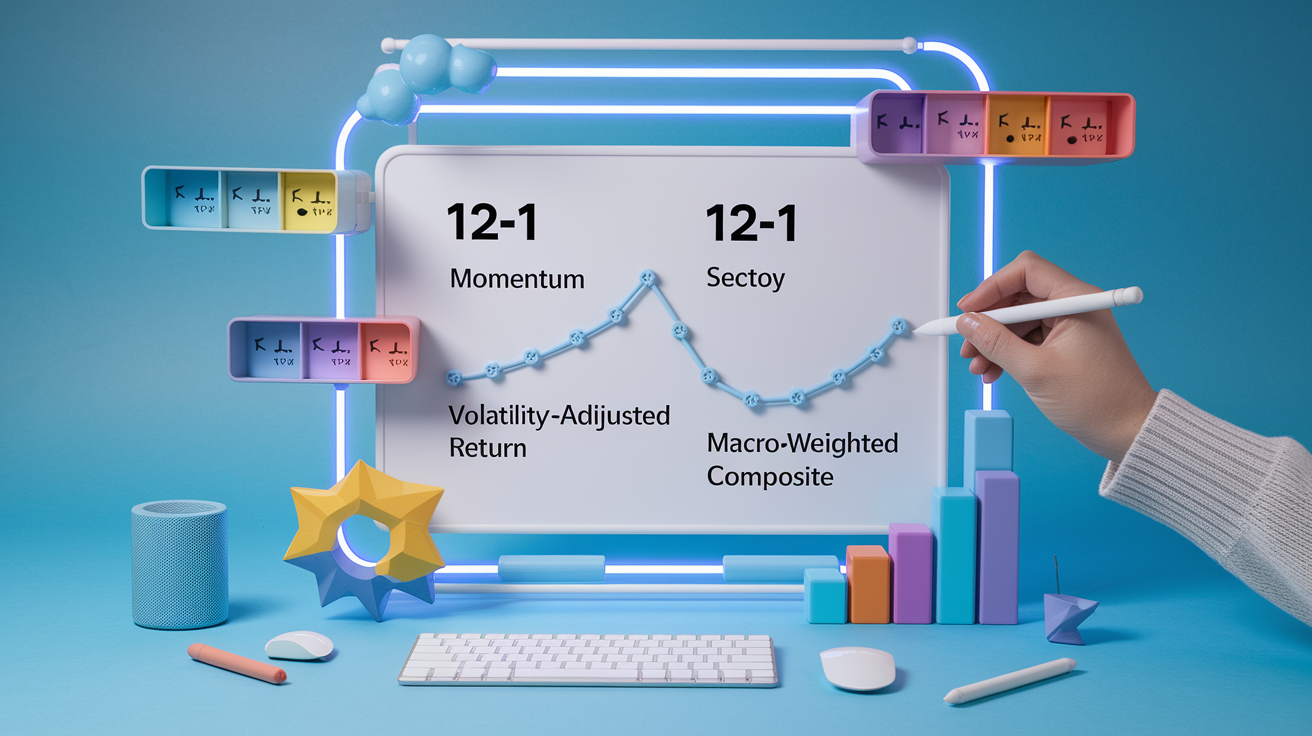
Rotation signals rank sectors to figure out which to hold and which to skip. The most common approach is momentum-based ranking, which measures each sector’s total return over a specified lookback period. Popular variant is the “12-1” momentum signal, calculated as the 12-month total return excluding the most recent month to cut short-term noise. Models may also blend multiple horizons like 3-month, 6-month, and 12-month returns with assigned weights (say, 60 percent to 12-month, 30 percent to 6-month, and 10 percent to 3-month).
Volatility-adjusted scoring improves risk-adjusted rankings by dividing returns by trailing volatility, creating a Sharpe-like ratio for each sector. This favors sectors with strong returns and stable price action over those with high returns but crazy swings. Economic indicator overlays add another layer by tilting toward cyclical or defensive sectors based on current macro readings. For instance, when PMI exceeds 50 and the yield curve is steep, the model may boost scores for consumer discretionary and financials while cutting defensive weights.
Examples of Signal Formulas
12-1 Momentum: Calculate the total return for each sector over the past 12 months, then subtract the return from the most recent month. Rank sectors from highest to lowest and put money in the top N (commonly top 1 to 3). This formula reduces the impact of short-term reversals that can happen right after strong one-month moves.
Volatility-Adjusted Return: Divide each sector’s 6-month return by its trailing 60-day volatility. Rank sectors by this ratio and allocate to those with the highest risk-adjusted scores, which means favoring sectors that deliver returns with less price chaos.
Macro-Weighted Composite: Assign a base momentum score, then multiply by a regime factor pulled from leading indicators. For example, if PMI is above 50 and the yield curve is positive, apply a 1.2 multiplier to cyclical sector scores and a 0.8 multiplier to defensive sectors. This tilts the portfolio toward sectors aligned with the identified economic phase.
Portfolio Construction and Allocation Rules

Once sectors are ranked, the model has to turn those rankings into actual portfolio weights. Simplest method is a top-N rule where the model equally splits capital across the top-ranked sectors. Typical setup selects the top 1 to 3 sectors and divides available equity exposure evenly among them. Choosing the top two sectors means 50 percent to each. Straightforward and limits concentration risk compared to holding only the single highest-ranked sector.
Volatility-based weighting adjusts allocations to target consistent portfolio volatility. Sectors with higher trailing volatility get smaller weights, while lower-volatility sectors get larger weights, normalizing risk contribution across positions. Position caps prevent too much concentration, commonly limiting any single sector to 20 to 25 percent of the portfolio no matter the rank. Some models also reserve 10 to 15 percent in cash to provide liquidity for transitions and protect against sudden shocks.
| Rule Type | Description | Pros |
|---|---|---|
| Top-N Equal-Weight | Allocate equally across the N highest-ranked sectors | Simple, diversified across leading sectors, easy to implement |
| Volatility-Weighted | Adjust weights by inverse trailing volatility to target constant portfolio volatility | Risk-balanced exposure, reduces impact of volatile sectors |
| Position Cap | Limit maximum allocation per sector (e.g., 25 percent cap) | Prevents concentration, maintains diversification |
| Cash Reserve | Hold 10 to 15 percent in cash during normal conditions, 100 percent during severe weakness triggers | Provides liquidity, downside protection during market stress |
Backtesting a Sector Rotation Model

Backtesting checks whether a rotation strategy would’ve actually delivered the claimed performance over historical periods and helps spot weaknesses before you go live. A solid backtest requires clean, survivorship-free data covering at least 10 to 25 years to capture multiple economic cycles, including recessions and bull markets.
The process:
- Collect historical data – Grab daily or monthly total-return series for all 11 sector ETFs, the S&P 500 benchmark, and relevant macro indicators, making sure data includes dividends and adjusts for corporate actions.
- Define the signal calculation – Code the ranking logic (like 12-1 momentum, volatility-adjusted return) and apply it each rebalancing date using only information available at that point to avoid lookahead bias.
- Construct the portfolio – At each rebalance, rank all sectors, apply allocation rules (top-N, weights, caps), and record the new portfolio composition.
- Simulate trading costs – Deduct round-trip transaction costs (commonly 5 to 25 basis points per trade) and model slippage (1 to 10 basis points) for each position change to reflect real execution friction.
- Track performance metrics – Calculate monthly and annual returns, annualized volatility, maximum drawdown, Sharpe ratio, Sortino ratio, Calmar ratio, win rate, and portfolio turnover.
- Perform out-of-sample validation – Divide the data into in-sample (for initial parameter selection) and out-of-sample (for validation) periods, or use walk-forward analysis where parameters are re-optimized periodically on rolling windows.
- Compare to benchmarks – Evaluate total return, risk-adjusted return, and drawdown metrics against the S&P 500 and a static equal-weight sector portfolio.
Walk-forward testing is critical because it stops overfitting. Instead of tuning parameters on the entire history, the backtest tunes on a rolling historical window and applies those parameters to the next out-of-sample period. This copies how the model would work in real time and shows whether performance depends on hindsight.
Transaction costs and slippage often eat a big chunk of net returns in high-turnover rotation strategies. A model rebalancing monthly with 200 percent annual turnover and 10 basis points per round trip loses roughly 2 percent per year to costs alone. Including these frictions separates realistic forecasts from wishful thinking.
Risk Management and Model Stability

Good risk management stops rotation models from blowing up during unexpected market regimes or data weirdness. Volatility filters automatically cut exposure when trailing volatility spikes above a threshold, like when the VIX tops 40. This keeps the model from adding new positions during panic selloffs when correlations spike and momentum signals turn useless.
Maximum drawdown rules halt new rebalancing or move the portfolio to cash if cumulative losses exceed a preset limit, commonly 15 to 20 percent. Once triggered, the model either pauses rebalancing until markets stabilize or goes entirely into a defensive asset like short-duration bonds. Turnover constraints limit how often positions can change, cutting both transaction costs and the risk of whipsawing in choppy markets. For example, requiring a minimum one-month holding period and only rebalancing when rank changes exceed a threshold reduces pointless trades.
Position caps and diversification rules make sure no single sector takes over the portfolio. Capping individual sector exposure at 20 to 25 percent and requiring at least two sectors in the portfolio at all times stops concentration risk. These controls give up some upside during long sector bull runs but protect against sharp reversals when a single sector collapses.
Tools and Platforms for Sector Rotation Modeling

Building a sector rotation model requires software that can handle time series data, perform ranking calculations, simulate portfolio rebalancing, and evaluate performance metrics. Python is the most popular platform for quant rotation strategies, using libraries like pandas for data manipulation, numpy for numerical calculations, and backtesting frameworks such as Backtrader, Zipline, vectorbt, or bt for systematic testing. Python’s flexibility allows for custom signal logic, dynamic allocation rules, and integration with data providers.
Excel works well for simple prototypes and for investors who prefer a visual interface. Monthly rebalancing models with straightforward momentum signals can be built entirely in spreadsheets using lookup tables, ranking functions, and basic return calculations. But Excel gets messy for daily rebalancing, complex multi-factor signals, or large-scale historical testing.
Common tools and platforms:
- Python (pandas, numpy, backtesting libraries) – Flexible, scriptable, supports custom signals and large datasets.
- R (quantmod, PerformanceAnalytics) – Strong statistical tools, good for econometric signal testing.
- Excel – Accessible for simple monthly models and quick prototyping.
- QuantConnect / Quantopian-style platforms – Cloud backtesting with integrated data, good for rapid testing.
- Bloomberg Terminal or Refinitiv – Professional-grade data and built-in backtesting tools, higher cost.
Common Pitfalls and Limitations of Sector Rotation Strategies

Overfitting is the biggest trap in rotation model development. Testing dozens of parameter combinations (lookback periods, weighting schemes, rebalancing frequencies) on the same historical data set will eventually spit out a configuration that looks amazing in-sample but tanks out-of-sample. The fix is strict separation of in-sample tuning and out-of-sample validation, plus walk-forward testing that continuously re-estimates parameters on rolling windows.
Regime shifts can wreck momentum signals. During high-correlation market environments like the March 2020 COVID crash, all sectors fell together and relative strength became meaningless. Rotation strategies that rely purely on momentum underperform in these periods because there are no winners to rotate into. Models need defensive overlays like moving the entire portfolio to cash when broad market volatility crosses thresholds or when the number of sectors trading above their moving averages drops below a critical level.
Transaction costs and taxes eat returns more than many backtests admit. Simulations that ignore spreads, commissions, slippage, and short-term capital gains taxes overstate net performance. Real rotation models should assume at least 5 to 10 basis points per trade and account for tax drag if implemented in taxable accounts. Using tax-advantaged accounts like IRAs or Roth IRAs kills the capital gains issue and is the better structure for high-turnover strategies.
Final Words
You now have a practical roadmap: core concepts, economic cycle frameworks, required data, signal construction, allocation rules, backtesting steps, risk controls, tools, and common pitfalls.
This framework helps you test ideas, weigh trade-offs, and keep the model honest with risk limits and realistic assumptions.
Use this guide as a starting point for how to build a sector rotation model. Start simple, iterate with clear tracking, and stay flexible. You’ll learn as the market teaches you — and that’s a good place to be.
FAQ
Q: What is a sector rotation strategy?
A: A sector rotation strategy is allocating capital across industry sectors based on economic phases, relative strength, or factor trends to capture sector leadership as the macro cycle evolves.
Q: Why do investors use sector rotation strategies?
A: Investors use sector rotation strategies to exploit cyclical leadership, improve risk-adjusted returns, reduce exposure in downturns, express macro views, and diversify away from single-sector concentration.
Q: What are the economic cycle phases used in rotation models?
A: The economic cycle phases used in rotation models are early, mid, late, and recession, each historically linked to predictable sector performance patterns and changing leadership across the market.
Q: What data inputs are required to build a rotation model?
A: The data inputs required include price momentum, rolling returns, macro time series (GDP, PMI, inflation), yield-curve signals, volatility measures, and sector-level fundamentals or earnings trends.
Q: How do you construct rotation signals?
A: Constructing rotation signals uses rolling returns (1–12 months), volatility-adjusted momentum, regime classification from macro indicators, or blended scoring systems that rank sectors for allocation.
Q: What allocation rules translate signals into portfolio weights?
A: Allocation rules translate signals into weights via top‑N selection, equal weighting, volatility targeting, capped exposures, and turnover limits to manage concentration and trading costs.
Q: How should I backtest a sector rotation model?
A: Backtesting a sector rotation model runs rolling windows with monthly or quarterly rebalancing, includes transaction costs, uses survivorship‑free data, performs out‑of‑sample tests, and compares against a benchmark.
Q: What risk management tools stabilize rotation models?
A: Risk management tools include volatility filters, maximum drawdown stops, sector caps, turnover constraints, and position sizing rules to limit concentration and control unexpected losses.
Q: Which tools and platforms are useful for sector rotation modeling?
A: Useful tools and platforms include Python (pandas, numpy), R, Excel, Bloomberg, and reliable ETF or sector data sources for pricing, fundamentals, and backtesting infrastructure.
Q: What common pitfalls should investors watch for with sector rotation?
A: Common pitfalls include regime shifts, overfitting, look‑ahead bias, sensitivity to macro revisions, high turnover and transaction costs, and relying on noisy short-term signals.