


Are reverse stock splits a desperate red flag or a routine fix?
They often look like a Hail Mary, but the calendar and the ratio tell the real story.
This post gives a clean, up-to-date calendar of upcoming stock reverse splits with announcement, record and effective dates plus exact ratios.
Use it to adjust positions, spot likely delisting plays, and confirm terms against SEC filings before you trade.
Think of the calendar as your checklist for timing, risk, and opportunity.
Tracking the Latest Announced Reverse Splits and Key Dates
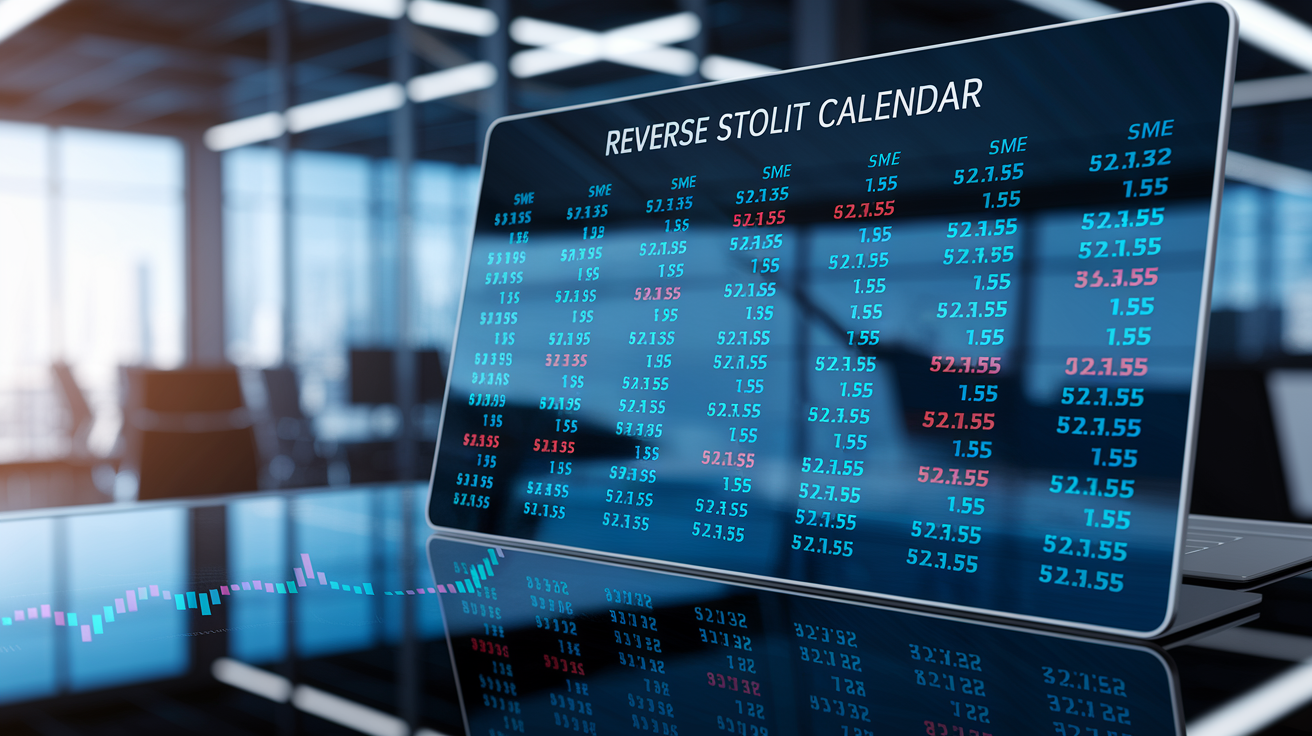
A reverse stock split calendar shows you which companies have officially announced plans to consolidate shares. They’re combining multiple existing shares into fewer new ones at a higher price per share. You need these calendars to track announcement dates, record dates, and effective dates so you can adjust positions, brace for volatility, and double-check the terms before you trade. A useful reverse split calendar displays company name, ticker, split ratio (like 1-for-10 or 1-for-25), announcement date, vote date if there is one, record date, and effective date. Plus links to the SEC filing that locks in the details.
Every reverse split follows a standard timeline. The company announces the split through a press release and files a Form 8-K with the SEC. If shareholders need to vote, the company files a proxy statement (Form DEF 14A) and schedules the vote. The record date determines which shareholders can vote or receive the new shares. The effective date is when shares start trading on the adjusted basis, often marked by a temporary ticker suffix. For example, AVAX One Technology Ltd. (NASDAQ: AVX) announced a 1-for-12 reverse split. That means every twelve pre-split shares would become one post-split share.
Good calendars update in real time as companies amend filings, change dates, or finish shareholder votes. You should confirm every entry against the official SEC filing before making any trading decision. Ratios, dates, and terms can shift between announcement and execution.
| Company | Ticker | Ratio | Effective Date |
|---|---|---|---|
| Example Corp A (illustrative) | EXCA | 1-for-10 | 2026-07-15 |
| Example Corp B (illustrative) | EXCB | 1-for-25 | 2026-08-01 |
| Example Corp C (illustrative) | EXCC | 1-for-50 | 2026-08-20 |
Why Companies Announce Reverse Stock Splits

The most common reason for a reverse stock split is exchange listing compliance. NASDAQ and NYSE both require minimum per-share bid prices, typically $1.00 for continued listing. When a company’s stock trades below that threshold long enough, the exchange issues a deficiency notice. A reverse split consolidates shares and lifts the per-share price, buying the company time to show they can stay compliant. A stock trading at $0.20 that executes a 1-for-10 reverse split will start trading near $2.00, clearing the minimum threshold immediately.
Beyond listing compliance, companies do reverse splits to reduce the total number of outstanding shares and simplify the capital structure. They want to attract institutional investors who have internal policies against buying sub-$5 stocks. Lower administrative and transfer-agent costs also matter when you’re managing a large shareholder base. Some companies want to move out of “penny stock” territory to improve perception. Others are preparing for a merger, acquisition, or recapitalization where a higher share price looks better. Some just want to consolidate the float to reduce volatility and make the stock easier to manage.
Exchange deficiency notices typically give companies 180 days to regain compliance. If the stock can’t sustain the minimum bid for 10 consecutive trading days during that window, the exchange may begin delisting proceedings. A reverse split is often the fastest path back into compliance, which is why many reverse split announcements come shortly after a deficiency notice goes public.
Evaluating Upcoming Reverse Split Details and Ratios

When you’re reviewing an upcoming reverse split on a calendar, the split ratio tells you exactly how many old shares become one new share. A 1-for-10 reverse split means the company will combine ten existing shares into one. If you owned 1,000 shares at $0.50 before a 1-for-10 reverse split, you’d own 100 shares at roughly $5.00 after the split, assuming the market price adjusts mechanically and nothing else happens. The total market value of your position stays the same right after the split. A 1-for-100 reverse split is way more aggressive. 10,000 shares at $0.05 would become 100 shares at $5.00.
Larger ratios signal more severe problems. Companies trading in the single-digit cents often need ratios of 1-for-50 or 1-for-100 to reach exchange minimums. The 1-for-12 ratio in the AVAX One Technology Ltd. announcement falls in the moderate range. Enough to lift a sub-$0.10 stock above $1.00, but not as drastic as triple-digit consolidations.
Understanding how reverse splits handle fractional shares matters. When the math creates a fractional share (say, 125 shares in a 1-for-10 split yields 12.5 new shares), brokers typically deliver 12 whole shares and cash out the 0.5 share at the post-split market price. Cash-in-lieu payments usually process within a few days of the effective date and may have tax implications. The reverse split doesn’t change total market cap. If the company had a $10 million market cap before, it’ll have the same $10 million market cap right after, just spread across fewer shares.
Pre-split prices must be adjusted in historical charts to keep percentage-change calculations and technical analysis accurate. Record date and effective date can differ by several days. Shares trade on a split-adjusted basis starting on the effective date, and the adjustment shows up in your brokerage account shortly after.
Always cross-check the ratio listed on any calendar against the official SEC Form 8-K filing. Typos, outdated pages, and unofficial summaries can show incorrect ratios.
Assessing Market Impact of Upcoming Reverse Stock Reverse Splits

Reverse splits are mathematically neutral to market cap, but market perception and liquidity dynamics often drive real price changes around the announcement and effective dates. Many reverse splits happen in distressed or micro-cap stocks that already face delisting pressure, weak fundamentals, or negative sentiment. That context means the split itself can amplify volatility instead of stabilizing the stock.
Short-term market effects commonly seen around reverse splits: price often rises on announcement day as algorithms and retail traders interpret the news as a step toward compliance or restructuring. Volatility typically increases between announcement and effective date as speculators, short sellers, and arbitrageurs adjust positions. Liquidity frequently drops post-split because the float is reduced by the inverse of the ratio. A 1-for-10 split cuts the number of tradable shares by 90 percent. Bid-ask spreads widen after the split due to lower share counts and reduced market-maker activity.
Institutional ownership may drop if the stock remains below internal price or market-cap thresholds even after the split. Short interest can shift unpredictably. Some shorts cover before the split to avoid adjustment complications, while others increase positions betting on continued weakness. Stigma persists. Many investors view reverse splits as a red flag signaling financial distress, which can pressure the stock even if fundamentals improve.
| Effect | Typical Outcome |
|---|---|
| Immediate price adjustment | Per-share price multiplies by the ratio (e.g., 1-for-10 → price × 10) |
| Liquidity and volume | Float shrinks; daily volume often declines; spreads widen |
| Medium-term price trend | Stocks often drift lower in the months following a reverse split, especially if fundamentals remain weak |
You should treat the reverse split as a signal to review the company’s underlying financial health, cash runway, and business model rather than a catalyst for immediate bullish positioning.
Trading Strategies for Upcoming Reverse Splits

Pre-announcement and pre-effective-date volatility creates both risk and opportunity. Traders who monitor reverse split calendars can position for short-term moves, but the mechanics require careful timing and risk controls. Before the effective date, shares still trade at the old count and old price, which can create order-execution confusion if limit orders are set too tightly or market orders are used during low liquidity.
Between announcement and effective date, use limit orders exclusively. Market orders can fill at distorted prices during adjustment periods or when market makers pull quotes. Consider reducing position size or exiting entirely if the reverse split signals deteriorating fundamentals or imminent delisting. Watch for shareholder-vote outcomes. If a vote is required and fails, the split may be canceled or delayed, reversing short-term price moves.
Monitor short interest and borrow rates. Reverse splits can trigger short squeezes if supply tightens post-consolidation. Check broker policies on fractional-share handling and cash-in-lieu settlement timing. Avoid options strategies around the effective date unless you fully understand OCC contract adjustments and deliverable changes.
| Strategy | When to Apply | Risk Level |
|---|---|---|
| Exit before effective date | When reverse split signals distress or delisting | Low (avoids post-split illiquidity) |
| Short-term swing trade on announcement pop | Momentum-driven micro-cap with high volume | High (reversal risk, low liquidity) |
| Wait and re-evaluate post-split | Fundamental story intact; compliance achieved | Medium (volatility and spread risk remain) |
After the effective date, liquidity is usually lower and spreads wider. Institutional interest may take weeks to materialize, if it happens at all. Some traders wait 30 to 60 days post-split to see whether the company can sustain the new price level and meet listing requirements on a durable basis. If the stock drifts back toward $1.00 within a few months, the reverse split may have been a temporary fix rather than a turning point.
How to Monitor and Verify Upcoming Reverse Splits

Official confirmation of any reverse stock split comes from SEC filings, primarily Form 8-K for current events and DEF 14A proxy statements when shareholder approval is required. Exchange notices from NASDAQ or NYSE also publish effective dates and ticker adjustments. Relying only on financial news aggregators or third-party calendars introduces the risk of outdated ratios, missed amendments, or incorrect effective dates.
To verify an upcoming reverse split, start by searching the SEC’s EDGAR database for the company ticker and keywords like “reverse split” or “share consolidation.” Form 8-K filings will include the announcement date, proposed ratio, and any conditions such as board or shareholder approval. Proxy statements (DEF 14A) filed ahead of annual or special meetings will detail the proposal, the vote date, and the rationale. After shareholder approval, the company typically files an additional 8-K confirming the vote outcome and final terms.
Search EDGAR using the company’s CIK number or ticker symbol and filter for 8-K and DEF 14A filings in the past 90 days. Read the filing’s item 5.03 (amendments to articles of incorporation) or item 8.01 (other events) for reverse split details. Confirm the exact ratio, record date, and effective date. These can change between initial announcement and final approval. Check the exchange’s corporate actions page (NASDAQ Trader or NYSE Daily List) for the official effective date and any ticker symbol changes. Set up EDGAR email alerts or RSS feeds for the ticker to receive real-time notices of new filings.
| Source | Type of Information Provided |
|---|---|
| SEC Form 8-K | Announcement date, ratio, record date, effective date, shareholder vote requirement |
| SEC DEF 14A (Proxy) | Proposal details, vote date, board recommendation, risk factors |
| Exchange notices (NASDAQ, NYSE) | Effective date, ticker symbol adjustments, trading halt windows |
Update your internal calendar or watchlist right after confirming the filing. Dates and ratios can shift if the board amends the proposal or if shareholder approval is delayed. Cross-referencing multiple sources reduces the risk of trading on stale or incorrect information.
Preventing Mistakes When Reviewing Upcoming Reverse Split Calendars

The most frequent errors investors make when reading reverse split calendars are misinterpreting the ratio, confusing record dates with effective dates, and failing to verify the company name against the ticker symbol. Calendar sites occasionally mislabel tickers or display outdated event rows, which can lead to trades in the wrong security or at the wrong time.
Before acting on any calendar entry, confirm the company name matches the ticker symbol. Verify on the exchange’s official listing or the SEC filing. Mismatches can indicate data errors or ticker reassignments. Make sure the split ratio is expressed consistently (1-for-X, not X-for-1). A 1-for-10 means you get 1 share for every 10 old shares, not the reverse. Record date and effective date should be clearly distinguished. Record date determines eligibility, effective date is when adjusted trading begins.
Check that shareholder approval status is current. If a vote is pending, the split isn’t final and may be canceled or amended. Make sure the SEC filing link is provided and leads to the correct document. Always open the 8-K or proxy to verify terms directly. Check that the update timestamp on the calendar is recent. Stale data can show canceled or amended splits as still active.
Set alerts for any ticker on your watchlist so that new filings, amended proposals, or vote results trigger an immediate review. Double-check the math on your own holdings. If you own 1,200 shares and the ratio is 1-for-12, you should expect 100 post-split shares. If the calendar or your broker shows a different outcome, contact the broker and pull the filing to resolve the discrepancy before the effective date.
When to Seek Additional Verification or Professional Guidance on Reverse Splits

Certain aspects of reverse splits fall outside the scope of public calendars and require professional advice. Tax treatment of fractional-share cash-outs, cost-basis adjustments, and impacts on financial ratios all need expert input. Cash-in-lieu payments for fractional shares are generally taxable events, and cost basis must be recalculated on a per-share basis after the consolidation. If you hold the stock in a taxable account, consult a tax professional to understand reporting requirements and whether the cash-out triggers a short-term or long-term capital gain.
Seek additional verification or professional help if you received cash-in-lieu for fractional shares and need to report it correctly on your tax return. Same if the reverse split occurred in an IRA, trust, or estate account with specific record-keeping or distribution rules. If you hold options, warrants, or convertible securities tied to the stock, know that contract adjustments are handled by the Options Clearing Corporation and may differ from standard equity splits.
If the company’s financial statements show post-split EPS, book value, or other per-share metrics that you need to compare against historical data, remember that reverse splits require retroactive adjustment of all historical per-share figures.
Brokers are required to adjust your cost basis automatically, but errors happen. Review your account statements after the effective date and compare the new share count and per-share cost basis against your own records. If the numbers don’t match, request a correction in writing before filing your taxes. Institutional investors should also verify that custodians and prime brokers have processed the corporate action correctly, especially for large positions or complex account structures.
Final Words
We tracked announced reverse splits and key dates, showed what fields a useful calendar needs, explained why firms do splits, broke down ratios and fractional-share math, and walked through market impact plus trading and verification steps.
Use a calendar that lists announcement, record and effective dates, ratios, last close, and SEC links. Verify filings, set limit orders, and mind liquidity and tax notes.
Keep this guide handy when watching upcoming stock reverse splits — they reward preparation. With the checklist and verification steps here, you’ll be ready to act calmly and confidently.
FAQ
Q: What stocks are going to reverse split?
A: The stocks going to reverse split are those with public reverse‑split announcements or SEC filings; check a reverse‑split calendar or Form 8‑K/proxy for company, ticker, ratio, announcement and effective date.
Q: What big stocks are going to split soon or are scheduled to split in 2026?
A: Big stocks set to split soon or in 2026 show up on split calendars; many are regular forward splits rather than reverse—confirm split type, ratio, announcement and effective date in company filings or the calendar.
Q: Is it better to buy before or after a reverse split?
A: Whether to buy before or after a reverse split depends on your risk tolerance; buying before exposes you to volatility, liquidity drops and delisting risk, while buying after the effective date reduces those unknowns.