


Did the Fed just tell markets the hiking cycle is over—or is it simply pausing?
The FOMC left the federal funds target at 3.50–3.75 percent today, a unanimous hold that matched near-term market odds.
Traders barely flinched; CME priced only an 8 percent chance of a March cut after Powell’s cautious press briefing.
The statement dropped the “additional policy firming” line and stressed data-dependence, so markets are parsing whether this points to a soft landing or prolonged higher rates.
This post breaks down the decision, the market reaction, and what to watch next.
Latest Fed Meeting Decision and Key Outcomes
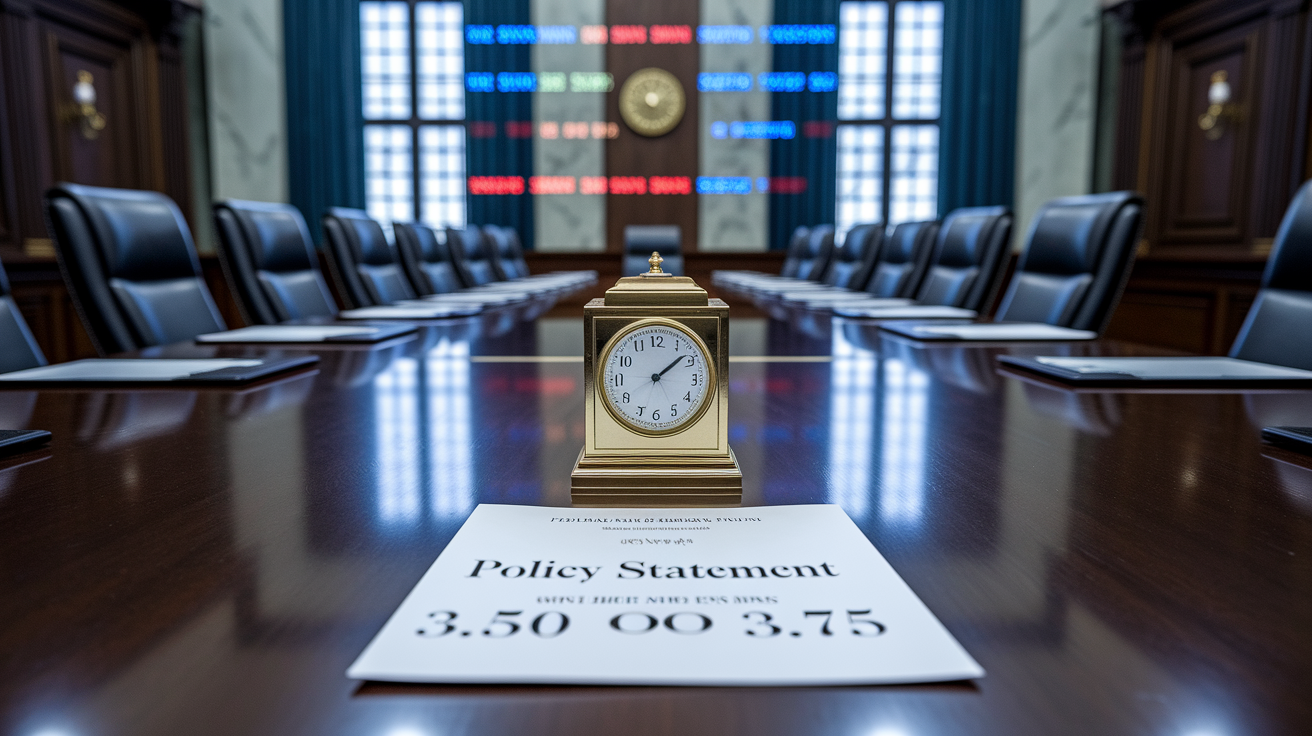
The Federal Open Market Committee wrapped up its two-day session on Wednesday, January 28, 2026, releasing the policy statement at 2:00 PM Eastern. They voted to keep the federal funds target rate stuck at 3.50 to 3.75 percent. That’s the same restrictive stance they’ve held since the last hike of the previous cycle.
Nobody was surprised. CME FedWatch Tool data showed a 97 percent chance of no change heading into the meeting, up from 78 percent a month earlier. Not a single dissent appeared in the official statement.
The policy statement gave a nod to modest improvement on inflation, noting that consumer price pressures have eased but still sit above the committee’s long-term 2 percent target. Recent headline CPI came in at 2.7 percent year-over-year for December. FOMC participants expect further cooling through March, mostly thanks to base effects. The statement kept the “sufficiently restrictive” language and doubled down on a data-dependent approach. Economic growth? Moderate. The labor market showed signs of cooling, with payroll gains softening and the unemployment rate ticking up a bit.
Chair Jerome Powell’s press conference kicked off at 2:30 PM Eastern, about 30 minutes after the statement dropped. Powell made it clear the committee isn’t rushing to ease, given that inflation’s not at target yet and financial conditions remain supportive. He described the twin pressures of above-target inflation and a softening labor market as reasons to stay flexible, saying “we can afford to be patient and careful.” Powell also flagged potential upside risks to inflation from tariff policy changes. The committee’s monitoring trade developments closely but hasn’t baked new tariff assumptions into its baseline outlook.
Key takeaways from the January meeting:
- Federal funds target rate held at 3.50 to 3.75 percent, the seventh straight hold since the last hike
- Statement acknowledged “some further progress” on inflation but flagged that price pressures remain elevated relative to the 2 percent goal
- Forward guidance removed previous references to “additional policy firming,” signaling the hiking cycle’s probably over
- Powell stressed that the timing of rate cuts depends on incoming data, particularly inflation persistence and labor market slack
- Market-implied probability of a quarter-point cut at the March meeting stood at just 8 percent right after the press conference
Fed Meeting Schedule and What Happens at Each Meeting

The Federal Reserve holds eight regularly scheduled meetings per year, a practice they formalized back in 1981. Each meeting runs over two consecutive days, usually starting on a Tuesday and wrapping Wednesday afternoon with the policy announcement and Chair press conference. The 2026 FOMC calendar includes meetings on January 27–28, March 17–18, April 28–29, June 16–17, July 28–29, September 15–16, October 27–28, and December 8–9. By statute, the committee has to meet at least four times annually. But they can also call emergency sessions if economic or financial conditions demand immediate action, like they did during the March 2020 pandemic onset.
A typical two-day meeting follows a structured format. Day one starts with FOMC participants receiving staff briefings on current economic conditions, financial markets, and the outlook. Board economists present the “Tealbook” (formerly the Greenbook and Bluebook), which includes staff forecasts and policy recommendations. Then participants do a policy “go-round,” where each of the 19 FOMC members (12 voting, 7 non-voting regional presidents) shares their take on the economy and what policy stance makes sense. Day two brings final deliberation, the formal vote by the 12 voting members, and drafting of the policy statement.
At the end of day two, the committee releases the official policy statement at 2:00 PM Eastern. For meetings held in March, June, September, and December, the statement comes with the Summary of Economic Projections. That includes the dot plot of participants’ rate forecasts and updated projections for GDP, unemployment, and inflation. The Chair’s press conference begins about 30 minutes after the statement. Meeting minutes get published three weeks later, giving you granular detail on the discussion and any dissenting views.
Breakdown of Federal Reserve Policy Tools Discussed at Meetings

The primary policy tool discussed at every Fed meeting is the federal funds rate target. That’s the overnight borrowing rate banks charge one another for reserves. The FOMC sets this as a target range, currently 3.50 to 3.75 percent, and adjusts it in increments of 25 basis points (0.25 percentage points). Though larger moves of 50 or even 75 basis points have been used during periods of urgent tightening or easing. Changes to the funds rate ripple through the economy by influencing short-term borrowing costs, which then hit consumer loans, mortgages, credit cards, and corporate debt.
A second major tool is the Federal Reserve’s balance sheet. It expanded dramatically during quantitative easing programs and remains a focus during the current quantitative tightening phase. At recent meetings, the committee’s discussed the pace at which it allows maturing Treasury securities and mortgage-backed securities to roll off the balance sheet without reinvestment. Runoff reduces the size of the Fed’s holdings, tightening financial conditions by pulling liquidity from the banking system. The current runoff caps stand at 60 billion dollars per month for Treasuries and 35 billion for agency MBS. The committee can adjust these parameters or pause runoff entirely if liquidity conditions tighten too sharply.
Forward guidance is the third critical policy mechanism. This involves signaling the likely future path of rates through statement language and the dot plot. Words like “some additional policy firming may be appropriate” or “the committee will carefully assess incoming data” shape market expectations and influence long-term interest rates even before any actual policy move happens. The dot plot, released quarterly with the SEP, shows where each FOMC participant expects the federal funds rate to be at year-end for the next several years and in the longer run.
The Federal Reserve’s monetary policy toolkit:
- Federal funds target rate, the primary lever for adjusting short-term borrowing costs across the economy
- Balance sheet operations. Quantitative easing (QE) expands the balance sheet by purchasing securities. Quantitative tightening (QT) shrinks it by letting securities mature without replacement
- Forward guidance, communication about the likely future path of policy, used to anchor market expectations and influence longer-term rates
- Discount window and standing repo facility, emergency lending tools and backstop liquidity mechanisms available to banks and primary dealers. Rarely front and center at routine meetings but discussed during periods of financial stress
Jerome Powell Press Conference Highlights

Chair Jerome Powell’s press conference is often more market-moving than the policy statement itself. The press conference begins at 2:30 PM Eastern, roughly 30 minutes after the statement drops, and typically runs 45 to 60 minutes. Powell opens with prepared remarks summarizing the policy decision and the committee’s assessment of the economy, then takes questions from credentialed journalists. Markets parse every phrase for clues about the future policy path. Particularly Powell’s characterization of inflation risks, labor market tightness, and whether the Fed remains data-dependent or is shifting toward a pre-set course.
At the January 28, 2026, press conference, Powell stressed patience and flexibility. He noted that while inflation has declined substantially from its 2022 peak, it remains above the 2 percent target and price pressures in services categories are proving sticky. He described the labor market as “strong but cooling,” pointing to slower payroll gains and a modest uptick in unemployment as evidence that supply and demand are coming into better balance. When asked about the timing of rate cuts, Powell wouldn’t commit to a specific meeting, saying “we’re going to be careful and methodical” and that the committee needs to see sustained progress on inflation before considering easing.
Powell also fielded questions on external risks, including potential tariff-driven price pressures. He acknowledged that new trade policies could complicate the inflation outlook but stressed that the committee hasn’t modeled these effects into its baseline forecast yet. On financial conditions, he noted that credit spreads remain narrow and equity valuations elevated, which reduces the urgency to ease even as the labor market softens. Powell’s tone was neither hawkish nor dovish. He reinforced a stance of “higher for longer” without ruling out cuts later in the year if disinflation continues and the labor market weakens further.
Economic Projections (SEP) and Their Importance

The Summary of Economic Projections is published four times per year, at the March, June, September, and December meetings. The SEP includes FOMC participants’ individual forecasts for real GDP growth, the unemployment rate, headline and core PCE inflation, and the future path of the federal funds rate. These projections are presented as central tendency ranges and median values, giving markets a read on where the committee collectively sees the economy heading and what policy path is consistent with achieving the Fed’s dual mandate of maximum employment and stable prices.
The most closely watched component of the SEP is the dot plot. It shows each participant’s projection for the appropriate federal funds rate at the end of the current year, the next two calendar years, and in the longer run. Each dot represents one participant’s view, and the median dot is often interpreted as the committee’s baseline path. Markets compare the median dot to current market-implied rate expectations to gauge whether the Fed is more hawkish or dovish than priced in. A dot plot that signals fewer cuts than markets expect can push Treasury yields higher and pressure equities. Conversely, a dot plot showing more easing can rally risk assets and flatten the yield curve.
Key elements of the SEP that move markets:
- Dot plot median path, the single most important chart for forward rate expectations, showing where the committee sees the funds rate at future year-ends
- GDP growth forecasts. Upward revisions suggest stronger activity and lower odds of near-term cuts. Downward revisions raise recession concerns
- Unemployment projections. Higher unemployment forecasts imply labor market slack and increase the likelihood of rate cuts
- PCE inflation outlook, the committee’s preferred inflation gauge. Persistent upward revisions delay the start of easing, while faster-than-expected cooling brings cuts forward
Market Reaction to the Latest Fed Meeting

Treasury yields moved modestly in the minutes following the January 28 policy announcement. The 2-year yield, most sensitive to near-term rate expectations, ticked up 4 basis points to 4.18 percent as the statement and Powell’s press conference removed any lingering hope for a March rate cut. The 10-year yield rose 3 basis points to 4.51 percent, reflecting a slight repricing of the terminal rate for this cycle. The yield curve remained inverted, though the spread between 2 and 10 year yields narrowed slightly as short-end yields rose more than long-end yields.
Equities finished mixed. The S&P 500 closed down 0.3 percent, with initial gains in the first 15 minutes after the statement reversing during Powell’s press conference as he doubled down on the need for more evidence of cooling prices. Technology stocks underperformed, as higher-for-longer rates weigh on long-duration growth names. Financials outperformed on the back of steeper short-end yields supporting net interest margins.
The dollar strengthened against major currencies, with the DXY dollar index rising 0.5 percent to close at 104.2. A higher-for-longer Fed stance relative to other central banks supports the dollar by widening interest rate differentials. Gold fell 1.2 percent to 2,028 dollars per ounce, pressured by rising real yields. Volatility as measured by the VIX spiked intraday to 16.5 but settled back to 15.1 by the close. That indicates that while the Fed’s message was cautious, it was largely in line with market expectations and didn’t trigger sustained risk-off positioning.
Final Words
The Fed wrapped its Jan 27–28 meeting — we walked through the decision, the policy statement, and the immediate market moves.
You saw the calendar context, the main policy tools (rates, balance sheet, guidance), key takeaways from Powell’s press conference, and what the SEP dots mean for rates. We also flagged typical market reactions and near-term things to watch.
Keep this playbook handy: the next fed meeting is already on the calendar, and the framework here makes it easier to act, not react.
FAQ
Q: What is the next Fed rate meeting?
A: The next Fed rate meeting is Jan 27–28, 2026, when the FOMC will review economic data, set interest-rate policy, issue a statement, and typically schedule Chair Powell’s press briefing.
Q: What time for the Fed rate decision?
A: The Fed rate decision is typically released at 2:00 p.m. ET on decision day, with the Fed Chair’s press conference usually starting about 30 minutes later, around 2:30 p.m. ET.
Q: What is Jerome Powell’s salary per year?
A: Jerome Powell’s salary per year is roughly $200,000; the Fed Chair’s pay is set by statute and remains near that level rather than matching large private-sector executive pay.
Q: Which bank in the USA is government owned?
A: The Bank of North Dakota is the only state-owned commercial bank in the U.S.; otherwise commercial banks are privately owned, while the Federal Reserve acts as the nation’s central bank.