


Think your dividend checks are guaranteed? Think again.
The dividend cut risk alerts calendar ties upcoming dividend dates (declaration, ex-dividend, record, payment) to live financial-health warnings so you can see which payouts are actually at risk before the market reacts.
It tracks payout-ratio spikes, falling free cash flow, rising leverage, credit downgrades, and earnings misses, then flags the next dividend event for any red-flag company.
Use filters and real-time alerts to protect income, trim exposure, or hedge positions before a cut hits your portfolio.
Complete Overview of the Dividend Cut Risk Alerts Calendar

A dividend cut risk alerts calendar isn’t just another ex-div tracker. It’s date-based dividend events (declaration dates, ex-dividend dates, record dates, payment dates) paired with real-time financial health warnings in one interface. You get to see which payouts are actually at risk instead of blindly assuming every dividend on the calendar will get paid.
The tool monitors corporate earnings releases (most dividend announcements drop within a week of quarterly earnings), payout ratios climbing past 80 percent, back-to-back quarters of negative free cash flow, debt-to-EBITDA ratios crossing 4.0 times, and interest coverage slipping below 1.5. Then it maps those red flags to upcoming dividend dates so you can see which payouts are in immediate danger.
It pulls live financial data (payout ratio spikes, liquidity metrics, credit downgrades, covenant breaches, analyst calls, operating-cash-flow trends) and stacks them against thresholds that typically show up before cuts happen. When a company’s fundamentals cross into the danger zone, you get a dividend risk monitoring alert tied to the next scheduled dividend event or earnings release. Say a telecom’s payout ratio jumps from 65 percent to 120 percent while free cash flow goes negative for two straight quarters. The calendar flags the upcoming ex-dividend date as high-risk and explains exactly why.
You can filter by sector (energy, REITs, telecom, financials), company name, yield band (anything over 10 percent gets auto-flagged), and event type. Integrate your watchlists so the calendar surfaces only holdings and prospects you actually care about. Alerts come through push notifications, email, and SMS the moment a payout ratio crosses your threshold, a credit agency puts a company on negative watch, or a second consecutive quarter of negative cash flow hits. You get a streamlined dividend alerts workflow that shows what’s happening, when it matters, and why each event poses cut risk.
Calendar Layout and Filters for Dividend Cut Risk Monitoring

Without filters, you’re drowning in noise. Hundreds of companies declare dividends each month. You don’t need to review stable blue-chips when you should be catching deteriorating mid-caps trading at 11 percent yields with payout ratios over 100. Filters let you jump straight to the calendar entries that match your risk tolerance, sector focus, and portfolio.
Date range filters narrow things down to the next 7, 30, or 90 days. Focus on imminent ex-dividend dates and earnings announcements instead of events months out.
Sector filters spotlight industries where cuts happen more often. Energy, master limited partnerships, REITs, telecom, financials. Monitor cyclical and capital-intensive sectors separately from stable consumer staples.
Yield band filters automatically highlight companies yielding 10 percent or more, the threshold where sustainability questions get serious. Set custom yield floors (say, 8 percent or higher) to catch emerging risks earlier.
Corporate event category filters separate ex-dividend dates, earnings releases, credit actions, covenant breaches, and guidance updates. Toggle between dividend timing events and fundamental deterioration signals.
Watchlist-only view shows exclusively the names you’re tracking. Syncs with brokerage platforms or manual watchlists to display position-level exposure and upcoming income events without clutter from the broader market.
Key Financial Indicators Driving Dividend Cut Alerts

Payout ratio thresholds are your first line of defense. A payout ratio above 80 percent means the company’s distributing most of its earnings as dividends, leaving almost nothing to buffer against downturns or fund growth. When the ratio exceeds 100 percent, the company’s paying out more than it earns. That dividend’s being funded by borrowing, asset sales, or burning through cash reserves. All unsustainable over multiple quarters. High yields often tag along with rising payout ratios not because the company increased the dividend but because the share price fell, inflating the yield percentage. A stock yielding 12 percent with a 130 percent payout ratio is statistically more likely to cut within 12 months than a 4 percent yielder with a 50 percent payout.
Free cash flow gives you the cash reality check behind reported earnings. Companies can report positive net income while burning cash if working capital swings, heavy capex, or accounting adjustments distort earnings. Negative free cash flow for two consecutive quarters (or three out of four) triggers elevated dividend risk alerts because management has to either cut the dividend, raise debt, or liquidate assets to fund the payout. An energy producer reporting negative $45 million trailing-twelve-month free cash flow while paying $60 million annually in dividends is heading straight for a reduction. Free cash flow alerts often fire before payout ratio warnings because cash is harder to manipulate than earnings.
Leverage ratios and interest coverage measure whether debt service is crowding out dividend capacity. Debt-to-EBITDA ratios above 3.0 to 5.0 times signal elevated leverage. When combined with falling EBITDA, the ratio can spike fast. Interest coverage below 1.5 to 2.0 times (EBIT divided by interest expense) means the company barely earns enough to cover interest, leaving little room for dividends. Liquidity deterioration shows up in shrinking cash balances, widening bond spreads, tightening credit lines. When a company breaches a debt covenant or gets a credit downgrade while maintaining a high dividend, the calendar escalates the alert severity. Creditors and boards typically force dividend suspensions to preserve liquidity.
Earnings misses, analyst downgrades, and credit actions serve as early warning flares. A 15 percent EPS miss versus consensus often precedes guidance reductions, which lead to dividend reviews. Analyst downgrades (especially cuts to forward EPS estimates) reduce the denominator in the payout ratio calculation, mathematically pushing the ratio higher even if the dividend stays flat. Credit agencies placing a company on negative watch or downgrading from investment grade to high yield frequently cite unsustainable dividends in their rationale. The calendar aggregates these signals, tags the next ex-dividend date, and pushes a notification explaining that the confluence of an earnings miss, analyst EPS cut, and Moody’s downgrade has elevated cut probability above the threshold.
Historical Dividend Cuts Database and Sector Patterns

Historical pattern recognition transforms the dividend cut risk alerts calendar from a reactive news feed into something predictive. Energy, master limited partnerships, REITs, telecom, and certain financials dominate the dividend cut archives. These sectors pair high yields with commodity exposure, regulatory constraints, heavy capital needs, or cyclical cash flows. Energy partnerships saw waves of cuts during the 2014–2016 oil collapse and again in 2020. Many slashed distributions by 50 to 75 percent within weeks of oil price crashes. REITs face dividend pressure when property valuations fall or interest rates spike, compressing net operating income and funds from operations. Telecom operators in competitive markets often maintain high payouts to attract income investors, then cut abruptly when subscriber losses or spectrum auction debt exceed projections.
Timing patterns cluster around quarterly earnings releases. Most dividend declarations occur on or within seven days of the earnings call, so the calendar links each earnings date to the subsequent ex-dividend date and flags any deterioration in the metrics management disclosed. Severe cuts (above 75 percent) typically accompany restructurings, asset write-downs, or covenant breaches and often appear in 8-K filings outside the normal earnings cycle. The database logs announcement date, prior dividend per share, new dividend per share, percentage cut, reason cited (cash flow shortfall, covenant breach, strategic pivot, regulatory change), and the stock’s price reaction within the first 24 to 72 hours. Median immediate declines range from 5 to 15 percent for cuts of 25 to 50 percent, though reactions vary by sector and whether the cut was telegraphed or sudden.
Sector-specific patterns observed in the historical database:
Energy and MLPs: Highest frequency of cuts. Typical magnitude 40–75 percent. Cuts correlate with commodity price declines and distribution coverage ratios falling below 1.0.
REITs: Moderate frequency. Cuts usually 25–50 percent. Driven by occupancy drops, interest rate spikes, or funds from operations shortfalls.
Telecom: Episodic large cuts (50–100 percent) when competitive pressures or spectrum costs overwhelm cash flow. Otherwise stable for incumbents.
Financials (regional banks, BDCs): Cuts often tied to credit cycle stress, non-performing loans, or regulatory capital requirements. Magnitude typically 30–60 percent.
Industrials and consumer cyclicals: Lower baseline frequency but sharp cuts during recessions. Cuts often exceed 50 percent and coincide with demand collapses.
Utilities and consumer staples: Lowest historical cut rates. When cuts occur they’re usually modest (10–30 percent) and tied to one-time events like regulatory disallowances or major storm costs.
Real-Time Dividend Cut Notifications and Delivery Channels

Real-time dividend risk notifications operate on latency measured in seconds to minutes, not hours. You learn of payout ratio spikes, covenant breaches, or credit downgrades as soon as the data hits regulatory filings or newswires. Speed matters because market reactions begin immediately. Option implied volatility jumps, shares gap down, institutional desks adjust hedges. Receiving an alert five minutes after a Form 8-K announces a dividend suspension gives you time to evaluate before the stock opens limit down. The system assigns severity tiers to each alert: informational (a yield rises above 9 percent but other metrics remain healthy), watch (payout ratio crosses 80 percent or free cash flow turns negative for one quarter), high-risk (multiple red flags such as negative cash flow for two quarters plus debt-to-EBITDA above 4.5), and confirmed cut (company has filed or announced a reduction). Severity determines routing and urgency.
Delivery channels include mobile push notifications for high-risk and confirmed cut alerts, email summaries for watch-level and informational updates, SMS for users who want instant text messages on their holdings, and webhook APIs for automated trading systems or portfolio management platforms that execute conditional orders when alerts fire. Mobile push appears as a lock-screen banner: “XYZ Corp: Payout ratio spiked to 115%, negative FCF for Q2, ex-div date April 10.” Tap through to the full calendar entry showing all metrics, historical dividend trends, and recommended actions. Email alerts batch lower-severity signals into a daily or weekly digest, listing each flagged company with its trigger reason, next key date, and a link to the detailed view. SMS delivery is reserved for portfolio holdings and user-selected watchlist names, keeping message volume manageable while ensuring critical warnings reach users even when they’re away from screens.
Dividend Cut Probability Modeling and Risk Scoring Logic
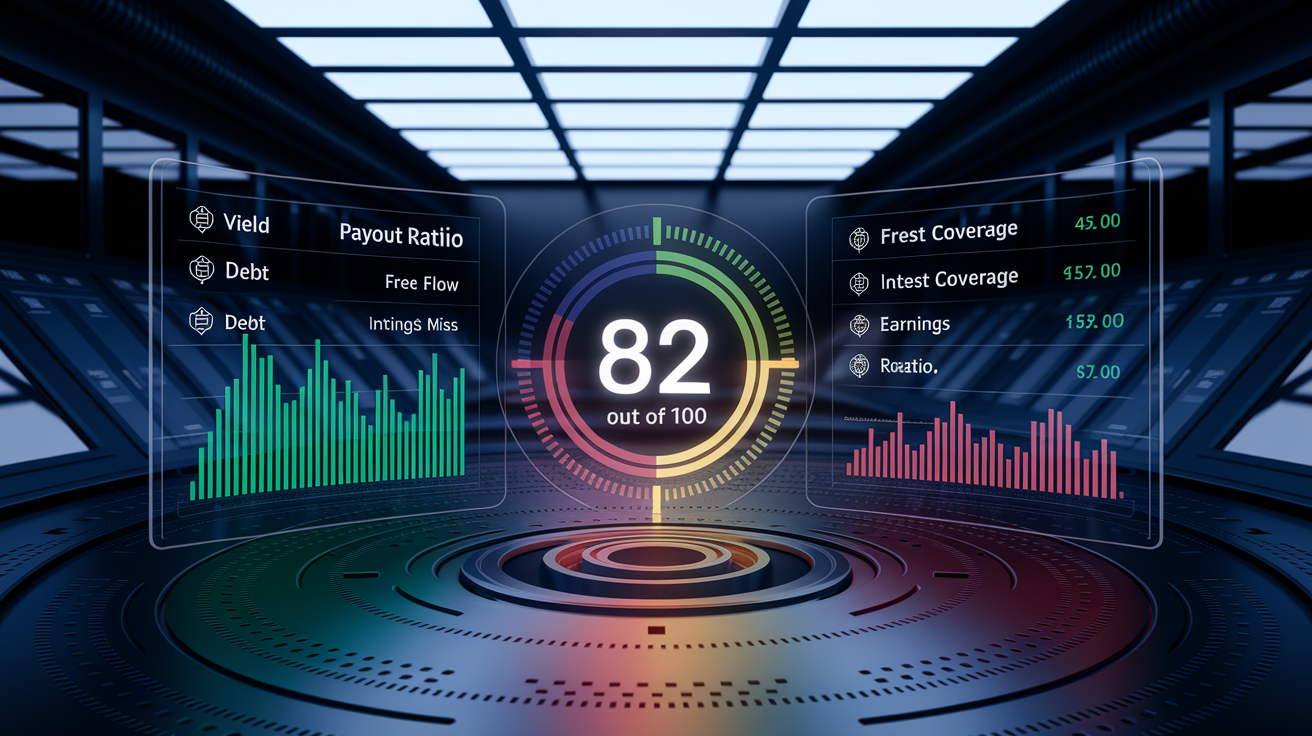
Dividend cut probability models combine multiple financial indicators into a single forward-looking score that estimates the likelihood of a reduction within the next 12 months. The system weights each input based on historical performance: how often companies exhibiting that signal went on to cut versus how often they sustained the dividend. A yield above 10 percent alone is a weak predictor. Many high-yield preferred stocks and utilities maintain payouts for years. But when you combine that with a payout ratio above 100 percent, negative free cash flow for two consecutive quarters, and a 20 percent year-over-year increase in net debt-to-EBITDA, the combined probability jumps above 60 percent. Machine learning models trained on decades of dividend cut events refine these weights, discovering non-linear interactions such as the compounding risk when interest coverage falls below 1.5 at the same time a credit agency places the issuer on negative watch.
The scoring system assigns each company a risk score from 0 to 100, where 100 represents near-certain cut within one quarter and 0 represents negligible risk. Scores above 75 trigger high-risk alerts. 50 to 75 generate watch alerts. 25 to 50 are informational. Below 25 remain off the alert radar unless you’ve manually flagged the name. The model updates scores daily as new financial data, filings, credit actions, and earnings releases arrive, so a company’s score can shift from 40 to 80 overnight if it reports a surprise loss and suspends guidance.
| Indicator | Trigger Threshold |
|---|---|
| Payout Ratio | >80% (acute risk >100%) |
| Free Cash Flow | Negative for ≥2 consecutive quarters |
| Debt/EBITDA | >4.0x, or >20% YoY increase |
| Interest Coverage | <1.5x EBIT/Interest |
You can customize weights and thresholds to match your own risk tolerance. Raise the payout ratio trigger to 90 percent if you accept higher baseline risk, or lower the debt-to-EBITDA threshold to 3.5 if you manage conservative portfolios. Custom scoring allows sector specialists to apply stricter leverage limits to capital-intensive industries while relaxing cash flow tests for asset-light businesses with lumpy working capital.
Portfolio Integration and Income Impact Modeling

Portfolio integration synchronizes the dividend cut risk alerts calendar with brokerage account feeds or manually imported holdings, overlaying position-level exposure onto the calendar view. Instead of seeing every high-risk dividend event in the market, you see only the events affecting your actual holdings, with each calendar entry annotated by number of shares, cost basis, current yield on cost, and estimated annual income. A $10,000 position in a stock yielding 10 percent generates $1,000 in annual dividend income. When the calendar flags that position as high-risk for a 50 percent cut, the income impact model instantly shows you’ll lose approximately $500 per year if the cut materializes. Multiply that across a portfolio of twenty dividend stocks and the aggregate income at risk becomes clear. Perhaps $3,200 of the portfolio’s $18,000 projected annual income sits in high-risk names.
The dashboard aggregates exposure by sector, showing that 40 percent of dividend income comes from telecom and energy, both flagged sectors in the historical database. Price reaction modeling estimates the potential capital loss: historical median declines of 8 to 12 percent within 72 hours of a 50 percent cut announcement translate to an $800 to $1,200 loss on that $10,000 position, on top of the halved income stream. You can then model defensive actions. Reduce position size by half before the ex-dividend date, hedge with puts, rotate into lower-yielding but safer alternatives, or set conditional sell orders that trigger if the company confirms a cut.
Steps to model income impact in the calendar:
- Import or link portfolio holdings via CSV upload, API connection to brokerage, or manual entry of ticker, shares, and cost basis.
- Review the watchlist-filtered calendar view showing only holdings and user-tracked names. Each entry displays current annual dividend per share, position size, and total annual income from that holding.
- Examine flagged positions where the risk score is 50 or higher. The tool calculates three scenarios: no cut (income unchanged), 25 percent cut (income reduced by one-quarter), and 50 percent cut (income halved), and shows the dollar impact for each.
- Aggregate sector and portfolio-level exposure in a summary table listing total income, income at risk (from scores 50 or higher), percentage of portfolio income at risk, and recommended rebalancing thresholds (e.g., if more than 20 percent of income is high-risk, consider trimming).
Export, API, and Calendar Sync Features

Export and sync capabilities transform the dividend cut risk alerts calendar from a standalone tool into part of a broader investment workflow. CSV and JSON exports let you download the entire calendar dataset: company name, ticker, ex-dividend date, payout ratio, free cash flow figure, debt metrics, risk score, alert severity, and next earnings date. Use it for offline analysis in spreadsheet software or import into quantitative models. Portfolio managers running custom screens can merge calendar exports with proprietary risk frameworks, backtest historical alert accuracy, and build automated rebalancing rules that sell any holding whose risk score crosses 75 two weeks before its ex-dividend date.
Calendar sync via iCal or direct Google Calendar and Outlook integration places upcoming ex-dividend dates, earnings releases, and high-risk alert deadlines directly into your daily schedule. A synced event might read “ABC Corp ex-dividend date (risk score 82, payout ratio 118%, watch for cut announcement)” and appear three days before the ex-date, prompting a final review. APIs deliver programmable access to real-time alerts and historical data, enabling institutional users to automate trade execution (such as submitting limit orders to exit a position if a confirmed cut alert fires) or feed alerts into risk management dashboards that consolidate equity, fixed-income, and derivative exposures. Webhook endpoints push JSON-formatted alert payloads to user-specified URLs the moment a new alert is generated, supporting low-latency integrations with algorithmic trading platforms and compliance monitoring systems.
User Case Studies and Real-World Alert Scenarios

Real-world scenarios illustrate how dividend cut risk alerts calendar systems guide decision-making under time pressure and uncertainty. Users typically set up weekly summary emails listing all portfolio holdings with yields above 8 percent combined with deteriorating payout ratios, free cash flow, or debt metrics, then drill into individual names when multiple red flags converge. The combination of a payout ratio spike, interest coverage deterioration, and a credit agency placing the issuer on negative watch often precedes a formal cut announcement by four to eight weeks, giving investors a narrow window to act.
High-Yield REIT Alert Scenario
A diversified REIT trades at $18 per share with a quarterly dividend of $0.54, yielding 12 percent. Already above the 10 percent threshold that flags elevated risk. The calendar shows the payout ratio climbing from 75 percent six months ago to 108 percent in the latest quarter, while trailing-twelve-month free cash flow turned negative at minus $22 million. Debt-to-EBITDA jumped from 3.8 to 5.1 over the same period as property valuations softened and refinancing costs rose. The system assigns a risk score of 78 and escalates the alert to high-risk. You receive a mobile push notification eight days before the next ex-dividend date, review the metrics, and decide to sell half the position at $18 rather than wait for a potential cut announcement that could drop the stock to $15 or lower. Two weeks later the REIT announces a 60 percent dividend reduction to $0.22 per quarter. Shares fall to $14.50 within 48 hours, validating the early-exit decision.
Telecom Earnings Linked Dividend Cut Scenario
A regional telecom reports quarterly earnings that miss analyst estimates by 18 percent, citing higher customer acquisition costs and competitive pricing pressure. The company lowers full-year revenue guidance by 12 percent but doesn’t mention the dividend on the earnings call. The dividend cut risk alerts calendar flags the name immediately because the updated earnings forecast pushes the forward payout ratio from 82 percent to 103 percent, and management’s silence on the dividend (despite analyst questions) raises suspicion. The calendar shows the next ex-dividend date is 22 days out and the next quarterly earnings release is 14 days away. You set a watch alert and monitor news flows. Ten days after earnings, the company files an 8-K announcing a 50 percent dividend reduction, effective immediately, to “preserve balance sheet flexibility and fund network upgrades.” Shares gap down 11 percent at the open. Users who heeded the calendar’s watch alert had a 10-day head start to reduce exposure, hedge with options, or mentally prepare for the income loss, while those relying only on ex-dividend schedules were caught by surprise.
Final Words
In the action: the dividend cut risk alerts calendar pulls date-based events and early-warning signals into one view.
It flags declaration, ex-, record and payment dates, earnings windows, payout-ratio spikes, negative FCF runs, leverage and credit moves. Filters, real-time push/email/SMS alerts, historical cut logs, and export/API finish the tool.
The dividend cut risk alerts calendar helps you prioritize what to watch, model income scenarios, and act sooner. Fewer surprises, clearer income plans ahead.
FAQ
Q: Where can I find the dividend calendar?
A: The dividend calendar is available on brokerage platforms, financial news sites, and specialist data tools; check your broker’s research tab or subscribe to a dividend‑alert service that shows ex‑dates, record dates, and payments.
Q: Is it wise to buy a stock right before the ex-dividend date?
A: Buying a stock right before the ex-dividend date can backfire: shares often drop by the dividend amount, and taxes and fees can erode gains; focus on fundamentals unless you accept capture‑trade risks.
Q: What is the cut off date for dividends?
A: The cut off date for dividends is the record date; to be on it you must own the stock before the ex‑dividend date, which is the market’s official cutoff for entitlement.
Q: What are the three important dates for dividends?
A: The three important dividend dates are the declaration date (company announces), the ex‑dividend date (cutoff to qualify), and the payment date (when cash is distributed to shareholders).