


Ever wonder why a company can beat earnings and still see its shares fall?
It’s not magic, it’s expectations.
When results differ from consensus, investors update future profit forecasts and the stock is repriced fast.
A beat usually lifts the stock; a miss usually pushes it down.
But the size of the surprise, revenue mix, and forward guidance often matter more than the headline EPS (earnings per share) number.
This post shows how beats and misses move prices, why some surprises fizzle while others spark rallies, and what to watch next.
How Earnings Surprises Affect Stock Prices (The Short Answer)

Earnings beats usually push stock prices up. Misses push them down. Simple reason: when results beat analyst consensus, it tells investors the business is doing better than expected. That lifts confidence and justifies higher share prices. Miss those expectations and you’re signaling weaker performance, which tends to trigger selling.
The size of the surprise matters a lot. A small beat (say, $1.10 EPS when analysts expected $1.00, a 10% surprise) typically produces a modest gain, often 3 to 8% in the initial session. A large surprise north of 20% can drive double-digit moves, especially in smaller-cap stocks where liquidity is thinner and positioning is more concentrated.
Here’s what you can typically expect:
Small surprise (±5% or less): Stock commonly moves ±1 to 4% intraday, with most action happening after hours or pre-market.
Moderate surprise (5 to 15%): Single-digit percentage moves, usually ±5 to 10%, with potential follow-through over the next few days as analysts adjust their models.
Large surprise (>15 to 20%): Can drive moves exceeding 10%, occasionally hitting 20 to 50% in high-volatility names or when guidance changes dramatically.
Revenue vs EPS composition: Revenue surprises often matter more for growth-focused companies. Pure EPS beats driven by tax benefits or one-time items may produce smaller, less durable reactions.
Scale and quality of surprise determine reaction strength. A 20% earnings beat paired with strong revenue growth, margin expansion, and raised guidance will rally much harder than a 5% beat driven by cost cuts and flat revenue. Markets reward breadth. When earnings, revenue, cash flow, and guidance all exceed expectations at once, the odds of a sustained upward move jump materially.
Why Investors React to Earnings Surprises

Investors price stocks based on expectations of future cash flows and profitability. When a company reports earnings that differ from consensus estimates, it signals that prior assumptions were wrong. If actual results exceed expectations, investors figure the business has stronger momentum, better competitive positioning, or improved operating leverage than previously modeled. That realization prompts a reassessment of what the company’s worth.
Sentiment shifts fast because earnings reports update the market’s information set in real time. Before the report, investors rely on estimates compiled from sell-side analysts, company guidance, and historical trends. The moment actual numbers drop, uncertainty collapses into fact. A beat confirms or exceeds optimistic scenarios. A miss validates pessimistic concerns. Because most institutional portfolios get rebalanced based on forward earnings models, any deviation from consensus forces immediate position adjustments—buying on beats to avoid underweight risk, selling on misses to limit downside exposure.
Short-term trading amplifies these sentiment moves. Algorithmic traders, options market makers, and momentum funds respond within milliseconds to headline numbers, creating sharp intraday swings. High-frequency systems parse earnings releases for keywords like “raised guidance” or “revenue decline” and execute large orders before human analysts finish reading the full report. This mechanized reaction layer adds liquidity but also magnifies initial price gaps, especially in after-hours sessions when trading volumes are lower and bid-ask spreads widen.
How Earnings Results Affect Valuation Models

Analysts build valuation models by forecasting future earnings and applying a multiple, most commonly price-to-earnings (P/E) or enterprise value to EBITDA. When a company beats earnings expectations, the immediate effect is an upward revision to forward EPS estimates. For example, if consensus had modeled $2.00 in next-year EPS and the company reports a strong beat with raised guidance, analysts may lift that estimate to $2.20. Holding the P/E multiple constant at 18, the implied fair value rises from $36.00 to $39.60, a 10% gain that the market prices in quickly.
The multiple itself can also adjust. A beat accompanied by accelerating revenue growth or improving margins often leads investors to apply a higher P/E, interpreting the results as evidence of durable competitive advantage or market-share gains. A miss can compress the multiple as perceived risk rises and growth expectations fall. This dual effect (revised earnings and revised multiple) explains why some stocks move far more than the headline surprise percentage would suggest.
Revised price targets typically follow within 24 to 72 hours as sell-side analysts update their models and issue new ratings. These target changes formalize the repricing and provide institutional investors with updated benchmarks for position sizing.
| Valuation Factor | Impact After Beat | Impact After Miss |
|---|---|---|
| Forward EPS Estimate | Revised upward, raising intrinsic value | Revised downward, lowering intrinsic value |
| P/E Multiple | Often expands if growth accelerates | Often compresses as risk perception rises |
| Analyst Price Targets | Raised, supporting higher stock prices | Cut, creating downward pressure |
The Role of Forward Guidance in Price Reactions

Forward guidance (the outlook management provides for future quarters or the full fiscal year) often determines the stock’s direction more than the reported quarter’s results. Companies issue guidance during earnings calls and press releases, offering ranges for revenue, operating income, and sometimes EPS. This forward-looking commentary updates the market’s expectations about momentum and near-term catalysts.
Positive guidance can override a modest miss. If a company reports EPS of $0.95 against a $1.00 estimate (a 5% miss) but simultaneously raises full-year revenue guidance by 10% and cites accelerating demand trends, investors will often focus on the stronger outlook rather than the past quarter’s shortfall. The stock may rally 5 to 10% because the guidance implies higher future earnings that more than offset the single quarter’s disappointment. Analysts quickly revise their models upward, and institutional buyers add positions based on the improved trajectory.
Negative guidance can negate a headline beat. A company might report $1.20 EPS versus $1.00 expected (a 20% beat) but warn that next quarter’s revenue will decline due to weakening demand or competitive pressure. In this scenario, the stock frequently falls, sometimes by 10% or more, because the beat is perceived as backward-looking while the guidance signals trouble ahead. The market trades on future cash flows, not past results, so weak guidance forces a repricing of all forward estimates and often compresses valuation multiples as perceived risk rises.
Timing of Stock Price Movement After Earnings

Most earnings releases occur outside regular trading hours, either after the 4:00 PM ET market close or before the 9:30 AM open. The initial price reaction happens in after-hours or pre-market sessions, where electronic communication networks allow institutional and retail traders to buy and sell with reduced liquidity. A beat typically produces an immediate gap up in the stock price within minutes of the release. A miss triggers a gap down.
The next trading day often sees follow-through movement as the broader market digests the news and additional volume enters. Institutional desks place larger orders during regular hours to minimize slippage, and analyst commentary published overnight influences sentiment. If the after-hours move was extreme, some mean reversion may occur as profit-takers exit or bargain hunters enter. Or momentum can accelerate if the earnings story aligns with sector themes or if options positioning forces additional buying or selling through dealer hedging flows.
Volatility tends to spike on earnings day and then decline sharply over the following week, a pattern known as implied volatility crush in the options market. Option premiums fall as uncertainty resolves, even if the stock moves favorably. Traders who bought options ahead of the event often see their positions lose value despite a directionally correct bet, because the drop in implied volatility offsets gains from the underlying stock’s movement. Typical implied volatility declines after earnings range from 20% to 40% of pre-event levels.
When Earnings Beats Don’t Lead to Higher Stock Prices

Weak or lowered forward guidance is the most common reason a stock falls despite beating estimates. Management may report strong results for the completed quarter but signal that demand is slowing, input costs are rising, or competitive dynamics are deteriorating. Investors discount future cash flows, so a cautious outlook can erase the positive sentiment from a backward-looking beat.
Overbought technical conditions and stretched valuations create another scenario where beats fail to lift prices. If a stock has rallied 30% in the month leading up to earnings on high expectations, the consensus estimates may already embed optimistic assumptions. When the company delivers results that merely meet those elevated expectations (or even slightly exceed them), the market’s reaction is often “sell the news.” Investors who bought ahead of the event take profits, and the stock declines even though the fundamental news was positive.
Broader macro headwinds or sector rotation can overwhelm company-specific positives. A technology stock might beat earnings by 15% during a period when the Federal Reserve is raising interest rates aggressively and investors are rotating out of growth sectors into defensive value names. The macro selling pressure dominates, and the stock falls alongside peers despite strong individual performance. Similarly, if sector-wide concerns (regulatory risk or supply-chain disruptions, for instance) are intensifying, even strong earnings may not provide enough conviction for buyers to step in.
When Earnings Misses Don’t Lead to Lower Stock Prices

A miss that was already priced into the stock can leave the shares unchanged or even push them higher. If a company has issued multiple warnings ahead of the official earnings date, or if sell-side analysts have already slashed estimates in recent weeks, the market may have front-run the bad news. When the actual results come in slightly better than the deeply lowered bar (or simply confirm what was expected), relief buying can occur as uncertainty is removed and investors who were waiting on the sidelines re-enter.
Strong forward guidance paired with a modest miss often produces counterintuitive rallies. If a company reports EPS of $0.90 versus $1.00 expected but simultaneously raises full-year revenue guidance and highlights new product launches or market-share gains, the stock may rise 3 to 8%. The market interprets the miss as a timing issue or one-time event and focuses instead on the improving trajectory signaled by management. Analysts revise their forward models upward, creating a positive estimate revision cycle that supports the stock over subsequent weeks.
Valuation context matters a lot. A stock trading at a P/E of 12 when peers are at 18 has room for multiple expansion if the business is stabilizing or improving. Even a small earnings miss may not prevent the stock from rallying if investors view the valuation as attractive and believe the miss was driven by transient factors rather than structural problems. In this case, value-focused buyers step in, seeing the dip as an entry opportunity rather than a signal to sell.
Real-World Examples of Earnings Beats and Misses
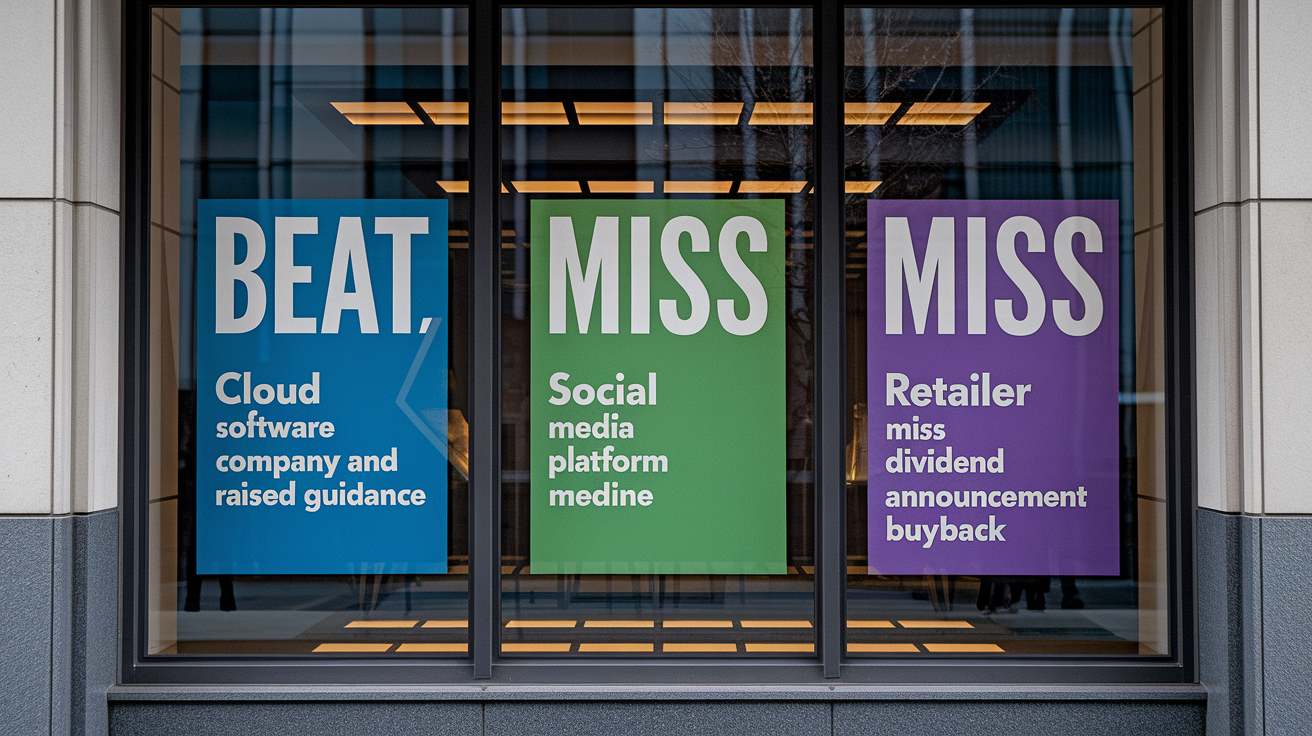
A major cloud-software company reported second-quarter 2021 results with revenue up 23% year-over-year, beating analyst estimates by roughly 5%. Management also raised full-year guidance for both revenue and operating margin, citing accelerating enterprise demand and strong renewal rates. The stock initially gapped up 8% in after-hours trading and finished the next session up 12%, as multiple sell-side analysts raised price targets and highlighted the guidance increase as evidence of durable growth. The combination of beat breadth (revenue, margins, and billings all exceeded expectations) and positive forward commentary drove sustained buying over the following month.
A global social-media platform missed second-quarter 2022 revenue expectations by roughly 1% and reported its first-ever sequential decline in daily active users. Although EPS came in slightly above estimates due to cost controls, management issued cautious commentary about advertising market softness and increased competition. The stock fell roughly 25% in a single session, wiping out tens of billions in market capitalization. The miss was small in percentage terms, but the user-growth reversal and weak forward outlook forced investors to reprice long-term assumptions about engagement and monetization, compressing the valuation multiple sharply.
A large-cap retail chain reported fourth-quarter 2020 earnings that missed EPS estimates by 8%, driven by higher-than-expected freight and labor costs. But the company simultaneously announced a 20% increase to its quarterly dividend and authorized a new $5 billion share buyback program. Same-store sales grew 6%, and management guided to mid-single-digit revenue growth for the coming year. The stock initially dipped 3% in pre-market but reversed to close up 4% as investors focused on the capital-return commitment and steady sales trends rather than the margin-driven EPS miss.
| Company | Surprise % | Price Reaction |
|---|---|---|
| Cloud-software firm (Q2 2021) | Revenue +5%, guidance raised | +12% next session, sustained rally |
| Social-media platform (Q2 2022) | Revenue −1%, user decline, weak outlook | −25% single session |
| Retail chain (Q4 2020) | EPS −8%, strong buyback and dividend | −3% premarket, +4% close |
Final Words
Earnings beats and misses move prices fast. Beats tend to lift shares; misses usually push them lower. The size of the surprise often sets the size of the move.
Why it matters: surprises change expectations, alter valuation models, and forward guidance can outweigh the headline number. Most action happens in after-hours or the next day as traders reprice risk.
If you want a quick takeaway on what an earnings beat or miss means for stock price, watch surprise magnitude, guidance, and timing — they tell you if the move will stick.
FAQ
Q: Do stocks go up if they beat earnings?
A: Stocks don’t always go up after an earnings beat; they often rise short-term, but guidance, surprise size, valuation and market context usually determine the actual price reaction.
Q: What is the 7% rule in shares?
A: The 7% rule in shares usually refers to informal guidelines — either capping a single holding at about 7% of your portfolio or using a 7% stop-loss; it’s not an industry standard.
Q: What is an earnings beat in stocks?
A: An earnings beat in stocks is when reported EPS or revenue exceed analysts’ expectations, often suggesting stronger momentum and prompting short-term share gains, depending on guidance and market context.
Q: What did Warren Buffett say about PE ratio?
A: Warren Buffett said the P/E ratio shows what the market will pay for one dollar of earnings, but he stresses focusing on business value and fundamentals rather than the multiple alone.